


Editor’s note: This article was originally published in French by ServirEnsemble. Vous pouvez lire cet article dans la langue originale en cliquant ici.
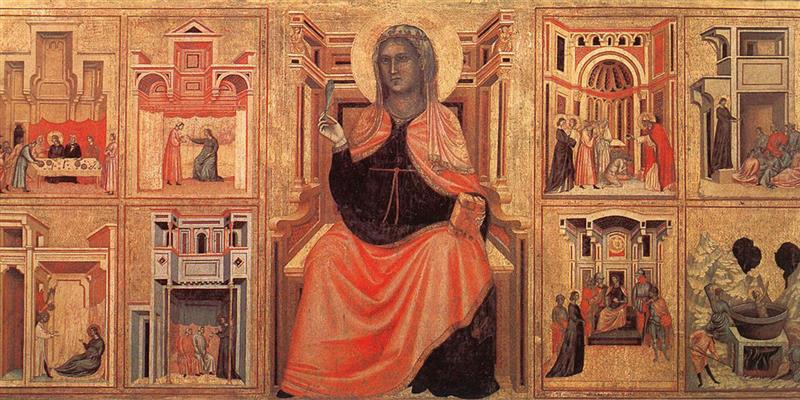
This summer, I had the good luck to find myself in Florence for a few days. Between two gelatos, we visited the can’t-miss Uffizi Galleries, a museum full of artistic masterpieces with numerous variations on certain religious themes. While I strolled halls filled with “Virgin and Childs,” one painting drew my attention: a representation of Saint Cecilia.
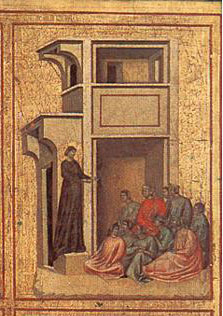
I didn’t know much about Saint Cecilia, except that she is the patron saint of musicians. But this painting drew my attention. In one of the vignettes, Cecilia is painted standing, surrounded by seated people who appear to be listening to her. The inscription confirms the impression this creates: “Cecilia preaches a sermon.”
My curiosity was piqued. Once I was back at home, I plunged into The Golden Legend, a medieval compendium that retells the lives of the saints—of which my husband, an enthusiast of literature and theology, certainly had a copy in his personal library.[1]
The Story of Saint Cecilia
In the third century, Saint Cecilia was a Roman noblewoman who had consecrated her life to God from a young age, taking a vow of virginity. Married against her will to a man named Valerian, she revealed both her faith and her vow to her spouse. Valerian (after verifying her claim) agreed to respect her vow, had his own spiritual experience, and converted to Christianity. He was baptized by Pope Urban I, followed by his brother Tiburtius, who had been deeply touched by the faith of Cecilia and Valerian.
Cecilia and her companions became devout disciples, dedicating their lives to distributing alms and burying the bodies of martyrs. This illegal activity attracted the wrath of the prefect, who began by arresting the two brothers. They were then put to death, but not before having testified about their faith and leading the soldier who was guarding them to God. The prefect then sought to arrest Cecilia, but she in turn preached the gospel to the more than four hundred soldiers the prefect sent and entrusted them to Pope Urban for baptism.
In the end, Cecilia was condemned to death. She miraculously survived three days of her martyrdom, during which she took the time to commend “all the faithful whom she had converted” to Pope Urban (who is decidedly not very active in the story and appears to simply wait for Cecilia to take the initiative!). Cecilia died around the year 200 under the Emperor Alexander Severus, and Saint Urban, after having buried her, turned her house into a church as she had asked.
Present-Day Echoes
Of course, her story contains its share of oddities, as is often the case with the lives of the saints. It talks about her fiercely protected virginity, of an angel who was her lover, of crowns of invisible flowers, and of boiling water which felt cold. But in reading between the lines, what stands out above all else is her position of authority and her teaching: to her husband, to her brother-in-law, and to the hundreds of people who crossed her path. Cecilia reminds us that women have always had a place in the teaching and transmission of the Christian faith. This painting and the story behind it encouraged me. In sharing it, I hope to encourage other women in their ministries—both their recognized ministries and their invisible ones.
Editor’s note: Readers interested in further exploring the life of St. Cecilia can consult an English translation of The Golden Legend, vol. 6, free online at The Christian Classics Ethereal Library.
Photo courtesy of Wikimedia Commons.
Translation by Mikaela Bell.

[1] Jacobus, La légende dorée, trans. by Teodor de Wyzewa (Editions du Seuil, 1998), 71925.
Related Resources
Popular Articles
Mary Magdalene’s Miracle
Barbie, The Book of the City of Ladies, and the Battle against Internalized Misogyny
Argula von Grumbach: Speaking Truth to Power
Lucretia Mott: Spiritual Warrior for Human Rights
Kay Smith: Mother of the Jesus Movement
Restoring Biblical Truth: Celebrating Patricia Gundry (1937–2024), an Egalitarian Pioneer
Lost in Translation: Female Elders in Titus 1–2
Celebrating Black Women Leaders in Church and Society
Twenty Centuries of Women Leaders in the Church
Academic Articles/Book Reviews
Book Review: Three Wise Women: 40 Devotions Celebrating Advent with Mary, Elizabeth, and Anna
Book Review: The Biblical World of Gender: The Daily Lives of Ancient Women and Men
Book Review: Mary and Early Christian Women: Hidden Leadership
Book Review: Tell Her Story: How Women Led, Taught, and Ministered in the Early Church
Book Review: Women in the Mission of the Church: Their Opportunities and Obstacles throughout Christian History
Book Review: Voices Long Silenced: Women Biblical Interpreters through the Centuries
The Ministry of Women and the Merger of Church and State in Fourth-Century Christianity
Historical Egalitarian Theology: Contributions from European and English Women in the Sixteenth through Eighteenth Centuries
Georgina Gollock (1861–1940) and World Christianity
The Biblewomen of South India: A Professional Pathway to Dignity and Empowerment
Audio/Visual Materials
Women in Scripture and History: The Free Methodist Church and the Silencing of Women with Dr. Christy Mesaros-Winckles
New Voices: Pastors’ Wives and Medieval Religion with Dr. Beth Allison Barr
Women and Words: Women Pioneers in Bible Translation with Dr. Boaz Johnson
Women in Scripture and Mission: Lady Doquz
Women in Scripture and Mission: Sor Juana Inés de la Cruz
Women in Scripture and Mission: Saint Rafka of Lebanon
Audio: Why Pastor Priscilla Ends Christian Patriarchy
Video: Why Pastor Priscilla Ends Christian Patriarchy
Audio: Women at the Margins: Leaders in Christian History
Video: Women at the Margins: Leaders in Christian History