

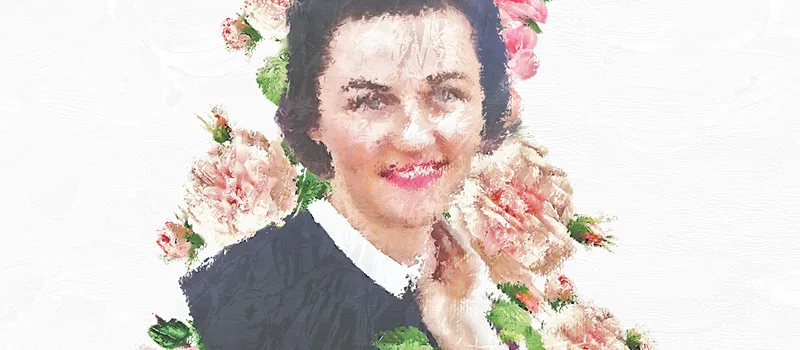

In early 2023, the box office hit Jesus Revolution told the story of the Jesus Movement of the late 1960s and early 1970s. The stories of charismatic preachers like Greg Laurie, Lonnie Frisbee, and Chuck Smith were highlighted particularly, shedding light on the lives of these important servants of God. One of the most significant figures of the movement, however, was mostly left out. Primarily known in the movie as “Chuck Smith’s wife,” Kay Smith (1927-2021) is more accurately considered the mother of the Jesus Movement. Kay’s ministry far exceeded its film portrayal, as she served as an advocate for the marginalized, a prophetic voice, and an incredible intercessor.1
In 1927, seven-week-old Catheryn was handed over to Minnie and Oscar Johnson, who ran a home for found children. It would be another fourteen years before she learned that the people who raised her were not her biological parents. This traumatic revelation was just one layer of the dysfunction that marred what otherwise appeared to be a privileged childhood for Catheryn, known later as “Kay.” Minnie and Oscar were affluent members of Aimee Semple McPherson’s church, and they ostensibly provided Kay with everything she could need. Behind closed doors, however, Minnie abused Kay. While Kay’s physical needs were always provided for, the ongoing emotional neglect and cruelty inflicted upon her in her youth would impact, even haunt her, the rest of her life.2
After enrolling in L.I.F.E. Bible College, Kay met a young man named Charles “Chuck” Smith at a baseball game. The couple dated for only six weeks before marrying. Together, the Smiths launched into full-time ministry in Arizona, leading several churches through difficult seasons. Returning sometime later to California, they started an independent church, which rapidly grew in size and fellowship. Despite this growth, it was not long before Chuck felt called to leave this thriving church to help a struggling church in Costa Mesa. Kay initially resisted this move, having formed deep relationships with church members. Still, after much prayer, she went with Chuck to this new church, Calvary Chapel.
It was here that Kay’s unique ministry began. Calvary Chapel bloomed under Chuck’s leadership and was soon a thriving church. Even as Calvary grew, however, Kay came to recognize a mission field outside the church walls. She became captivated by the hippies who seemed to cover the beaches. Calling them God’s “lost children,” she began to pray fervently for them and to urge others to do the same.3 Where her husband saw “a threat to society,” people who were “disrupting things, challenging the status quo,” Kay saw young people desperately in need of the love of Christ.4 Despite her husband’s protests, Kay’s deep compassion for the hippies grew. She shared her heart with her women’s prayer group, and together they prayed that God would open a door for them to come to Christ.
The answer to her prayers came in the form of her daughter Janette’s new boyfriend, John. He had spent a brief period as a hippie in Haight-Ashbury before surrendering his life to Christ through the influence of an early Jesus Movement commune. At Kay’s request, John brought a “real hippie” to their home—Lonnie Frisbee. Kay and Lonnie connected quickly, the two finding common ground in their painful pasts. Kay was taken by the way Lonnie was able to be both a hippie and a Christian, and immediately invited him to Calvary Chapel. Lonnie was impressed by the church and quickly moved his itinerant ministry under Calvary’s roof. Soon, the pews burst with hippies.
Young women in the church began to approach the woman they called “Mama Kay,” asking her to lead a home Bible study. This small Bible study quickly outgrew their home and soon, she and two friends turned this gathering into the Joyful Life Bible Study, which continued for over thirty years, at times having hundreds of women in attendance. This, coupled with the women’s prayer meetings she already held, formed a thriving women’s ministry. Kay continued to minister to women until early-onset dementia rendered her unable to continue. Preceded by Chuck, Kay died in 2021 at age ninety-four.
It is no surprise that Kay felt such intense compassion for the hippies. Like Kay, the majority of the hippies came from affluent families but experienced unsatisfying, even painful upbringings. In her book Pleasing God, Kay wrote of the way her family’s lifestyle left her disillusioned with spiritual things despite how badly she wanted to believe in God.5 Just as the hippies left the lives their parents had made for them in search of a more fulfilling path, Kay had left her affluent upbringing for the “alternative lifestyle” of full-time ministry. The “freedom, love, and peace” that the hippies sought was exactly what Kay had found in her faith.6
Kay’s attitude toward the hurting helped shape the direction of Calvary Chapel as well as the larger Jesus Movement. Following Kay’s death, her daughter Janette Manderson recalled how Kay was intuitively and intentionally loving, choosing to reach out to people and urging other women to do the same. Janette recalls “that she was filled with the Holy Spirit and that she walked in the Spirit, prompted by Him to live a life of love.”7 It was from this foundation of love that everything else flowed.
Along with her deep care and compassion for people, Kay was also known for being one who spoke prophetically and exhorted others. In his writings, Chuck repeatedly refers to his wife as a prophetess. Kay herself recounts a time when she felt that God “overrode [her] flesh” and “caused His words to begin flowing through [her].”8 Perhaps the most far-reaching of Kay’s prophecies occurred during a deep time of prayer. Lonnie recalled that the Holy Spirit came upon Kay with a prophecy for the Frisbees, saying, “Because of your praise and adoration before my throne tonight, I’m gonna bless the whole coast of California.”9 In this, the fulfillment of Kay’s hope for revival among the hippies was shown to her before it occurred.
Kay also used her prophetic voice for exhortation. Chuck wrote of her, “After she speaks to and exhorts various groups, they’re ready to go out and challenge the world.”10 Kay was known as a gentle but firm force who corrected those who served under her without hesitation but with kindness. Scores of women she poured into, inspired by her exhortation, went on to significant ministries of their own.
In addition to, or perhaps because of, the childhood abuse and trauma that she had endured, Kay struggled with fits of deep depression. In these times, she retreated from people but not from God; her ministry became one of intense prayer at home. She would intercede for hours at a time for those under her care, making even the most mundane of daily chores into opportunities for conversation with God.
Along with her personal prayer life, she encouraged those she mentored to start prayer ministries. Teaching women to “bathe everything in prayer” was a priority for her, one she taught by example.11 During the early days of the Jesus Movement, she was described as saturating the air with prayers for the hippies, organizing prayer groups with her friends until it seemed like they were praying all the time.12
Through her attentive eyes for those around her, the prophetic nature of her ministry, and her commitment to prayer, Kay Smith served as the mother that the Jesus Movement needed to grow and thrive. Her personal story shaped her into a woman of deep understanding who saw hurting people for who they were—lost children in need of the healing love of God. Where a painful past and lifelong struggle with mental health issues could have created bitterness, in Kay it produced kindness and compassion for those suffering as she had. Thanks to her eyes for the lost and her obedience to God, thousands of women and men came to lifelong faith in Christ.
Notes
- Larry Eskridge, God’s Forever Family: The Jesus People in America (Oxford: Oxford Theological Press, 2013), 1–2.
- Jeanine Michaels, “Mama Kay: The Woman Behind the Jesus Movement,” SheBelieves Magazine 1 (2023).
- Michaels, “Mama Kay.”
- Eskridge, God’s Forever Family, 69–70.
- Kay Smith, Pleasing God (Temecula, CA: The Word for Today), Kindle edition, ch. 14.
- Nafisatul Lutfi, “The Hippies Identity in the 1960s and Its Aftermath” Rubikon Journal of Transnational American Studies 2:1 (2015), 51.
- Christmas Beeler, “Kay Smith’s Legacy for the Lord, Part 4: Godly Comfort, Genuine Love” Calvary Chapel Magazine, 7 October 2021.
- Kay Smith, The Privilege (Costa Mesa: The Word for Today, 2010), Introduction.
- J. Leutton, “‘Come, Holy Spirit’: Lonnie Frisbee’s Prayer and the Origins of the Vineyard,” (M.Div Project, Malyon College Brisbane, 2018), 79.
- Chuck Smith, Living Water (Costa Mesa: The Word for Today, 2001), 54.
- Christmas Beeler, “The Praying Wife Behind the Pastor’s Fruitful Ministry: Remembering Kay Smith” Calvary Chapel Magazine 89 (Fall 2021).
- Chuck Smith and Tal Brooke, Harvest (Temecula, CA: The Word for Today, 2000), 16.