

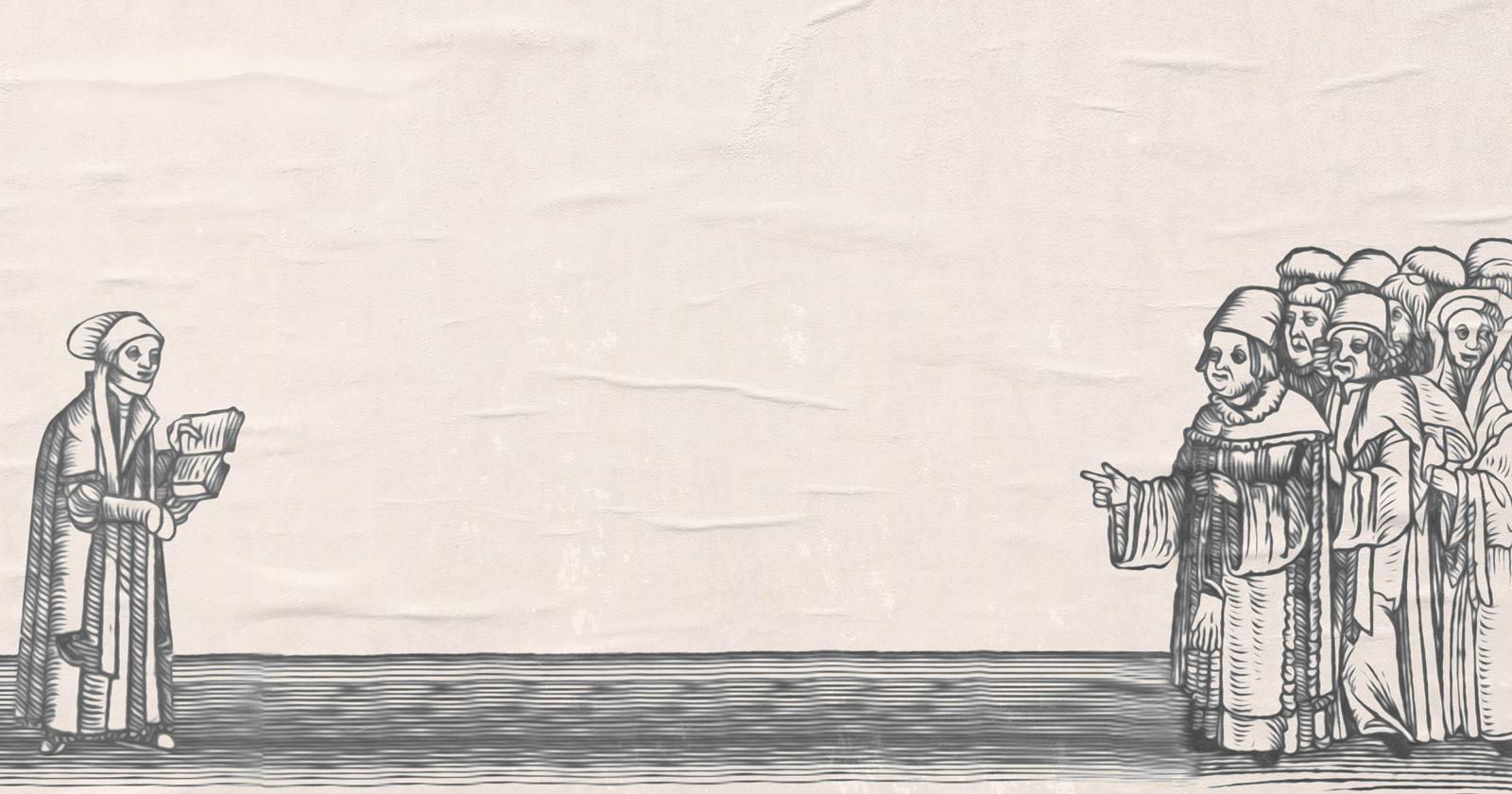

Bullying and slander are intended to silence opposition. When those tactics are successful, voices that could help the church are muted. For most of church history, bullying happened out of public view, but now it plays out on social media for all to see. In the 1500s, the printing press was the social media of the day. It was an essential tool used by reformers to share their thoughts outside the authorized seminaries and church pulpits. They wrote letters and pamphlets exposing the lack of a biblical basis for certain practices and challenged the established church to amend their doctrines. Those in power who had been accustomed to using bullying and slander now found their victims would not stay silent. One persistent woman was appalled by the coercive tactics of theologians at a local university, and she made her voice heard.
A Courageous Woman
Argula von Grumbach was a young mother to four children whose mind was influenced by her careful study of Scripture and the Protestant writings shared in her social circle. She was friends with Martin Luther, and the letters between them reveal her theological interests. A teenage university student, Arascius Seehoffer, occasionally acted as a courier between them. In 1523, Arascius was arrested after officials at the University of Ingolstadt caught him with Lutheran material.1 He was threatened with death unless he publicly recanted his Lutheran beliefs by swearing on the Gospels.
Argula was shocked at this bullying and abuse of power by spiritual leaders and theologians. After waiting to no avail for others to speak up, she was compelled to act and wrote a private letter to the university. She explained both her reason for writing and initial hesitation: “I suppressed my inclinations . . . heavy of heart I did nothing because Paul says in 1 Timothy 2: ‘The women should keep silence and should not speak in church.’ But now that I cannot see any man who is up to it, who is either willing or able to speak, I am constrained by the saying: ‘Whoever confesses me before men, I also will confess before my Father who is in heaven.’”2 She took seriously her duty as a Christian to speak up: “This is why I am compelled as a Christian to write to you. For Ezekiel 33 says: ‘If you see your brother sin, reprove him, or I will require his blood at your hands.’”3
That she would write at all was unheard of, but the content of the letter reveals her fierce spirit and confidence in her cause. Her words are richly peppered with biblical references and allusions, and convey her deep faith. She pulls no punches when she confronts the rector and entire council of the university with their sin. Like the prophets of old, she speaks with clarity as she points out the injustice of their abuse, saying, “How in God’s name can you and your university expect to prevail when you deploy such foolish violence against the word of God; when you force someone to hold the holy Gospel in their hands for the very purpose of denying it?”4 In her closing, she insisted the Spirit of God was speaking through her and provided the authority for her letter: “What I have written to you is no woman’s chit-chat, but the word of God; and (I write) as a member of the Christian Church against which the gates of Hell cannot prevail.”5
Vicious, Virulent, and Viral Reactions
The response from the university was not contrite. The faculty theologians dismissed her as a “shameless whore” and a “female desperado.”6 Though it was not her initial plan to launch a public campaign against them, it was clear that private communication was ineffective. She reflected in a later letter, “I would have thought that they would have kept the matter to themselves.”7 Undeterred, she wrote to other religious and secular authorities and continued to implore those in power to consider the matter through Scripture. Handwritten copies of her original letter to Ingolstadt began to circulate and were later printed. By the next year, demand for her letters had triggered fourteen editions as well as the publication of seven other pamphlets. She became the first Protestant woman to be published, and around 29,000 copies of her letter were printed and dispersed.
Though popular with the public, her writing had severe ramifications for her private life. The theologians of Ingolstadt indirectly made her the target of bullying, and they used coercive tactics in their attempts to silence her. Through their influence and social connections, her husband was fired from his magisterial position, and they faced financial hardship and marital stress. Outside the home, others used their spiritual authority and leveraged their pulpits to verbally abuse her. At least one professor gave angry sermons against “heretical bitches and desperate fools,” and more lewd names were slung at her.8 Powerful men of academia called for the duke to “tame the hag” and ban publications of letters like hers.9 She apparently had physical threats made against her—yet she entrusted herself to God. “I hear that some are so angry with me that they do not know how best to speed my passage from life into death. But I know for sure that they cannot harm me unless the power to do so has been given them by God. He will keep me safe, for His name’s sake.”10 She took courage from knowing her suffering was not in vain and consoled herself with the thought that even if they succeeded in taking her down, it would cause other women to rise up: “I am persuaded too, that if I am given grace to suffer death for his name, many hearts would be awakened. Yes, and whereas I have written on my own, a hundred women would emerge to write against them.”11
The verbal attacks against her continued in the form of an anonymously published poem full of vulgar and derisive slander. She responded with a poem of her own appealing to Scripture’s confirmation of a priesthood of all believers that justified her continued writing:
“In Corinthians 3 we are acclaimed
The temple of the Lord we’re named.
God’s spirit is within you, read,
Is woman shut out, there, indeed?
While you oppress God’s word,
Consign souls to the devil’s game
I cannot and I will not cease
To speak at home and on the street.
As long as God will give me grace.”12
Modern Day Argulas
Five hundred years later, with the advent of the internet and social media, we are experiencing a similarly dramatic increase in the way ideas are spread. Female Bible teachers, theologians, and writers have gained access to a larger audience than was formerly available. While theological study is still primarily taught and controlled by men, more women now have access to training and resources and are using their gifts accordingly. Unfortunately, when anyone dares to challenge people in power, “there is nothing new under the sun” (Eccl. 1:9), even within the church. Modern-day Argulas face enormous bullying in the form of foul epithets and unfair critique simply for speaking up about injustice or pointing out flaws in the doctrine of complementarianism. Perusing the comment section of social media posts leaves one disturbed at the behavior of men writing from the security of anonymous accounts who insult, hurl accusations of heresy, twist the Scriptures, or question someone’s salvation. Many of these same men have notes like “Husband, Father, Pastor” listed in their profile bios. It all feels eerily similar to the vulgar poem published about Argula using a pseudonym but presumed to be written by a professor:
‘For Scripture is twisted to your fancy.
Auntie dear, are you really that loony?
Do you think we’ve never read Scripture before?
So none can withstand your wondrous lore?
So arrogant, and without control
As if the Bible you’d swallowed whole.
It’s not a woman’s place to strut
With the words of God, or lecture men
But to listen like the Magdalene.’13
Even if they don’t stoop to public name-calling, they may use their power of influence as pastors or leaders in more subtle ways by calling into question a woman’s credibility without engaging in a substantive analysis of her content.
Prominent professors have reportedly questioned seminary applicants about their views on certain women, using their responses as litmus tests to weed out students. These same people were also allegedly texting each other about “how to handle” a particular female scholar. Reminiscent of those who had Argula’s husband fired, people are still seeking ways to silence those who have the audacity to speak truth to power.
Fear or Faith
At the core of this reaction are insecurity and fear. When honest conversations are silenced and people are bullied, slandered, and exiled, one must wonder whether the motivations are to honestly to defend sound doctrine or protect fragile egos. We must be committed to defending the truth no matter the personal cost, but there are lines we should not cross in the effort to defend our conviction of what is true. Malicious attacks, bullying, and slander are not tactics followers of Jesus should use.
When we are the victims of character assassination, we can look for encouragement in the Scriptures and church history for stories of those who were steadfast against abuses of power. Those who have been maligned or pushed out will echo Argula: “A disputation is easily won when one argues with force not Scripture.”14 Following her example, our commitment to doctrinal integrity should not be measured by how we gatekeep and enforce our convictions upon others, but by how much we are willing to endure.
Bibliography
- Katelyn, Beaty, “No Woman…Bro Code,” The Beaty Beat (blog), November 17, 2023.
- Aimee Byrd, “Genevan Commons…Church Office,” AimeeByrd.com, accessed August 26, 2024.
- Aimee Byrd, “I Guess…My Book, AimeeByrd.com, accessed August 26, 2024.
- Kelly M. Kapic and Hans Madueme, eds., Reading Christian Theology in the Protestand Tradition (London, UK: Bloomsbury T & T Clark, 2018).
- Peter Matheson, “Martin Luther and Argula von Grumlach (1492–1556/7),” Lutheran Quarterly 22, no. 1 (Spring 2008): 1–15.
- Peter Matheson, “A Reformation for Women? Sin, Grace and Gender in the Writings of Argula von Grumbach,” Scottish Journal of Theology 49 no. 1 (1996): 39–55.
- Peter Matheson, “Breaking the Silence: Women…Reformation,” The Sixteenth Century Journal 27 no. 1: 97–109.
- G Sujin Pak, “Rethinking…Luther,” Reformation & Reniassance Review 14, no. 2 (2012): 151–69.
- Leenane Shiels, “Argula…Reformer” Touchstone 35, no. 2: 59–65.
- Bob Smietana, “Bible…Baptist,'” Religion News Service (blog), March 9, 2021.
- Kirsi Irmeli Stjerna, Women and the Reformation (Malden, MA: Blackwell, 2009).
- Argula von Grumbach and Peter Matheson, Argula…Reformation (Edinburgh: T & T Clark, 1995).
- Argula von Grumbach, “To the University…(1523),” Accessed April 22, 2022.
Notes
- Argula von Grumbach and Peter Matheson, Argula Von Grumbach : A Woman’s Voice in the Reformation (Edinburgh: T & T Clark, 1995), 74.
- Von Grumbach and Matheson, Argula Von Grumbach, 79.
- Von Grumbach and Matheson, Argula Von Grumbach, 75.
- Von Grumbach and Matheson, Argula Von Grumbach, 76.
- Von Grumbach and Matheson, Argula Von Grumbach, 90.
- Kirsi Irmeli Stjerna, Women and the Reformation (Malden, Mass.: Blackwell Pub, 2009), 79.
- Von Grumbach and Matheson, Argula Von Grumbach, 117.
- Stjerna, Women and the Reformation, 79.
- Stjerna, Women and the Reformation, 79.
- Von Grumbach and Matheson, Argula Von Grumbach, 119.
- Von Grumbach and Matheson, Argula Von Grumbach, 120.
- Von Grumbach and Matheson, Argula Von Grumbach, 178.
- Von Grumbach and Matheson, Argula Von Grumbach, 168.
- Von Grumbach and Matheson, Argula Von Grumbach, 84.