
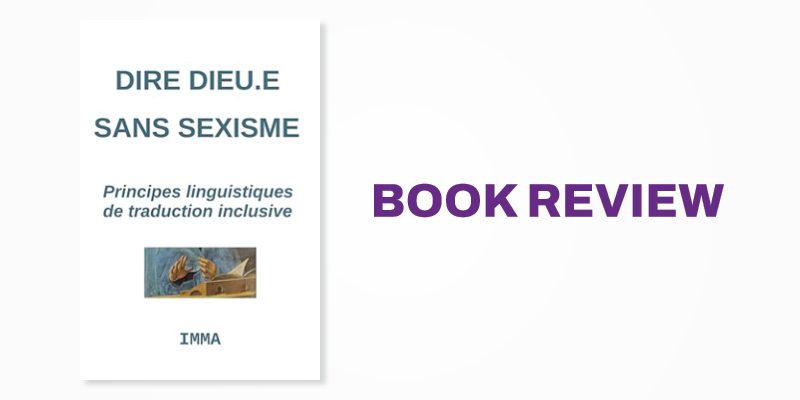
The French-language book Dire Dieu.e sans sexisme (Talking About God Without Sexism) lays out the linguistic principles used by the author, who publishes under the nom de plume Imma, in creating her gender-inclusive Gospel translations. Appearing in two versions, one for silent reading and the other for reading aloud, her self-published Gospels attempt to de-masculinize the traditional translations of Scripture in the French language. This book takes a deep dive into French grammar, vocabulary, and syntax. If the reader is unfamiliar with these, the book will make little sense.
However, to the francophone reader, it provides a treasure trove of eye-opening examinations of the way the language has been used to masculinize Scripture without the casual reader’s noticing it. For example, in French, all nouns are gendered: either masculine (le chat, the cat) or feminine (la fleur, the flower). When such nouns designate people, a masculine noun is understood as including females (l’enfant, the child, could refer to a male or female child). Plural masculine pronouns similarly are understood to have the potential to contain or include females (ils, masculine they, could refer to a group of men, or a mixed group; a group of women would be elles).
The author sees sexism in this linguistic masculine dominance and suggests that in many passages readers have been conditioned to picture males when in fact the Greek does not always specify the gender of the subject. A good example of this is the Greek word adelphos, which is gender neutral, and can be used to mean brother or sister. English readers have been fortunate enough to enjoy a few translations of the Bible that render this word “brothers and sisters” (CEB, NIV, NLT, and NRSV, just to name a few).
The problem is exacerbated in French, where one must specify if one actually means “females.” An example is the word shepherd: If you mean a male shepherd, it is le berger. A female shepherd is la bergère. When the shepherds came to visit the infant Jesus, using les bergers could mean all male shepherds or a mixed group. How is the French reader to know if the original language suggests which of these is more accurate? Without an inclusive translation, the default has too often been masculine. Our author suggests using les berger.es, a kind of hybrid of the masculine and feminine version, to designate a group of shepherds that could indeed be all male, all female, or mixed.[1] Her point is that when the language makes you picture an all-male group, women are effectively erased from the scene.
The author attempts to combat this invisibilization of women by suggesting hybrid forms, almost always by adding the “.e” to ambiguous nouns and their accordant adjectives. This is why she has created the term “Dieu.e” in her title. It essentially means that God is both male and female, without using the term déesse, “goddess,” which connotes something not-quite-Christian in French, just as it does in English. In the same way, she hybridizes il, “he,” and elle, “she,” by creating the term iel, s/he. In some cases, like these examples, she invents inclusive terminology; in others, she uses inclusive terms already in usage in French (toustes, an amalgamation of the masculine and feminine plurals for the word “all” or “everyone).
Everything I’ve just described barely scratches the surface of the author’s method of “finding” women in Scripture and creating a highly inclusive reading of the Gospels. What if some or all of the shepherds at the manger were female? Would that make a difference in our understanding? Would female readers be able to picture themselves in the stories of the Gospels more fully? The author says that is entirely the point of creating an inclusive translation.
She laments that at the time Koine was in use, the two Greek words meaning “man”—aner and anthropos—had lost some of the precision of their earlier distinctions, the first meaning a male human being, and the other humanity in general, as in earlier iterations of the Greek language. Further, she notes that where the Greek specifically uses a feminine noun like prophete, prophetess, that French translations have used the masculine/generic word prophet. As for instances in Greek where the masculine plural is used to denote a mixed-gender group (as in French), she errs on the side of feminization. She offers little rationale for this choice other than to note the assumed male bias of the original writers of the Gospels.
Her insistence on opening up our ideas of the people in the Gospels, as well as the God revealed in them, to include the feminine is a potentially dangerous idea. It threatens the patriarchal establishment among French biblical scholars, linguists, academicians, and translators. The danger is not lost on our author, who has taken the pseudonym Imma to publish this book and her Gospel translations as a way to protect herself from any violence. She is described as a believer, a feminist, and a linguist with her doctorate in language science and diplomas in Greek and theology. It is both tantalizing and disappointing, if realistic, that “Imma” cannot unveil herself in the current climate.
While this book with its extensive grammatical and syntactical notations is not really intended for the casual reader, the underlying philosophy is one that friends of CBE will find satisfactory. The potential value of this book lies in the possibility that other scholars will follow suit, creating inclusive translations of the rest of the Bible. What might this do to awaken the faith of women and men in the francophone world? We can pray for a world in which Imma and her work can be recognized, and her leadership followed.
[1] This usage parallels wider practices of gender-inclusive language in modern French. The interested reader can examine the relevant article on French Wikipedia, “Langage inclusif en français,” Wikimedia Foundation, accessed September 20, 2024.
You May Also Be Interested In:
Book Review: Valiant or Virtuous? Gender Bias in Bible Translation
Book Review: Voices Long Silenced: Women Biblical Interpreters through the Centuries
Book Review: The Bible in Cross Cultural Perspective
Book Review: First Nations Version: An Indigenous Translation of the New Testament