

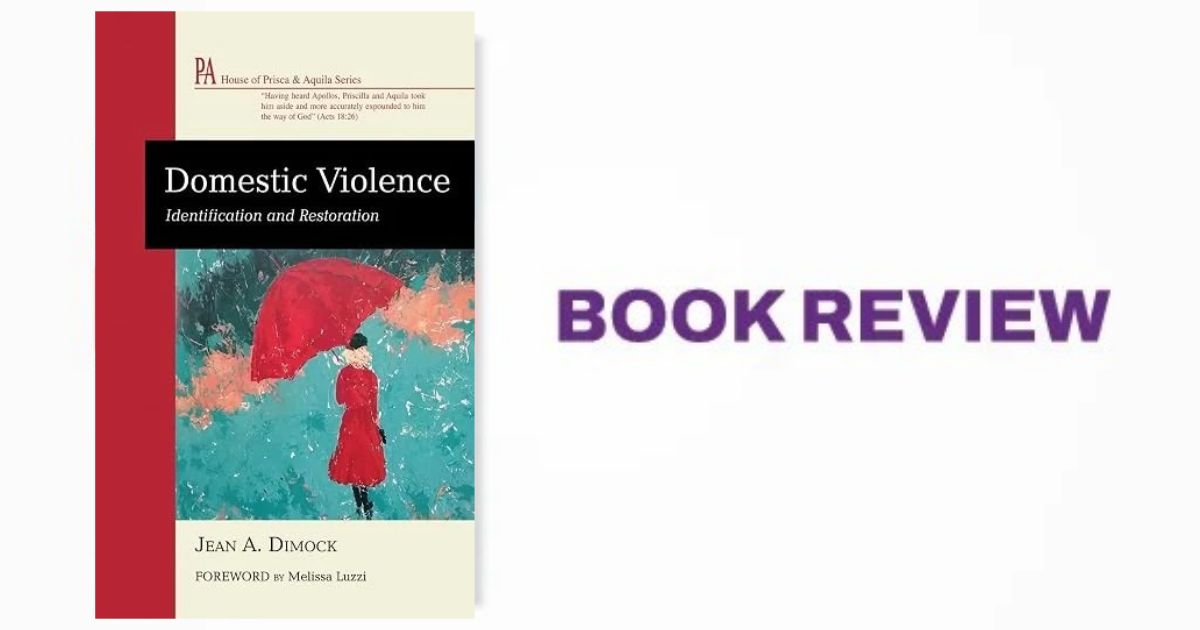

Over the last fifty years, there have been many changes to how our society addresses domestic violence. Yet, even now, there is still more work to be done to support victims and hold batterers accountable. In Jean A. Dimock’s 2024 book, Domestic Violence: Identification and Restoration, she addresses these discrepancies by sharing invaluable education around the issue.
The foreword to the book, written by Dr. Melissa Luzzi, notes that domestic violence is a family issue. It is incredibly complex and therefore challenging to confront. How we respond to domestic violence can either promote “harm or healing.”[1] This is why Dimock’s book is so important—it shows readers how to respond in a healing approach.
The book uses male pronouns for the batterer and female pronouns for the victim, though there is a disclaimer in the introduction that this is not always the case but is the focus of the author. Her stated goals are to help those in or from domestic violence families, to educate professionals working with these families, and to encourage further resources around this issue. It is organized into nine chapters, each with an emphasis on one specific element of domestic violence, such as parenting, separation and divorce, incest, court culture, and the woman’s parents. It revolves around a case study featuring a fictional couple compiled from real-life stories. Each chapter ends with a Scriptural focus.
Dimock describes the slow build-up of domestic violence. Much like a frog in increasingly hot water, a woman in a domestic violence relationship may not realize the danger she is in until it’s very difficult to get out. Relationships may start positively but over time become increasingly violent. Domestic violence may include threats, manipulation, extreme jealousy, imposing repercussions, using children against the mother, rape, withholding finances, and the misuse of Scripture, among other tactics. This type of behavior towards a woman over a long period of time often leads to an increase in mental illness, suicidal behavior, substance use, and even death.
The book covers the influence of domestic violence on children as well. Children living in homes experiencing domestic violence witness between 68–80 percent of the assaults on average.[2] This leads to a higher risk of many long-term consequences, such as at-risk behaviors, mental health struggles, and school or social difficulties. These children also have a 45–60 percent higher likelihood of co-occurring physical abuse or neglect and are 6.5–19 times more likely to experience sexual abuse.[3] Dimock states these correlations are because of the similarities between batterers and child abusers, noting both tend to be controlling, entitled, exploitative, and confuse love with abuse.
Dimock discusses the challenge women have when dealing with the court system. While theoretically the law should be designed to protect victims, not the abusers, it doesn’t always work out that way. Courts often have a lack of domestic violence training and awareness. They may have a bias against women; a bias which can be reinforced when the batterer comes into the courtroom with confidence and a good public persona, but the woman comes in nervous or agitated. This bias may lead courts to be more likely to believe men over women. They may also believe that children need their fathers, and therefore give partial or full custody to fathers, even when the mothers worry for their children’s safety. Since batterers are manipulative, they may turn the children against their mothers, which makes it increasingly more difficult for mothers to protect them.
One thing I appreciated about the book was its focus on cultural influences on domestic violence. Dimock notes that batterers use different tactics across different cultures, though the undercurrents of control and intimidation remain the same. Where gender inequality is present in a culture, domestic violence rates are higher. Media depictions of females, even in Disney movies, often contribute to the problem by depicting girls as weak or emotional and in need of a man to come save them from themselves. Pornography is another contributor, as the depiction of rape, sexual assault, and even strangling women while they are being raped is rising in popularity among viewers. Domestic violence behavior also tends to cycle through families, where girls who witness domestic violence growing up may be more attracted to a batterer, and boys who witness domestic violence growing up may be more likely to become batterers.
This book is a great resource for anyone working with families who have experienced domestic violence. Both those new to the issue and those with a working knowledge will likely gain something from this well-researched material. It is a heavy topic but written in a conversational tone that makes it easy to get through. The biblical examples and Scriptural encouragement sections are a great resource for pastoral leaders and counselors. Due to the serious nature of the topic, it is recommended for individuals ages 18 and up.
Domestic Violence: Identification and Restoration is currently available in the CBE Bookstore.
Notes
[1] Foreword, vi.
[2] Dimock, 133.
[3] Dimock, 43.
Related Resources
Domestic Violence Awareness Month: Resources for Churches