

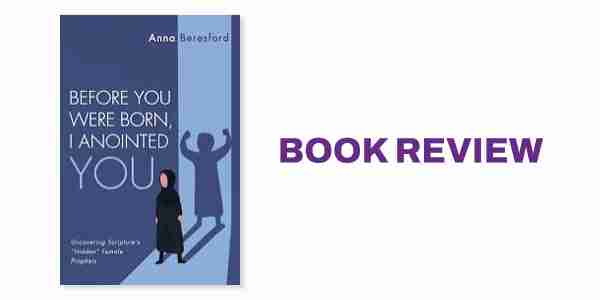
Anna Beresford’s Before You Were Born, I Anointed You: Uncovering Scripture’s “Hidden” Female Prophets argues that the Bible has more female prophets than is commonly recognised, but their prophetic work is obscured by stereotyped, masculinised understandings of prophecy.
In the first chapter, Beresford develops an understanding of the role of prophecy by considering a number of the prophetic books of the Old Testament. In the second chapter, she explores the definition of parables, including the idea that some stories are enacted parables in which people become signs of God’s message to the world, thus fulfilling the role of prophets in the same way that Isaiah, Ezekiel, and Jeremiah did. The rest of the book (Chapters 3–9) explores the stories of biblical women, some of whom are named as prophets and many who are not, through this lens of women’s stories as enacted parables that demonstrate their prophetic role.
Throughout the book, Beresford provides an overview of differing theological perspectives on each story. Chapter 9, for example, covers The Canaanite Woman, otherwise known as the Syro-Phonecian woman of Matthew 15:21–29 and Mark 7:24–31. Beresford lays out the story from both gospels and then considers allegorical, Calvinistic, socioeconomic, typological, and feminist perspectives. These are helpful summaries of how each pericope has been understood across historical perspectives and displays a pleasing breadth of scholarship across historical, denominational, and political positions. The focus on different women who are often overlooked is also helpful to the reader who is new to feminist theology or reading the Bible with an eye to women’s stories. However, there are a number of problematic issues with this book.
First, the claim that women and men act and relate to other people in inherently different ways is not supported by current research.1 This essentialist understanding of gender is read back into the text, leading the author to focus on evidence that supports this view rather than allowing the text to speak for itself. Beresford describes women of the Bible who do not conform to this very limited role as “feisty” (Ruth and Naomi), “manipulative” (Rebecca and Tamar),2 and reliant on their “feminine wiles” (Esther). These gendered descriptors reinforce the idea that women who fulfil the role of prophet are unfeminine and fundamentally deceptive, labels which are too readily still applied to women within the church today.
Second, Beresford overemphasises the value of the enacted parable lens. Beresford argues that “the real message” of the woman married to multiple brothers in Luke 20 can only be understood as an enacted parable. This undermines the value of approaching the text from a range of perspectives so that multiple meanings can be revealed. Similarly, the claim that “it was not unusual for the evangelists to use an enacted parable as a physical demonstration of the disconnect between the situation as it was and what God expected it to be” (125) would probably come as a shock to the gospel writers who likely never heard this term or conceptualised their writing in this way. This is not to say that this way of reading the text is not a useful lens, but it must be understood as only one way among many to read these texts and one possible way to describe a prophetic role for many unnamed women in the bible.
Finally, I was disappointed that Beresford offered no engagement with the title of the book, which might be a nod to Jeremiah 1:5.3 I think this was a missed opportunity to discuss how prophets receive their appointment directly from God.
Of the eleven epigraphs throughout the book, only three quote women. While this is a slight criticism, it is indicative of a wider practice throughout the book of focusing on male characters (including Jesus) and a reliance on male commentators despite the author’s critique that theology has too often been seen through a white, male lens. One way to change the male focus within theology is to intentionally amplify women’s voices and perspectives. This can take a little more effort, but the epigraphs quoting Malala Yousafzai (34), Shirley Chisholm (56), and Laurel Thatcher Ulrich (135) demonstrate that it can be done.
While Before You Were Born, I Anointed You promised to uncover female prophetic activity within the biblical text, this task was undermined by language and perspectives that limited women’s role to a patriarchally informed stereotype that reinforces essentialist notions of gender, which limit us all.
- For more information see: Cordelia Fine. Delusions of Gender: The Real Science Behind Sex Differences. (United Kingdom: Icon Books, 2011); and Cordelia Fine. Testosterone Rex: Myths of Sex, Science, and Society (United Kingdom: WW Norton, 2018).
- Tamar from Genesis 38.
- “Before I formed you in the womb I knew you, and before you were born I consecrated you; I appointed you a prophet to the nations.” (Jeremiah 1:5, NRSVUE)