

Mollie Gregory’s chronologically organized history of stuntwomen in the American movie industry (Stuntwomen: The Untold Hollywood Story, 2015) makes a fascinating read. Did you know, for example, that theatres played the equivalent of popular television series featuring action heroines? An alternative was for a stuntwoman to play the actress’s body double.
At a time when women had minimal social and political agency, for them to watch members of their own “weaker” sex leaping off high-rises and revving into crazy car chases had the potential for tremendous change. That changed very quickly as movies became money spinners. Men made their way in, and stuntwomen were elbowed out into the margins. By the 1950s, a mafia of about a dozen bosses decided who got hired into stunt roles in Hollywood. It suited them to hire men. Much like in the theater of Shakespeare’s day—and in traditional folk performances in India—men threw a wig and a dress on and stood in when the actress had to do anything that was ruled inappropriately physical for a woman. Even though this trend is undergoing reversal, the highest compliment from men that a stuntwoman still gets is ironic: “She hits the ground like a man!”
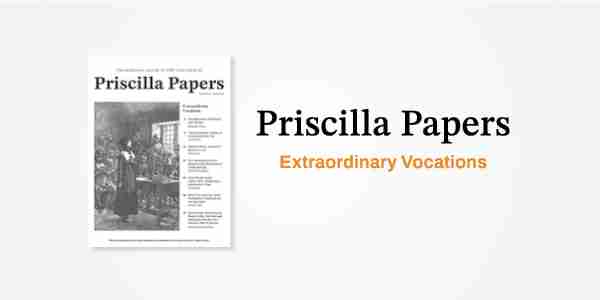
One of the voices in the book is that of Jadie David, a stunt professional whose rationale for this extraordinary vocation is relevant to the theme of this issue of Priscilla Papers: “I enjoyed doing something most people would call insane . . . The more fearless you are in what you do, the fewer regrets you’ll have.”
This issue features women who risked taking up extraordinary vocations. Michaela Rollins introduces us to the “prison diary” of Perpetua and Felicitas, who, in the early third century, fearlessly embraced the calling to be martyrs for their new faith in Jesus. This, despite Perpetua being a nursing mother, and Felicitas being heavily pregnant.
Joan Brown traces the chronology of the “extraordinary call,” the condition under which women could be permitted to preach in exception to what was understood as the Pauline rule that women “ought not to teach” (1 Tim 2:12), making a case against complementarians and hierarchists who lay down a blanket ban on females in the pulpit.
Jenn Gash holds up for our observation the group of women who played a saving role in the infancy narrative of Moses: his mother Jochebed, his sister Miriam, Pharaoh’s daughter, and her attendants. In their common female response(s) to an endangered baby, their ordinary womanly vocation was raised into the extraordinary, into a subversive act against the throne of Egypt.
Another ordinary vocation, that of prayer, is elevated into the extraordinary by metaphor. Daniel Schwabauer reads the injunction that women cover their heads (1 Cor 11:3-5) in the light of the orant, the males and females in the early centuries of the Church who stood before a congregation to offer up prayer. In this pose and position in which the man represents Christ and the woman the Bride of Christ, the prayer shawl over the woman takes on a particular meaning lost to those of us who have overlooked the Bible’s use of imagery.
Ian Randall brings us the story of Annie Royale Taylor (1855-1922), a missionary adventurer who dared the icy perils of Tibet, even recruiting and leading an all-male team. Patrick Oden unpacks the court trial Anne Hutchinson (1591-1643) who with extraordinary courage stood her ground on her insight into pneumatology.
I pray that this issue of Priscilla Papers helps us appreciate better women who bravely tread into areas of Kingdom work that to many of us would seem “insane.”
Together, side by side, in God’s world.