

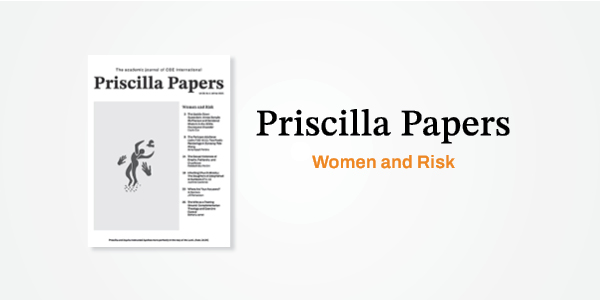
A West African proverb urges men: “Beat your wife regularly. If you don’t know why, she will.” In this issue on women and risk, Rebekah Mui Pei Ern explores the issue of women and the risk of physical violence. Before Christianity became the religion of the Roman state, the cross symbolized those populations which came under imperial and patriarchal domination. These would be those placed under subjection in the social stratification of the empire and within the hierarchies of the household: slaves and women. Common to this population was its vulnerability to shame and violence, often, sexual violence. Penetrability marked slaves and women, as it did the crucified body of Christ. This symbolism took a surprising turn after Constantine, morphing the crucified Christ from one who endured a shameful sacrifice to one whose heroic masculinity made possible an applause-worthy painful sacrifice. Mui argues that the cross, instead of representing the dominated, that is, slaves and women, came to represent the dominator.
A traditional Indian view is that any investment into a girl child is as futile as “watering a neighbour’s garden,” because a daughter eventually leaves her birth family to benefit another. This kind of thinking could well underlie the legal restriction on inheritance passing to female descendants, a restriction that to this day exposes widows and the female fatherless to the risk of living precariously on the margins of society. Jazmine Lawrence’s article concludes that in successfully challenging ancient Israel’s inheritance laws, the daughters of Zelophehad proved that they had “bodies to meaningfully occupy space, voices to be meaningfully heard, and ideas to meaningfully influence the believing community.”
Anna Kasafi Perkins and Jill Richardson reflect on the story of the women in John 8 who were taken to Jesus on the charge of adultery by men of the religious institutions of his day. Here is a woman who runs the risk of death by stoning because a group of males use her as bait to bring down an opponent. The woman is eminently
expendable, as the Spanish proverb puts it: “Women are like buses; if one leaves, another will come.” Perkins reflects on a pair of poems on the narrative. One poem calls into question the motives of those who would throw stones; the other calls them agents of gender violence and urges resistance to stone-throwers. Meanwhile, Richardson’s sermon fleshes out a Jesus who “won’t stand for people using women or for meting out unequal justice between the sexes.”
Caylie Cox analyses articles from the Foursquare Crusader of the 1930s, the newsletter of the church that the charismatic leader Aimee McPherson founded and led. Contrary to the Anglo-American proverb which assures that “a whistling girl and a crowing hen always come to no good end,” McPherson’s followers treated her as a happy exception to the rule of male church leadership. She was a “crowing hen” that was to be admired. This allowed them to gain from her giftings while keeping the traditional paradigm of masculine, muscular ministers.
“The woman with long feet ends up alone in a room,” observes a Chinese maxim. “Long feet” stands for anything that might threaten the male/female status quo in a culture which gives the man the upper hand over his wife. Along these lines, Bethany Jantzi brings up a possibility of risk peculiar to Christian complementarian marriages. Complementarianism can create the opportunity for the husband to mimic the behaviour of a domestic abuser, deploying coercive control under the cover of biblical sanction.
The risks to women—whether at home or outside—are many. Distressingly so. I pray that this issue of Priscilla Papers increases our awareness and motivates our biblically-sound responses.
Together, side by side, in God’s world.