


By the time Jesus walked the dusty trails of Judea, centuries of mistrust and mutual accusation had created a palpable enmity between “true” Jews and Samaritans. Travel through Samaria when making the journey between Galilee and Judea still occurred frequently, particularly at the time of the festivals in Jerusalem. Respectable Jews, however, might choose the hotter, longer, desert route that ran to the east of the Jordan river, rather than the more direct and cooler way through the Judean mountains—and through Samaria.[1]
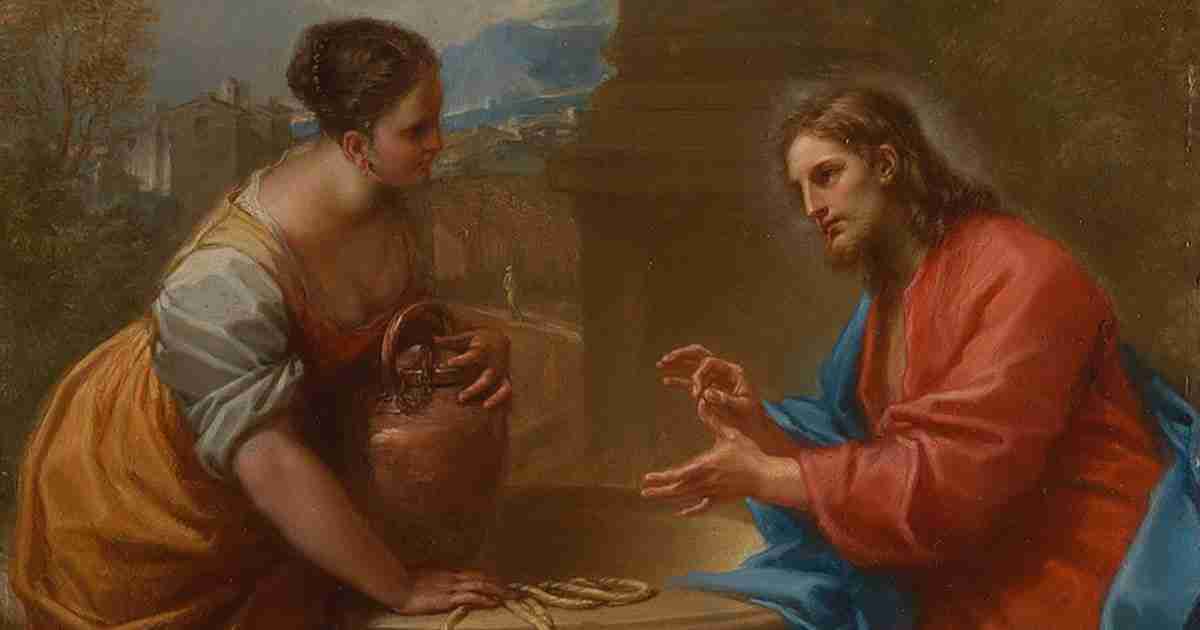
But by all accounts, Jesus was no “respectable” Jew. He lived out his inclusive message to the full, frequently offending the religious leaders’ sensibilities and becoming known for his unacceptably close, personal contact with the nation’s rejects (Matt. 9:11). It is perhaps not surprising, then, that when returning with his disciples to Galilee from Jerusalem after the Passover, he chose to go through Samaria (John 4). And once the disciples had left him to head into the Samaritan town of Sychar in search of food, Jesus found himself sitting by Jacob’s well, alone.
The Samaritan Woman
I imagine most of us will know what happens next: How Jesus enters into conversation with a Samaritan woman who came to draw water—a conversation that leads to a powerful personal encounter for her and paves the way for many others in Sychar to come to faith. There’s so much that can be said about Jesus’s deliberate engagement with this unnamed Samaritan woman—how he chooses her as a “worthy person” (Matt. 10:11) or “child of peace” (Luke 10:6), the key to opening the hearts of others in the village. But for now, I’d like to focus on the disciples’ reaction when they return to the well and are “surprised to find him talking with a woman” (John 4:27).
Of Jews and Samaritans
Let’s just stop for a moment and let that sink in. What’s the issue here? The sorry state of relationships between Samaritans and Jews is discernible throughout the gospels.[2] Yet despite the disciples’ own evident antagonism to Samaritans, the text does not say that they were irked at Jesus striking up a conversation with a Samaritan, per se. Rather, they were “surprised” (NIV)—better translated as “amazed” or “astonished”[3]—that Jesus was talking with a woman.
Talking with a Woman
Ah, a woman. . . . Unaffected by Jesus’s inclusion of women amongst his closest followers, it seems that his disciples were still steeped in traditions that mandated the separation of women and men. Perhaps they were concerned for Jesus’s reputation, or even his safety—after all, warnings of the dangers of falling afoul of lurking adulteresses abound in the Proverbs.[4] The slippery slope into sexual sin can start with a simple conversation, they had learned, so why play with fire? Typifying attitudes prevalent at that time, Pirkei Avot (Ethics of the Fathers, a foundational document of the Jewish Mishnah containing sayings attributed to respected Jewish rabbis between 200 BC and AD 200) states:
“Yosi ben Yochanan of Jerusalem said: Let your house be wide open and let the poor be members of thy household; and do not talk much with women. This was said about one’s own wife; how much more so about the wife of one’s neighbour. Therefore the sages have said: He who talks too much with women brings evil upon himself and neglects the study of the Torah and will in the end inherit Gehenna” (1:5).[5]
Wherever their views stemmed from, and however shocked they were by the scene that greeted them, they said nothing. But they thought it, and furtive looks no doubt cemented their silent agreement. Lone encounters with women were dangerous, and Jesus was seriously out of order.
The Disciples’ Unconscious Bias
Developing from an early age and throughout childhood, unconscious bias occurs when we hold stereotypical views about different social groups outside our own conscious awareness. Operating in our subconscious, unconscious or implicit bias often coexists alongside conscious values that may be the exact opposite. It is significantly more pervasive than known prejudices and has a noticeable impact on thinking and behaviour.[6]
Did the disciples realise how much their thinking was impacted by the powerful forces that shaped the world they had grown up in, with its cultural norms surrounding the place of women, reinforced by both implicit and explicit instruction? Did they have any idea to what extent the patriarchal system that they unreservedly embraced was in fact contrary to God’s design for humanity? Were they in the slightest bit aware of their unconscious bias against women?
Are we?
We too have inherited a world rooted in centuries of tradition, societal norms, and theology that have accepted—and at times promoted—misogynistic convictions and behaviour. None of us are immune from their subtle but enduring influence, with the result that each of us sees and interprets the world through the lens of our unconscious biases. Even our reading of Scripture itself is subject to these presuppositions, imposing interpretations on the text that go far beyond what is justified.
Challenging Unconscious Bias
Any attempt to remove the obstacles to women’s full participation in the life of the church and restore balance in the relationships between women and men will thus not be achieved solely by appeals to Scripture. It must uncover, name, challenge and ultimately undo the sophisticated web of silent convictions woven by unconscious biases.
How? Simply becoming aware that our thinking is subject to implicit bias is an excellent starting point, and churches need to create safe spaces that encourage vulnerability and where unconscious discrimination against women can be openly, honestly, and lovingly addressed.
Beyond this, we need to learn to be sensitive to the tell-tale clues that reveal where such biases are at work, then have the courage to address them and proactively seek change. Perhaps the disciples had not yet seen enough of Jesus’s way of working, but their own surprise at seeing Jesus “talking with a woman” should have alerted them to their misdirected thinking. In a similar way, whenever we find ourselves in situations where we—or others we work with—are uncomfortable with women living in the freedom that is theirs in Christ—freedom to serve with the gifts God has given them and follow the still small voice of God in their lives—we must ask what lies behind that discomfort. Otherwise, we may find ourselves in the same place as the disciples: amazed that Jesus still speaks with, and indeed through, a woman.
[1] The frequency with which Jews traveled through Samaria—a three-day trip—or took the much longer route through Perea is debated by scholars, but historical sources make clear that avoiding Samaritans was the ideal, and travel through Samaria was a matter of necessity, not desire. Leon Morris (in The Gospel According to John, The New International Commentary on the New Testament, [Eerdmans, 1995], p. 226) summarizes the situation as, “The necessity for Jesus to pass through Samaria was not absolute. Strict Jews, like the Pharisees, disliked the Samaritans so intensely that they avoided their territory as much as possible. Their route from Jerusalem to Galilee lay through the region beyond the Jordan. This was considerably longer, but it avoided contact with the Samaritans. Those who were not so strict went through Samaria. For those in a hurry the shorter way was a necessity. Josephus uses exactly the expression here rendered ‘had to’ [in John 4:4] when he says, ‘for rapid travel, it was essential to take that route (i.e. through Samaria)’ (Vit. 269). John may possibly wish us to take the expression in this fashion. More probably the necessity lay in the nature of the mission of Jesus. John often uses the word “must” of this mission (3:14; 9:4; 10:16; 12:34; 20:9; see on 3:7). The expression points to a compelling divine necessity. Jesus had come as ‘the light of the world’ (9:5).”
For different sides of the discussion, see also:
- William Barclay, The Gospel of John (Vol. 1), John 4:1–9, The Daily Study Bible, (Saint Andrew Press, 1958). https://www.studylight.org/commentaries/eng/dsb/john-4.html
- Jeffrey P. Garcí, “Jesus and His Pilgrimage Practices,” Biblical Archaeology Review (summer 2021). https://library.biblicalarchaeology.org/department/jesus-and-his-pilgrimage-practices/
- Craig S. Keener, Notes on John 4, The Cultural Backgrounds Study Bible (NIV, Craig S. Keener and John H. Walton, eds. Grand Rapids, MI: Zondervan, 2016).
- Wave Nunnally, “Did Jews Travel Through Samaria in the Time of Jesus?” Center for Holy Lands Studies, May 27, 2020. https://thechls.org/en/Resources/Israel/Did-Jews-Travel-Through-Samaria-in-the-Time-of-Jesus
[2] Rejecting Jesus’s claims about himself, an angry Jewish crowd revealed their own prejudices when they accused Jesus of being “a Samaritan or demon-possessed” (John 8:48). Jesus saw the same hatred in his own disciples as the “sons of thunder,” James and John, asked for his blessing to call down fire from heaven and burn up a Samaritan village that had refused them entry because they were headed to Jerusalem (John 9:51–55). We can speculate that it was to avoid unnecessary confrontation that, when first sending out the twelve, Jesus wisely instructed them to stay amongst Jews, avoiding Gentiles and being careful not to “enter any town of the Samaritans” (Matt. 10:5). On one occasion, having healed ten men of a skin disease while travelling along the border between Samaria and Galilee, Jesus was at pains to point out—to the shame of the Jews—that the only one to return to give praise to God was a Samaritan (Luke 17:9–11). And knowing full well the impact it would have, Jesus used a Samaritan as the hero of a story designed to demonstrate the true meaning of loving your neighbour (Luke 10:25–37).
[3] This is my own opinion after majoring in translation and reading the New Testament in the original Greek, but many other translations share my conclusions: the ESV says “marveled,” the GNT “greatly surprised,” the ISV “astonished,” the NASB “amazed,” and the MSG, NET, and NLT give “shocked.” See A Greek-English Lexicon, ed. Liddell-Scott-Jones, (Oxford: Oxford University Press, 1843), s.v. “θαυμάζω.”
[4] See Proverbs 7, amongst other passages.
[5] Pirkei Avot – Ethics of the Fathers, Chapter 1, My Jewish Learning. Accessed June 17, 2024. https://www.myjewishlearning.com/article/pirkei-avot-ethics-of-the-fathers-3/
[6] For more information on unconscious bias, see Bailey Rainers, “Unconscious Bias: 16 Examples and How to Avoid Them in the Workplace,” BuiltIn, 2024. https://builtin.com/diversity-inclusion/unconscious-bias-examples. For a more academic approach, see Richard L Byyny, “Cognitive Bias: Recognizing and managing our unconscious biases,” The Pharos, Winter 2017. https://www.med.upenn.edu/inclusion-and-diversity/assets/user-content/cognitive-bias.pdf. I also recommend the University of California San Francisco Office of Diversity and Outreach’s Unconscious Bias Training, available at https://diversity.ucsf.edu/programs-resources/training/unconscious-bias-training.
Photo by Renata Sedmakova. Original painting by unknown 17th-century painter, on display in the Chiesa di San Gaetano and the chapel of the Crucifixion in Padua, Italy.
Related Resources
Popular Articles
Three Reasons to Rethink the Samaritan Woman in John 4
Women in Scripture and Mission: The Samaritan Woman
Samaritan Sinner, Celebrated Saint: The Story of the First Christian Missionary
Four Attitudes of Jesus that Empower Women
Vindicating the Vixens: How We View Bible Women Shapes Our Response to #MeToo
Presumption, Bias, and Gender Accuracy in Bible Translation
Book Reviews
Book Review: The Samaritan Woman’s Story: Reconsidering John 4 After #ChurchToo
Book Review: Tell Her Story: How Women Led, Taught, and Ministered in the Early Church
Audio and Video Resources
Women and Words: Translation Bias and How to Read the Bible Well with Dr. Roy Ciampa
Christ—Ever Culturally Relevant, Never Culturally Captive: Freeing Christianity from Bias and Cultural Captivity