

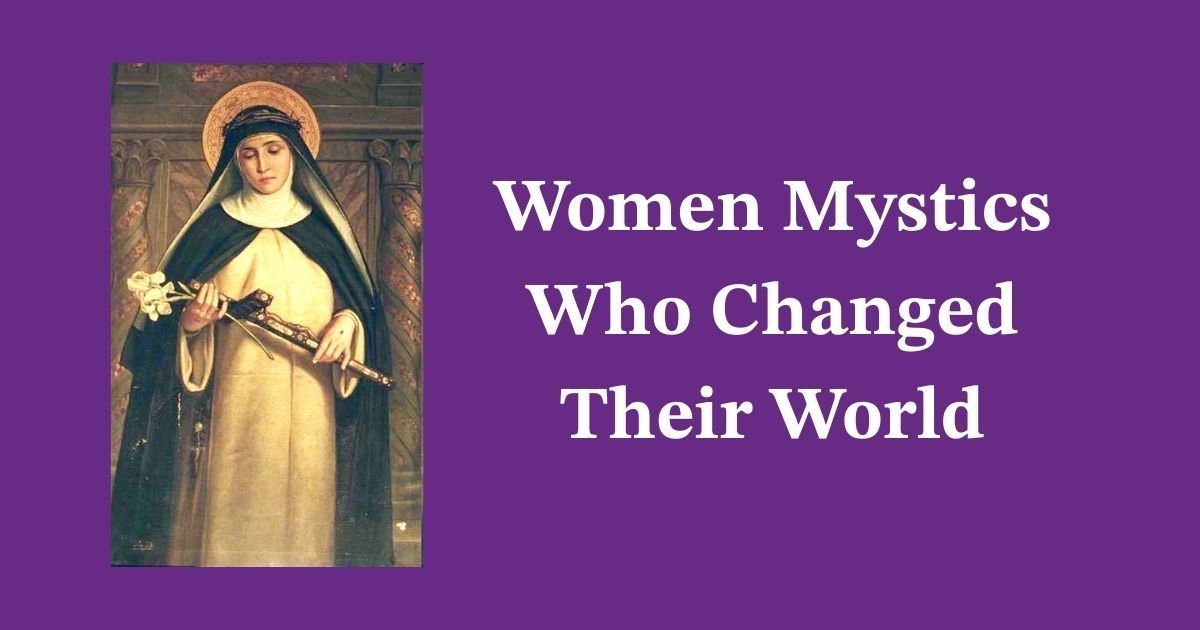

Editor’s Note: Join us in celebrating Women’s History Month by reading about the inspiring lives of Christian women mystics!
C.S. Lewis observed how people who are the most heavenly-minded often accomplish much earthly good.[1] Throughout history, Christian mystics have been powerful forces of spiritual renewal and social reform. Absorbed in God’s presence, the mystics were God-oriented rather than self-oriented. Detached from lesser gods, mystics were freed to focus on Christ and his purposes in the world. In this way, the Christian church has been revived and renewed throughout its history by “fresh contacts with mystics.”[2] The Christian mystical tradition thus constitutes a prophetic and reforming movement within the church, one that empowers women and men for extraordinary work in the world on behalf of Christ and the gospel.
Some believe the mystics lived cloistered behind monastic walls, insulated from the world and its struggles. Strikingly, Christian mystics are individuals whose intimacy with God propels them into social action at times in history when their wisdom was gained both through spiritual renewal and theological expertise. Many mystics were great thinkers, like Hildegard von Bingen.
Hildegard von Bingen (1098–1179)
A mystic of the highest order, Hildegard was a Benedictine nun who served along the Rhine in Germany. An abbess over a double monastery (of nuns and monks), Hildegard led with tremendous intellectual vigor, ecclesial savvy, and political power. One of the best-known women leaders from the Middle Ages, Hildegard was noted for her learning, visions, and unquenchable industry. Her range of talent was daunting for anyone, in any period of history. Among her achievements, Hildegard was a physician, poet, composer,[3] theologian, and activist.[4] She worked tirelessly to revive spiritual health in a church that was indifferent and corrupt. Greatly troubled by immoral clergy, Hildegard called people to look to the Bible and to Christ rather than the priests to find salvation. In fact, the pope himself commissioned her to preach to church officials so that they might become holy. One bishop referred to Hildegard as “a flaming torch which our Lord has lighted in His church.”[5]
One thing remained constant for Hildegard: she was a mystic of the highest order. Her actions were “always dictated by inward commands, and whose source of power lay beyond the visible world.”[6] Like all great mystics, Hildegard had many disciples, and thanks to them, we know much about her life and her encounters with God. The monk Guibert was her secretary, and he recorded her experiences of God as light. For Hildegard, God was “a flaming light of marvelous brightness coming from a rift of heaven, [God] penetrated my brain, heart and breast like a flame that warms but burns not, even as the rays of the sun strike the earth.”[7] From her infancy until age seventy, Hildegard’s soul soared into God’s “brightness which,” she said, “…is not limited by space and is more brilliant than the radiance round the sun… I cannot measure its height, length, and breadth. The name, which has been given me, is ‘Shade of the Living Light’… Within that brightness I sometimes see another light,”[8] which is a reference to Psalm 36:9.[9] “When and how I see this, I cannot tell; but sometimes when I see it all sadness and pain is lifted from me, and I seem a girl again, and an old woman no more!”[10] Note the joy, the renewal of soul, body, and mind, with its heightened awareness of the spiritual life that empowered and equipped Hildegard for enormous service and leadership.
Hildegard’s mystical writings were compiled in a book titled Scivias—Latin for “know the ways of the Lord.” Her Scivias not only displays an intimate understanding of Paul’s writings, the O.T. prophets, and Revelation, but it also exposes corruption within the church.
Catherine of Siena (1347–1380)
Like Hildegard, Catherine of Siena, Italy, was a mystic whose intimacy with Christ brought needed social and ecclesial reform. The world into which Catherine was born was one of unparalleled degradation. Life was miserable! Corruption, violence, plague, alongside political and spiritual wickedness of usual proportion, were unbridled in Italy. Here enters Catherine, who at the age of seven claimed to have seen Christ enthroned in a sky of radiant colors and shapes.[11] She believed that he looked straight at her and blessed her. Then, at the age of twelve, Catherine had another vision in which God led her to a cave where she was married to Christ. God showed Catherine she would lead a life of consecration to Christ. After this vision, Catherine spent the next three years trying to conquer herself by fasting (consuming occasional herbs, bread, and water) and sleeping two hours a day. At sixteen, Catherine moved into a small cell where she lived in solitude for three years. Through rigorous self-denial, Catherine aimed to become a purer instrument of Christ by freeing her soul from the material world to enter more fully into God’s presence. During this time, Catherine experienced visions and ecstasies, but also terrible conflict with evil spirits, culminating in what she called her “spiritual marriage” to Christ.
Having been united in God and fully absorbed by God’s love, Catherine asked God for “perfect love of her fellow human beings, such as Christ had… [She asked]…for a clean heart.”[12] The Lord appeared to her, removed her heart, and gave Catherine his own heart, which, she said, beat much more vigorously and louder as well. This was Catherine’s version of Paul’s “I live, not I, but Christ,” in Galatians 2:20. At the age of twenty-one, Catherine sensed God calling her to public service. Obediently, Catherine went forth to work in Siena, believing that “there is no perfect virtue—none that bears fruit—unless it is exercised by means of our neighbor.”[13] During the plague, Catherine walked among the sick and nursed the dying. To the imprisoned and those condemned to execution, she visited and prayed with them. When a young man had been unjustly condemned, it was Catherine who alone spoke out against the injustice. She ministered to this man, led him to Christ, and remained with him through the execution, stirring the conscience of the town. Her wisdom and fame spread, and soon, a group of disciples from many strata of society shadowed her ministry.
Catherine’s leadership was continually marked by fresh onslaughts of visions and ecstasies, some culminating in a trance that lasted for hours. Her friends thought she had died. Once released from the trance, Catherine believed her spirit had separated from her body and entered heaven, where she was told she had more work to do. She was horrified with the thought of leaving heaven, but the Lord comforted her with these words:
The Salvation of many souls demands thy return, and thou shalt no more live as thou has but will, go forth from thine own city for the good of souls. I shall be ever with thee, and shall guide thee. Thou shalt bear the honour of My name and witness to spiritual things before small and great, layfolk, and the religious; and I shall give thee words and wisdom that none shall be able to withstand.[14]
Thus began her international career. Nothing, except her intimate encounters with God, could have prepared her for her task of challenging church leaders. God had called her to speak against the church leaders who were oppressing the people. Catherine demanded that spiritual rulers mirror Christ. She wrote countless letters to clergy denouncing their greed and spiritual poverty. To one church official, she had the courage to write, “Those who should be the temples of God are the stables of swine…Those who rule must above all be able to rule themselves.”[15]
In a letter to Pope Gregory XI, Catherine called him to return to Rome, reminding him that “Since God had given him authority and he have assumed it, he should use his virtue and powers; and if he were not willing to use them, it would be better for him to resign what he had assumed; more honor to God and health to his soul it would be.”[16]
She then wrote to the pope saying: “Lift up the banner of the Holy Cross. Come, that you may reform the church with good shepherds, giving back to her the colour of most ardent charity that she has lost; for so much blood has been sucked from her by wicked vultures that she is pale.”[17] Boldly, Catherine entered the pope’s palace at Avignon, where she reminded him of the church’s highest mission: saving souls. After she had delivered a message to Pope Urban and his cardinals, he exclaimed, “Behold my brethren, how contemptible we are before God, . . . This poor woman puts us to shame, . . . It is she who now encourages us.”[18]
Catherine, like all great mystics, gave birth to many spiritual children. Her authority and energy were quickly recognized, as was her personal charm. Soon, Catherine had a devoted circle of disciples comprised not only of other women, but also of priests, friars, and young nobles, all for whom Catherine was their “holy mother.” God told Catherine to “conceive and give birth to a race of people that shall hate sin and love ME with a great and burning love.” [19] Catherine of Siena was made a doctor of the church in 1970 by Pope Paul VI.
Teresa of Avila (1515–1582)
The mystic Teresa of Avila was a Spanish Carmelite nun, a writer, and, like Catherine, a church reformer. She was also called Teresa of Jesus. Her Jewish grandparents converted to Christianity during the Spanish Inquisition. One of the most celebrated women in all of church history, Teresa’s work is read more than that of any other mystic.
Born into a wealthy family, Teresa was urged (or forced) to join a monastery at the age of twenty, after much philandering during her teens. She was the sort of teenager you do not want your teenager to spend too much time with. Once a Carmelite novice, Teresa was found gazing at a cross on her bedside table, and she fell into a trance. Believed to be dying, she received the last rites. Once recovered, Teresa believed God was calling her to himself, more specifically to a life of prayer. In response, Teresa devoted herself to the discipline of mental prayer and a life of solitude. Yet her quiet life of contemplation was frequently interrupted by her longing for a life of pleasure. Possessing a passionate temperament, Teresa’s life was disrupted by self-discipline as she attempted to slay her sensual impulses, even as her spiritual life included states of joy and spiritual visions. She described this inner conflict with these words:
On the one side God was calling me, on the other I was following the world. [In] all the things God gave me great pleasure, and [yet] I was a prisoner to the things of the world. It seemed as if I wished to reconcile two contradictions so much at variance with one another as are the life of the spirit and the joys, pleasures and amusements of sense. . . I passed nearly twenty years on this stormy sea, falling and rising, but rising to no good purpose seeing that I went and fell again. [20]
This struggle continued until age forty-one, when her mystical life was formed completely. All her life, Teresa experienced ecstatic visions over which she had little control. These raptures and trances seized her, often in public, embarrassing Teresa and confusing her spiritual directors. Each mystic experienced encounters with God in ways that are consistent with their own personality. In Teresa’s case, it was all-or-nothing. One would expect nothing less of her.
Teresa wrote a spiritual classic titled The Interior Castle, which was to Spain what Victor Hugo’s Les Misérables was to France: a flowering of spiritual literature. Teresa’s Interior Castle offers a guide through the labyrinth and mysteries of the inner, spiritual life, illustrating through analogy the process of her “mental prayer,” which ultimately leads us to union with God. She called her work The Interior Castle because it is based on a vision she had of drawing close to God, who resides in the center of a castle—a metaphor for our soul. In her vision, Teresa sees a large crystal castle in which light radiates from a central fire. One must walk through each level in pursuit of Jesus—the brightest light, at the center of our soul. We must leave sensual pleasures, illusions, vanities, and restlessness of life in drawing close to Christ. Her work remains a classic in Christian spirituality.
Teresa’s entire life brought her into conflict with her order, the Carmelites. Because their greed was growing like cancer, she began a reformation of her order by calling the Carmelites back to their roots of simplicity. In the end, she established sixteen convents built on her reform. Despite her many great literary, administrative, and reformation achievements, Teresa remembered that it is not great achievements so much that God favors, but the love behind our labor. “The important thing,” she said, “is not to think much but to love much; and so do that which best stirs you to love.” [21]
Teresa’s words were not always welcome. In fact, she was never free from persecution from those Carmelites who opposed her reforms as unorthodox. Many mystics who publicly celebrated their spiritual ecstasy and visions of God lost their lives to the Spanish Inquisition. Teresa herself was aware of her constant peril.
Like many great mystics, Teresa gave “birth” to spiritual children. Jon de la Cruz, or John of the Cross, was animated by Teresa’s spiritual vitality and became a close colleague. Eventually, John suffered imprisonment because he supported Teresa’s reforms. John of the Cross wrote The Dark Night, a spiritual classic. Like Catherine of Siena, Teresa of Avila was also made a doctor of the church in 1970 by Pope Paul VI.
Consider the Outcome of Their Lives
The achievements of mystics like Catherine of Siena, Hildegard von Bingen, and Teresa of Avila are stunning examples of lives animated, shaped, and led by Christ. Through their intimacy with Christ, women mystics were propelled into significant leadership, both in the church and in wider culture. In both contexts, these women not only challenged cultural and ecclesial sexism and corruption, but their spiritual and intellectual dynamism also revealed God’s power in gifting and commissioning women as church reformers when church leaders had failed the church spiritually and morally. Mystics such as these exemplify how Christ’s power in women accomplishes what many viewed as impossible—the capacity to recover the church’s moral, spiritual, and intellectual vitality that corrupt leaders had tarnished.
The example of women mystics known and lesser known among us challenges the sexism of theologians and church leaders who too often exclude women from leadership because of Eve’s failures. As women mystics identify with Christ, in whose image they are remade, women like men receive not only redemption and power through God’s Spirit but also opportunities to represent Christ in service and leadership alongside men. The mystic’s intimate communion with Christ gave women new dignity and agency to “distance themselves from identification with Eve’s sin.”[22] While the example of women mystics may seem extraordinary, even inaccessible or impossible to achieve given the limitations of time most of us face each day, the more we drink in God’s presence, the more time and capacity we seem to have for God and others. Intimacy with God was, for Catherine of Siena, given for the sake of one’s neighbor.[23]
Notes
[1] C.S. Lewis, Mere Christianity, (Harper San Francisco, 2021), 34.
[2] Evelyn Underhill, The Mystics of the Church (Schocken Books, 1971), 11.
[3] https://www.youtube.com/watch?v=HYzPR0nwcmY&list=RDHYzPR0nwcmY&start_radio=1
[4] Hildegard von Bingen, Hildegard of Bingen Scivias, Classics of Western Spirituality, (New York: Paulist Press, 1990).
[5] Joyce Hollyday, Clothed with the Sun: Biblical Women, Social Justice and Us (Westminster John Knox, 1994), 146.
[6] Underhill, The Mystics of the Church, 75.
[7] Underhill, The Mystics of the Church, 78.
[8] Underhill, The Mystics of the Church, 76.
[9] “…in his light we see light.”
[10] Underhill, The Mystics of the Church, 76.
[11] Edith Deen, Great Women of the Christian Faith. (Barbour and Company, Inc., 1959), 52.
[12] Carol Lee Flinders, Enduring Grace: Living Portraits of Seven Women Mystics, (HarperCollins, 1993), 114.
[13] Underhill, The Mystics of the Church, 155.
[14] Underhill, The Mystics of the Church, 157.
[15] Deen, Great Women of the Christian Faith, 55.
[16] Deen, Great Women of the Christian Faith, 56.
[17] Underhill, The Mystics of the Church, 158–159.
[18] Deen, Great Women of the Christian Faith, 58.
[19] Flinders, Enduring Grace: Living Portraits of Seven Women, 117.
[20] Underhill, The Mystics of the Church, 174.
[21] Flinders, Enduring Grace, 155. See also Kari Borrensen’s The Image of God.
[22] Monica Furlong, Visions and Longings: Medieval Women Mystics, (Shambhala, 1997), 13.
[23] Deen, Great Women of the Christian Faith, 53.
Related Reading
We Need Women’s History Month Because Every Month Is Men’s History Month
Women’s History Month: Early Evangelical Women