

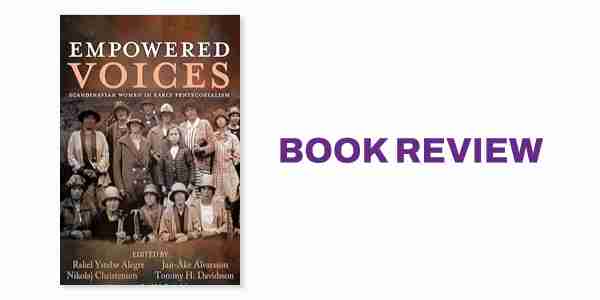

Note: Buy Empowered Voices: Scandinavian Women in Early Pentecostalism through CBE’s online bookstore.
Women’s participation in Pentecostalism has wavered throughout the years. In the book Empowered Voices: Scandinavian Women in Early Pentecostalism, author Jan-Åke Alvarsson has concluded that male dominance within executive church positions has directly influenced this phenomenon.1 Pentecostalism operates on a system that follows a traditional, patriarchal structure, and even today, women are rarely given any influential positions, let alone ones in leadership.2
Empowered Voices acknowledges how this treatment dates to Pentecostalism’s roots and compiles a series of ten chapters to recognize significant women leaders, missionaries, and evangelists at the height of the Scandinavian Pentecostalist Revival (1906).3 The authors involved hope to examine these convicted, determined women, and assess the degree they dedicated their lives to Pentecostalism. As mentioned, to properly assess their influences, the chapters specifically point out the importance of egalitarian marriages and the equal bonds between women and men. This book aims to emphasize the value women bring to the church, the importance of their self-worth, and why recognition of influential Pentecostal women today is crucial for equal treatment of Christian women and men in the future.
Historically, women Pentecostalists were leaders and figureheads of the movement, but they were eventually completely barred from key roles in congregations, churches, and more.4 Given that Pentecostalism originated with high levels of woman evangelists, the decline is especially notable; in fact, many women, not men, became the first crucial Pentecostal missionaries and evangelists.5 Even so, despite the surge in women members in Pentecostalism’s early years, it is important to reiterate that both men and women strived to spread Pentecostalism in equal measure. Some of these same men went even further and recognized the need for gender equality within the church.
John Ongman, a preacher in Örebro, Sweden, affirmed that the world promoted male supremacy, a fact that needed to be recognized nationally and internationally. He concluded that with the help of the Bible and Christianity, women would be liberated, and the effects were immense. With Ongman’s support for women in power, along with his formation of the Örebro Mission School, his work brought more women in who now believed that they could be just as influential as men evangelists.6 His alliance and ability to work with women proved to be crucial for Pentecostalist growth.
In addition, Empowered Voices offers examples of married couples that show the full range of accomplishments possible from gender unity. For instance, Frida and Gunnar Vingren’s magazine Boa Semente, eventually merging with another to form Mensageiro da Paz, stood strong for years because of the equal partnership between husband and wife. Frida would provide the writing and material, and Gunnar handled most of the official editing. Their work expanded to invite Brazilian writers to share their own views,7 providing a platform for other women evangelists in Brazil whose voices were previously unheard and increasing women participation in the country. From the examples of Ongman and the Vingrens,8 from diverse backgrounds, even those in considerable authority, were able to realize the value of women with witness to God’s Word.9
Empowered Voices, as mentioned, is authored by Jan-Åke Alvarsson and is co-authored by Kael Ystebø Alegre, Glenn Gohr, Nikolaj Christensen, Malene Kjær Eriksen, Tommy H. Davidsson, Gunilla Nyberg Oskarsson, Liv Toril Rinding Skjeggestad, and Kristina Undheim. Most chapters are written by no more than three authors and are dedicated to a singular woman; the only chapter that covers two women helps to compare their experiences as co-workers who worked together on the same mission. Thus, each chapter can be read as a standalone, individualized biography, usually beginning with an introduction paragraph to reiterate what the woman is most well-known for, involving a description of her childhood, first experience(s) with God, and their realization of their role in Pentecostalism.This format allows the authors to fully describe the woman’s journey and provide details of her work with proper respect.
For example, the first chapter, which focuses on Swedish Pentecostalist leader Laura Barratt, begins with a description of the social climate and religious state Barratt worked in. Not only that, but it also includes where she grew up, her marriage in Sweden, and her emigration to the United States. These influences are considered when assessing the impact she had when she returned to Adelöv, Sweden. Thanks to the information provided, it is evident that Barratt was an integral figure to early Pentecostalism, specifically when it came to women’s rights in the church. In addition to being a pastor’s wife, she was a leader of her own who edited, managed, published, and created ideas for her and her husband’s periodical (Byposten). She also became a deaconess in their own Pentecostal church (Filadelfia) in Oslo, Norway, and, as she preached, was highly respected among fellow believers.
The other women in Empowered Voices have unique paths from Barratt and each other, but are all similarly motivated by their strong sense of conviction for evangelizing and converting others. Some are more known for their leadership status within Pentecostalism, while others focused more on missionary work; Anna Larssen Bjørner and Ingrid Løkken Chawner are exemplary of this.
Anna Larssen Bjørner is an example of being most recognizable as a figurehead for the Pentecostal movement, specifically in Denmark. She lived her childhood and early adult years as an actress and was only introduced to Christianity later in life. Due to her status, her conversion to Pentecostalism brought international recognition and attention. Bjørner’s late conversion and faith was questioned by outsiders, but her work in the Revival within Denmark was undeniable. After marrying fellow evangelist Sigurd Bjørner, she would go on to travel and preach in cities across the country. She also had a talent for translating Pentecostal and religious books, and she used her skills to bolster the movement’s image.
On the other hand, Ingrid Løkken Chawner is defined the most by her missionary work. She was, and is, lesser known, with especially few details available in her youth other than her conversion at sixteen. Even with the sparse information available, her accomplishments are just as admirable. Chawner established several mission stations in and around Mozambique, preaching, teaching, and praying with the locals in the 1920s and 1930s. At one point, she and her husband managed two missions and twenty outstations in Africa at once. Even when she was eventually banned by the Roman Catholic Church, Chawner had left a long-lasting impact in Mozambique, and she would live to see a strong resurgence of Pentecostalism in the 1970s.
Throughout Empowered Voices, the authors’ support for women’s visibility is made abundantly clear. At the start of the book, Alvarsson states that despite many of the other perspectives lost to time, Empowered Voices exists to bring more light to women’s Pentecostalism and their complete, evident right to be in positions of power. This intention is shown in every chapter, whether direct or indirect, such as an acknowledgment toward the woman’s less than advantageous circumstances, unjust treatment by male authority figures, and more. Recognizing these achievements and bringing these women back into the spotlight, Empowered Voices intends to, as the title suggests, empower women in religion and inspire them to advocate for themselves and their ability to make a difference.
Notes
1 Jan-Åke Alvarsson, et al. Empowered Voices: Scandinavian Women in Early Pentecostalism (Pickwick Publications, 2024), 1–12.
2 Rosinah Mmannana Gabaitse, “Pentecostal hermeneutics and the marginalisation of women,” Scriptura 114, (2015): 1–12, https://doi.org/10.7833/114-0-1043.
3 Alvarsson, Empowered Voices, 39.
4 Alvarsson, Empowered Voices, 12.
5 Cecil M. Robeck Jr., foreword to Empowered Voices: Scandinavian Women in Early Pentecostalism, by Jan-Åke Alvarsson et al (Pickwick Publications, 2024), ix.
6 Alvarsson, Empowered Voices, 6.
7 Alvarsson, Empowered Voices, 175.
8 Alvarsson, Empowered Voices, 7.
9 Alvarsson, Empowered Voices, 7.