

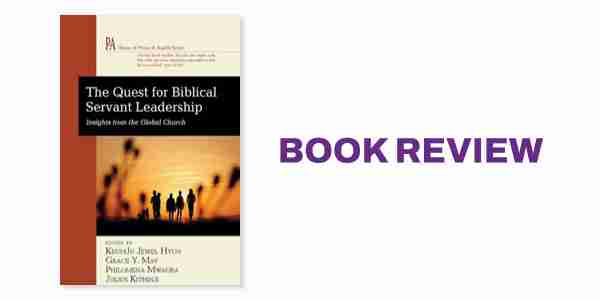

The book, The Quest for Biblical Servant Leadership: Insights from the Global Church, edited by Keumju Jewel Hyun, Grace Y. May, Philomena Mwaura, and Julius Kithinji, pragmatically addresses the issue of being a leader while serving God and humanity concomitantly within or outside the church. With rich cultural, religious, and theological experience, the authors present helpful insights to the issue of servant leadership that has bothered the church and the world over the centuries. Their insight addresses the concerns of those who feel that the biblical concept of leading through service is impractical in today’s church and multicultural, pluralistic society. Highlighting the thesis of the book, Sunil Kim posited that “Distinctively Christian servant leadership begins by fully recognizing God’s ultimate authority and providence” (166). Servant leadership transcends gender, ethnic, cultural, political, and religious barriers.
Portraying the compromised state of servant leadership in an Asian (Korean) context, Kwang Kun Kim laments that, “Christian leaders have blindly adopted secular values for their personal gain and to build their reputation, losing the purity of Christian values. Thus, we can say that the leadership is secularized” (106). The church, as the salt and light of the world, should set the pace in leading through service.
To better embrace and embody the concept of leading while serving, the book is divided into two major sections. Part 1 is titled “A Biblical Basis and Historical Perspective for Servant Leadership,” and is further divided into six chapters:
- Chapter 1 explores biblical servant leadership.
- Chapter 2 examines a biblical theology of servant leadership in the Old Testament.
- Chapter 3 probes into the New Testament practice of foot washing.
- Chapter 4 examines biblical servant leadership and its practical implications for the church today.
- Chapter 5 compares the relationship between gender equality and servant leadership.
- Chapter 6 explores leadership development across Christian history.
The chapters in Part 1 present solid background of servant leadership from the biblical and historical points of view. The book demonstrates that the concept of servant leadership is not a new phenomenon in Scripture, nor is it alien to the church or the world. Diphus Chosefu Chemorion posits that, “The subject of servant leadership has its origin in the book of Genesis” (15). He then uses the examples of Deborah, Moses, King David, King Josiah, and Nehemiah as evidence of this point, stating “All the five leaders are examples of people who demonstrated qualities of servant leadership” (21).
In the New Testament, Jesus is portrayed above other biblical figures as an epitome of servant leadership. Julius Kithinji captures this better by stating that, “Being God, yet taking the form of a slave, is not an easy balance when understood within merely human expressions” (31). He describes, “Jesus’s type of leadership is focused on people, Scripture, and purpose” (28). Other sections of the book cite Augustine of Hippo (64), Francis of Assisi (73), and Mother Theresa (146) as models for leaders in the present era by acting as servant leaders to transform the church, society, and the world.
Part 2, titled “Practicing Servant Leadership in Our Contemporary Context,” is also divided into six chapters:
- Chapter 7 examines how servant leadership can be practiced in the workplace.
- Chapter 8 probes how servant leadership can be practiced in African culture.
- Chapter 9 also looks into ways by which servant leadership can be practiced in Asian cultures.
- Chapter 10 offers helpful insights by which servant leadership can be lived out in a multi-faith context, particularly among Christians and Muslims.
- Chapter 11 considers the connections between servant leadership and soul care.
- Chapter 12 emphasizes the need for transformational servant leadership.
Part 2 presents how servant leadership deeply rooted in the Bible is important and applicable in the contemporary era. Larry Peabody, addressing how biblical servant leadership is effective and relevant in the workplace today, argues that “Working Christians have a powerful platform from which to reflect the heart of the Good Shepherd . . . they can offer glimpses into how he rules in the present form of God’s kingdom” (90). Lydia Mwaniki quips on the praxis of biblical servant leadership from the African perspective of Ubuntu,[1] “When applied to leadership, a leader’s success depends on the success of those led” (93). Shedding light on the relevance of biblical servant leadership for the people of Asia in the present era, Kim cautions that “Asia Christian leaders are in danger of being contaminated and assimilated by the influx of diverse and changing cultures” (105). The devastating effect which makes servant leadership much needed in the Asian culture, according to Kim, is that “This cultural contamination and assimilation is affecting the leadership framework of Christian teachings, causing Christians to be coerced into following leadership styles and practices based on popularity of pop culture and certain institutions’ secular worldviews and values” (106).
The Quest for Biblical Servant Leadership has several strengths, first of which is the academic rigor of the authors. Each author has in-depth knowledge of their fields and the themes of the book. Second, despite the scholarly composition of the book, it can be read, understood, and embraced by readers at all levels. Additionally, the limited scope of the book, specifically African and Asian contexts, enhances its credibility and validity for a focused study and results. Further, this presents a fair limitation for future researchers to consider exploring the concept of servant leadership from continents other than Africa and Asia. Exploring servant leadership from the lens of Islam and Christianity offers fresh insight for interfaith dialogue and balanced skills for leading others in the contemporary era. The striking benefit of this for women, according to Kiilu, is that “…community dialogue and space have given people from both religions space and the opportunity to express themselves without fear, especially women” (127). This helps readers to embrace the present reality of multicultural, pluralistic societies in the nexus of interfaith dialogue. Future editions of the book could benefit from exploring interfaith dialogue with non-Abrahamic religions so that readers could learn from the writer’s insights.
Overall, “This book makes a case for servant leadership in global settings rooted in the biblical tradition (166). To that end, the book is a must-read for women and men who aspire for leadership positions within and outside the church. Those already in leadership positions would also benefit greatly from the shared principles for positive transformation of lives and societies. Servant leadership should be lived within the actuality of the servanthood of Christ and evidenced in praxis to God and others. Going contrary to this biblical reality subjects the community of God to ridicule. God will be glorified through this book.
Notes
- Ubuntu is a philosophy that emphasizes the interconnectedness of individuals within a community, where the well-being of one person is interconnected with the well-being of others.