


Archaeology uncovers the stories that history has overlooked or buried. Rooted in evidence and inquiry, it challenges assumptions and invites us to re-examine the past with fresh eyes. Many support complementarian theology based on tradition and a misunderstanding of women’s historical participation in the church and society, believing the push for equality between women and men to be the influence of secular feminism in the church. The archaeological evidence begs to differ. As scholars bring to light artifacts and inscriptions long obscured—sometimes deliberately suppressed—a fuller picture of women’s leadership begins to surface.
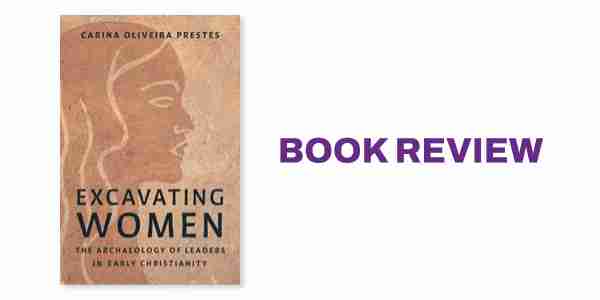
The book Excavating Women: The Archaeology of Leaders in Early Christianity does just that. Exquisitely researched and thoroughly reasoned, this book traces the archaeological markers used to honor women leaders in pre- and early Christian centuries. From Greek and Roman temples to tombs, churches, and catacombs, archaeologist and professor Dr. Carina Prestes excavates examples of women’s leadership at odds with literary texts of their day. As her analysis unfolds, we learn how one generation speaks to another in the language of archaeology, repeating and repurposing leadership markers in clothing, objects left in tombs, mosaics, and inscriptions that, once seen, are impossible to ignore. As ancient stones cry out, Excavating Women is a book whose time has come!
A New Methodology Yields New Evidence
Each chapter stress-tests Prestes’s methodology to yield impressive results. In the first chapter, “Introduction: Context, Scope, Method,” Prestes begins by noting the scarcity of historical research on women—a bias that is all too common. Because of this, she has developed a process that assesses archaeological artifacts depicting women’s lives and leadership alongside relevant texts in the same timeframe. She writes:
There is currently no publication that documents the chronological development of women’s participation in Christian communities based on a broad analysis of evidence from different artifact classes including a wide variety of artistic media. (4–5)
In chapter one, Prestes begins by describing her methodology and the scope of her work, which she has pioneered.1 She recognizes two leading scholars—Dorothy Irvin and Christine Schenk—both of whom are archaeological experts on women leaders in the early church.2 As archaeologists, they have the freedom to ask not “should women be ordained?” but “what was the role of women in Early Christianity?” and what does “a broad analysis of the material evidence in its context suggest?” (7). Through a multi-disciplinary analysis coupled with new “methodologies and approaches” (9), Prestes demonstrates the capacity of archaeology to minimize the risk of bias from “a single media to illuminate as many aspects as possible” (9).
Titled “Women Before Christianity: An Unexpected Strength,” chapter two considers prominent examples of women’s overlapping leadership in cultic and civic spheres and clarifies how culture rewarded women’s status as well as influence with financial, legal, and social benefits, as well as through public recognition in the form of statues, inscriptions, and artwork. Prestes guides readers in learning the language of archaeology to identify women priestesses as frontal facing and with hands “lifted in prayer suggesting piety” (18). Pre-Christian symbols of leadership also include the wreath, “laurel branch, libation bowl (or jugs) . . . vestments, jewelry, a fancy headband or crown, and a draped mantle under the right arm” (18). Christians later adopted these symbols to identify women leaders in early churches even as Greek and Roman culture had held different expectations for women’s public behavior in pre-Christian centuries.
Whereas Greek women were sometimes honored for their cultic and civic leadership, Roman women were expected to be modest, “quiet, subordinate to men, passive members of society . . . they were not allowed to speak in public” (20). However, archeological remains indicate that, in times of war and political instability or if they were wealthy and high in social status, women entered public life. They ran shops, spoke for civic leaders, and served as city patrons (21ff.). Rome also had its women priests—the Vestal Virgins who wielded remarkable power (23). Prestes examines the remains of women priestesses, patrons, and benefactors as they were honored with statues at the front of temples and with “inscriptions in prominent places in the city . . . the forum and the city gates” (29).
Brilliantly, this chapter shows how women leading “house churches” merged both “public and private spheres” (45). This not only honored cultural expectations for women alongside their lived experiences, whether Greek or Roman, but also how women “evangelized within their social network” (50) to the point that they outnumbered men in these communities. By the second century, “an estimated 60 percent of the members of Christian communities . . . were women” (50). As women thronged to religious leadership, the emperor Augustus (63 BC–AD 14) issued laws curtailing women’s behavior (54). Prestes points out that “when Paul advises women to be silent it is not because this was the expected behavior of modest women in that society or in Jewish circles” (55). On the contrary! The archaeological evidence shows women leaders were far from silent when in cultic and civic spaces. Prestes joins the scholars who suggest something else was behind Paul’s silencing of women in 1 Corinthians and 1 Timothy.
Chapter 3, “Women and the Evidence of Early Christian Burials: An Unexpected Bishop,” demonstrates how early Christians harnessed pagan and Jewish symbols of leadership to depict women leaders serving churches. A tomb located close to an altar where church leaders were honored contained gold earrings, a gold diadem, and a silver medallion that belonged to an influential, wealthy woman in Sicily (64). According to Prestes, since the Greeks were influential in Sicily, and as they also accepted priestesses, the leadership of women from Greek temples spilled over to Christian churches.
But as church hierarchy strengthened, so did the limits on women church leaders. By the fourth century, the Council of Laodicea prohibited women presbyters and forbade women from approaching the altar, thus confirming the existence of both practices (76)! These prohibitions parallel the archaeological evidence from inscriptions that honor women “leading religious communities” along with their “Christian clerical titles” (77). One example is the woman Kale—a presbyter, and a “woman without reproach’”—a phrase used for leaders holding religious office. Equally, Prestes shows that women leaders were also honored by symbols (wreaths and crowns) with inscriptions marking them as presbyters, prophets, and apostles.
Turning to the catacombs, Prestes unearths a trove of early Christian art to examine symbols marking women in ecclesial offices, “realities not always expressed in the written record” (84). “Christian catacombs not only contain a disproportionately greater number of images of dead women in comparison to men” (85), but also that the many “women portrayed in these frescoes seem to suggest the strong engagement, presence, and agency of women in the Christian communities” (85). Two prominent women featured in the San Gennaro catacombs in Naples are Bitalia and Cerula. Both are frontal facing “with open arms and raised in a prayer-like orans position” (87), with what is likely the Gospels opened above their heads—indicating their literacy and, most likely, ordination as priests, deacons, or bishops. Symbols like the alpha and omega further suggest that both women were either deacons or bishops. Prestes argues that when mosaics, tombs, frescos, and inscriptions are analyzed, the combined evidence reveals that ordained women led churches at high offices, even as their leadership was prohibited by the writings of male clerics at the time.
In chapter 4, “Women and the Christian Mosaics of Late Antiquity: An Unexpected Counterpart,” Prestes examines women portrayed in the mosaics in early Christian worship. She reveals a consistent pattern of women leading church worship as elders. One well-preserved example is the mosaic of empress Theodora (490/500–548) and her emperor husband Justinian I (482–565), which is prominently featured in San Vitale, a church in Ravenna, Italy. Both spouses are frontal facing and close to the altar—in the apse—where clergy served communion. On one side of the apse, Theodora holds the chalice for wine, while on the other side, Justinian holds the bowl for bread. According to Prestes, the apse was a holy space most often reserved for the clergy; the portrayal of Justinian and Theodora, then, suggests that both men and women served the communion. Prestes observes how the mosaic of this church depicts the vision of the throne of God registered in Rev 4 and 5—elements include the four living creatures (Rev 4:7), the scroll with seven seals (Rev 5:1), and the Lamb (Rev 5:6), indicating that the processions led by Theodora and Justinian could depict female and male elders. The theme of the coronation of Christ (Rev 4 and 5) also appears in another building in Ravenna, San Apollinare Nuovo. It likely depicts elders casting their crowns before the throne. These mosaics also imply that both men and women were “perceived as part of the twenty-four elders (presbyteroi) of Revelation—leaders of the community bringing their crowns before the one sitting on the throne” (126). Prestes concludes by examining women’s clothing in a mosaic panel retelling Mary’s visit with Elizabeth. In this image, both women are located in the apse, and each wears a long white scarf under her cloak with the Greek cross that scholars use to identify a bishop (137–38).
Mounting further evidence, Prestes considers two churches in Rome named after women, and both are also featured in the apse—the church of Santa Pudenziana and Santa Praxedis. Prestes notes that Santa Pudenziana was located “on top of a second-century house” believed to be a house church with the “earliest surviving apse with mosaics in Rome” (138). Citing other mosaics that portray women “performing all ministerial activities that men performed” (143), a tipping point of women leading as elders and bishops is reached. This chapter alone is worth the price of the book!
The last chapter, “An Unexpected History,” evaluates Greco-Roman archaeological remains through the sixth century. Here, Prestes highlights significant patterns. First, the literary accounts diverge from the archeological evidence. Second, whereas women leaders are either prohibited or under-represented in written texts, the archaeological remains tell their story as elders, deacons, and bishops. Third, “literary accounts” favor “the ideologies of the author or of the patron” (147) over and against the actual work and lived experiences of women. While the bias of the written texts is rehearsed, strengthened, and passed on as historical fact across the centuries, archaeologists like Prestes have a powerful tool and a unique opportunity to challenge longstanding bias by excavating women’s leadership through the language of archaeology. Chapter 5 is a delightful review of these material remains that free women’s leadership from bias by those who have controlled the past to control the future. Excavating Women tells the story of women’s authentic leadership from pre-Christian to early and Christian times, bringing light and life on every page.
The book’s strengths are manifold, including the author’s innovative methodologies tracing markers of women’s leadership in pre-Christian centuries through the early church period. Prestes’s original thesis is supported by substantial evidence and is accessible to a wide range of readers. Despite some minor weaknesses, Excavating Women is a pioneering achievement that demonstrates the power of archaeology to accurately recover the history of early Christian women. Readers will come away from this book encouraged, empowered, and armed with ample evidence to correct the long-held misunderstandings of women’s participation in the church.
Notes
- Compare the publications of Ally Kateusz, including “Women Leaders at the Table in Early Churches,” Priscilla Papers 34/2 (Spring 2020) 14–22.
- See Jamie Manson on Dorothy Irvin, https://ncronline.org/blogs/grace-margins/women-priests-demonstrate-profound-faithfulness-god. Christine Schenk’s book, Crispina and Her Sisters: Women and Authority in Early Christianity (Fortress, 2017), won the Catholic Press Association’s first-place award in the history category. See also https://cbeinternational.org/resource/bitalia-ancient-woman-priest/ and https://cbeinternational.org/resource/religion-women-and-children-christian-womans/.
- “Who controls the past controls the future: who controls the present controls the past” is a quotation from George Orwell’s 1949 novel, 1984.