

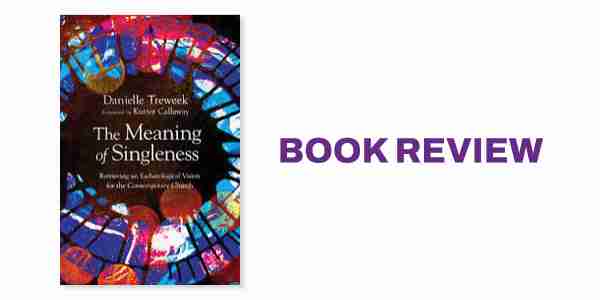

Editor’s Note: CBE maintains an irenic voice when publishing articles on books written by complementarians. The Meaning of Singleness, written by Danielle Treweek, a complementarian, has been vetted by CBE and approved for CBE’s bookstore. Each resource is chosen based on its agreement with CBE’s statement of faith and core values, whether the author has expressed agreement or disagreement elsewhere. By including a resource, CBE is not endorsing the entire body of work by an author, the author, or any organization or denomination they might have or currently represent.
Much current evangelical teaching practically idolizes marriage and family. In The Meaning of Singleness, Danielle Treweek pushes back against this posture in a unique and unexpected way: by reminding readers of the eschatological significance of singleness and why it matters for our churches’ theology. As a single Christian herself, Treweek knows from experience what it’s like to be single in the church; as a scholar, her argument is backed by extensive research (this book is the fruit of her PhD dissertation).
Part 1: The Context of Singleness
Treweek starts by taking the reader on a historical tour of how societal perceptions of singleness have changed from Early Modern times through the present day. She divides this historical exploration of singleness into four time periods: Early Modern Europe, Colonial and Postcolonial America, the Twentieth-Century West, and the New Millennium. Her exploration uses statistical evidence to highlight how the increasing prevalence of singleness within modern Western society has not eliminated the stigma surrounding unmarried persons. However, while the language is academic, her explanations are well-written and comprehensible to the reader.
In the second chapter, Treweek transitions to a thorough, statistical overview of the church’s approach to singleness throughout history. She analyzes how the rise of secularism inspired some changes but largely resistance within the church in terms of redefining marriage and family values. Her overview provides a timeline for how evangelical views on singleness as “otherness” have developed into what they are.
Part 2: The Diagnosis of Singleness
In the second section of the book, Treweek dives into an unvarnished discussion of what the contemporary Western evangelical church teaches about singles and singleness—and why. She writes that singles have come to be viewed as deficient, aberrant, and unfulfilled (the three sections of chapter three). This discussion has the potential to be validating for single Christians who are all too familiar with these views but have never seen them explained and laid out so starkly in writing. The discussion is also vital for non-singles and will help them take an honest look at what is being taught about the singles in their church community—that is, if there are single people who have stuck around in their church. CBE readers might also be interested in how the teachings of purity culture have played a part in getting the Western evangelical church to where it is now regarding our understanding of singleness. She defines this Christian view of “purity culture” as an emphasis on abstaining from areas of sexuality until one marries the partner with whom they will have children (page 58). Finally, Treweek wraps up this section by looking at how these negative views of singleness play out in the church, especially when it comes to the perceived value of singleness and the single person’s sense of belonging.
Part 3: The Retrieval of Singleness
Treweek’s goal is to help the contemporary church rediscover a faithful theology of singleness, so she spends three chapters analyzing singleness in the fields of church history, biblical exegesis, and Christian theology, with special emphasis on the eschatological importance of the single way of life. These chapters help the contemporary Christian see beyond the narrow scope that is often taught in churches. Treweek then concludes each chapter with a helpful discussion of implications for the reader to consider.
Part 4: The Meaning of Singleness
Treweek uses her concluding three chapters to pull together the ideas discussed throughout her book. She cites two dominant reasons for the church’s thin and anemic theology of singleness: a failure to recognize the cultural influences shaping their views on marriage and singleness and how those same influences have “baptized” those views as “the Christian way of life” (page 218). Having demonstrated this thin and anemic ideology of the contemporary church throughout her book, Treweek now argues that the situation is detrimental not only to single Christians but also to married people and to the body of Christ as a whole. She encourages us toward a renewed vision of what it means to be the united body of Christ with a focus on eternity. To emphasize this vision, Treweek paints a picture of the church of “forever,” a community which is bound not by blood but by the “indwelling Spirit.” She claims that the full integration of single members is vital to the church’s eternal identity: unity in Christ and an orientation not towards life in this age but rather to life in the age to come (page 237).
Conclusion
This is a vital conversation, not just for singles but for non-singles in the Church as well— maybe especially for non-singles. Treweek shows that the way single believers are sidelined, excluded, and devalued in the contemporary church has to do with our theology, eschatology, and lack of historical memory. She gives readers a bigger picture to help us reimagine a better way. While the writing contains a fair bit of academic jargon, the discussion will be beneficial for casual readers as well as intermediate readers and academics. Treweek helps us think about singleness in a way most of us probably never have, and she helps us see it as a foretaste of life in eternity. This book is an important contribution to current conversations about sex, marriage, and purity culture, and it is written for the whole church, not just singles.