

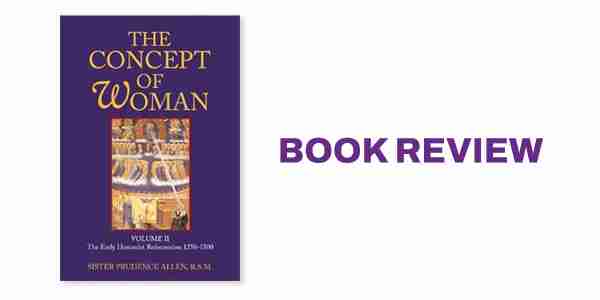

The Concept of Woman: A Synthesis in One Volume is a helpful synthesis of Prudence Allen’s masterful three volume work The Concept of Woman. For readers who are interested in the content of Allen’s work but do not want to commit to the full three volumes, this book is a must-have resource. The Concept of Woman is a comprehensive, though perhaps not exhaustive, exploration of the history of philosophical anthropology as it relates to women in the Catholic Church. The author begins her survey in ancient Greece and ends in the twentieth century with the work of Karol Wojtyla, who became Pope John Paul II from 1978–2005. This book is appropriate for readers who are interested in the philosophical reasoning behind gender complementarity and how metaphysics confirms biblical truth. Specifically, the metaphysical framework of body-soul hylomorphism affirms the account of the creation of humankind in Genesis chapter 2. The Concept of Woman affirms CBE’s values both in argument as well as in structure of content, highlighting the work of many female philosophers throughout the centuries.
The strength of the book lies in how it traces the thread of anthropological integration from Aristotle to Augustine and down through the twentieth century with Pope John Paul II. Allen uses John Henry Newman’s seven criteria for true development of doctrine as the guideline for evaluating this anthropology. These criteria are listed on pages three and four of the The Concept of Woman. The strength of Allen’s argument is bolstered by her interaction with other anthropological ideas that ultimately did not meet Newman’s criteria. Allen features the work of both female and male philosophers including Hildegard of Bingen, Christine De Pizan, Alice von Hildebrand, and Edith Stein. It culminates in a description of the anthropology set forth by Pope John Paul II in the twentieth century, which arguably has practical implications both for the Church and the culture of the twenty-first century as well. For example, beginning in chapter seventeen, Allen details how fractional gender ideologies have stemmed from the dualistic anthropology of Descartes in the sixteenth and seventeenth centuries. She builds an argument for the necessity of the Church’s response to this development being grounded in an integrated anthropology.
Allen makes a strong case for the theory of integral gender complementarity based on this well-developed anthropology and she demonstrates complementarity anecdotally through examples of women and men working together throughout history. She concludes that integral gender complementarity rests on four principles: 1) Equal dignity, 2) Significant difference, 3) Synergetic relationship, and 4) Intergenerational fruition. Allen explains how each of these principles interacts with varying anthropological arguments throughout the book and, ultimately, how they are all four supported in the anthropology described by Pope John Paul II.
Allen, however, does not engage with the Catholic Church’s insistence on male-only priesthood, which would be an interesting addition to her work. John Paul II argued for male-only priesthood based on the maleness of Christ and the twelve apostles so an examination of this argument would be an appropriate extension of the discussion of anthropology. Given the size and scope of Allen’s book, perhaps a future volume could take up its assessment.
Although The Concept of Woman’s strength lies in its thorough historical tracing of the roots of Catholic anthropology, it is weak in its interaction with the Protestant Church. A few lines interact with Protestant attempts at, and even distortions of, gender complementarity, but a more complete analysis of the Protestant Church’s teaching on anthropology and complementarity would be interesting and necessary for Christians of other traditions.
This book is recommended for anyone wanting to engage with gender complementarity from a metaphysical and theological standpoint. The compilation of sources that Prudence Allen has provided is a real service to anyone interested in this subject. The list for further reading is extensive and instructive and can help readers to better understand the Catholic Church’s current position on gender. The Catholic Church has a firmly established egalitarian2 position on gender since John Paul II’s addresses on gender in the 1980’s. These addresses were compiled and eventually became Man and Woman He Created Them: A Theology of the Body. For egalitarian readers, understanding the historical roots of Allen’s anthropological argument for complementarity is most helpful and delightful.