

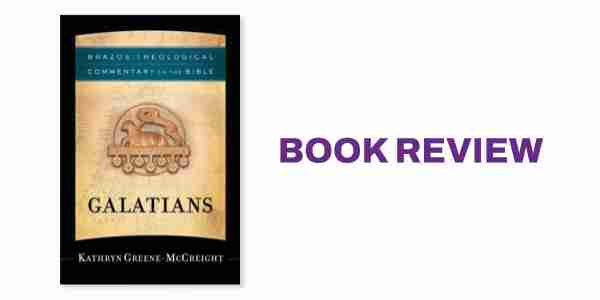

Kathryn Greene-McCreight’s Galatians is a well-organized commentary on Paul’s letter to the Galatians. There is a five-page general introduction. Each chapter has a short introduction, and other turning points are also clearly identified. Chapter and verse references in highlighted bold type indicate chapter subheadings. Most verses have just a short paragraph or two of commentary, while more important verses may extend the commentary to six or eight pages.
The general introduction provides a helpful foundation for some of the unusual facets of Greene-McCreight’s presentation.
- Previous anti-Semitic interpretations prompted her to use the term “Third Party” for the promoters of circumcision.
- Gender issues are important in Galatians, especially regarding circumcision and in the allegory in chapter 4 focusing on mothers.
- Her comments are expressed in scientifically explicit language not often seen in commentaries.
- She several times critiques specific translations for using gender-neutral language that distorts the points Paul is making.
- Two experiences, leading a parish Bible study and attempting a gender-neutral translation, helped the author define the heart of the letter: covenant election in Christ.
The strength of this commentary is in its clear identification of the seriousness of the Galatian problem and in showing the pattern of Paul’s pastoral responses. The problem in Galatia is of a different order than the problems of Paul’s other churches. They have erroneously been drawn away from the “truth of the gospel” (Ch. 1-2). They have been “bewitched” into forgetting the truth of the Spirit they first believed (Ch. 3). Their ignorance of the purpose of the law has brought them back into slavery, slavery to the same elementary principles of the world that had enslaved them to those who are not gods (Ch. 4).
This problem is so severe that Paul cannot see anything to be thankful for. He confronts this erroneous gospel and calls it accursed. This applies to the Third Party, the false teachers in Galatia (Ch. 1) and to Peter’s actions that denied this unity (Ch. 2). “The truth of the gospel” is the unifying factor for the first-century church; there is one gospel, whether Paul is preaching to the Gentiles or Peter is preaching to the Jews. This gospel ideal becomes a “canon” (Ch. 6), the first expression of the “rule of faith” that recognizes the coherence of the gospel and proscribes views outside of its norm.
Paul’s pastoral responses move from amazement at their error (Ch. 1); to challenging their foolish choices (Ch. 3); to reminding them of the love they shared (Ch. 4.) They include teaching on the purpose of the law, on the promise made to Abraham before he was circumcised, and on practical advice for living in the freedom of Christ (Ch. 5-6).
Greene-McCreight’s commentary on Galatians 3:28 begins by comparing the structure with similar Greek and Hebrew triadic statements. She points out that Paul moves the gender-specific statement from the middle to the end, emphasizing its importance. She notes that Paul does not say the three triads “no longer” exist. He uses a “neither/nor” structure for the first two, and a different structure “not male and female” for the third. The “male and female” phrase is from Genesis 1:27. She concludes that our baptismal identity in Christ (Gal. 3:27) is parallel to our creational gendered identity in the image of God before any racial or socio-economic divisions existed.
Greene-McCreight uses “typology” as a method of interpretation, identifying it as “a version of multivalent interpretive strategies,” (122) and she speaks approvingly of the fourfold interpretative method that predominated in the church until the Protestant Reformation (121). It should be noted that this method goes beyond the biblical use of types, the practice of interpreting the Bible by the Bible, and using the “analogy of faith” to express topics not explicitly mentioned in the text.
Her discussion of Galatians 4:4 covers a wide range of topics, and it is not always clear what she is affirming or critiquing. Using Mary as an example, her first paragraph mentions the “tradition of the duplex nativitas, this claim to Christ’s double birth points not to the two natures of Chalcedon but to the one Christ who is born of the Father in eternity and of the womb of Mary in the fulness of time” (p. 101). However, she later seems to affirm Chalcedon: “Jesus’s mother grounds his humanity” (p. 103), then states that “Mary is mother of God” (104) without further discussion of the implications of this title. She clearly affirms the virgin birth (104) but goes on with typological references to John the Baptist, Eve, the tabernacle, and Sarah (104–108), which extend beyond biblically identified typology.
She correctly says that Paul did not reject Gentile circumcision because it is a “gendered” rite that problematizes women’s equality (95). She then asks (but fails to answer) “Why, indeed, is the rite of circumcision given to only half of the population?” Her discussion of female circumcision (which she calls “rare”) is uninformed (96). She does not seem to understand that women do not have any skin that can be removed without causing genital mutilation. A simple Google search would show that the World Health Organization counts 200,000,000 women and girls suffering from female genital mutilation.
Although covenants are mentioned throughout Galatians, the development of “covenant election in Christ” is not fully proven and does not seem to relate to all sections of the epistle.
I would recommend this book with reservations. Because of her use of “typology” as a method of interpretation, this book would not be suitable for anyone without a solid theological foundation for evaluating her methodology. Others might object to her emphasis on the importance of gendered humanity or be discomfited by her explicit language on this topic.