


Years ago, I heard a sermon in which the preacher expounded on the idea of strength. As he spoke, he categorised different strengths according to gender: According to him, men are physically strong whereas women are strong in the way they manipulate others (primarily men). As long ago as it was, I remember the sermon because it seemed so disconnected from reality as I knew it.
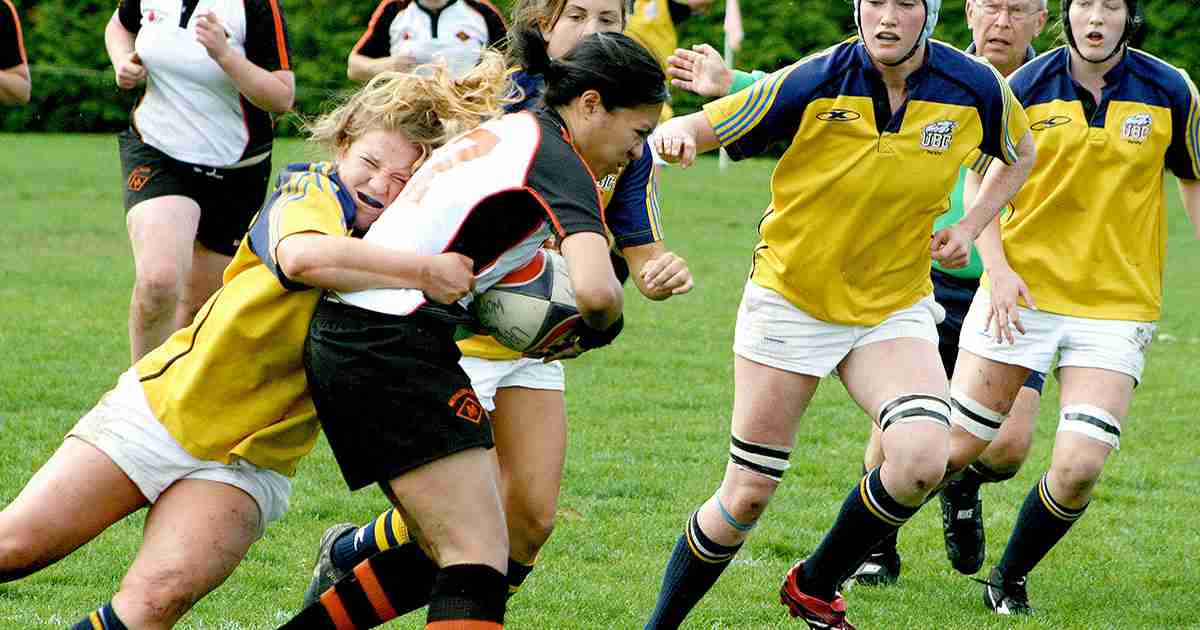
As a young woman, I had both the privilege and pleasure of playing rugby at the club level in Sydney, Australia. It was the late ’90s, and the sport was newly opening up for women to play at competition level.
Playing rugby was an immense pleasure. There was the team camaraderie, the full-body experience of pre-match nerves mixed with the knowledge that there were fourteen other women on the paddock who had my back, as I had theirs, and my self-esteem that grew as my body’s strength grew. To this day, the solidarity in women’s rugby circles remains: There is a sisterhood of former and current players, and we still have each other’s backs.
As women’s club competition was just beginning, there was only one level in the competition. Consequently, beginner players like me were playing alongside and against seasoned athletes: a “baptism of fire” if you will, and a front-row seat to the Lord’s creation of women’s bodies in every shape, size, and strength. I continue to be blown away by the way the rugby culture included every body type and how the game was open to anyone willing to train hard and work as part of the team.
In contrast, my experience in churches has been one of an unquestioned culture that dismisses women’s strength. If my life experience was purely gleaned from church culture, I would be forgiven for thinking that all women looked and acted a certain way, and that way was always expressive of an inherent weakness. From the preacher I mentioned, who believed that only men possess real physical strength, to a popular teacher who openly discourages women from going to the gym,1 the message is that women are always—and should remain—physically weak.
This teaching of women’s weakness seems to be married to a prevailing myth that men are God-ordained to physically protect women. I can count on the fingers of one hand the number of men I’ve met in church who would be willing and able to step onto the rugby pitch with a women’s team, and yet how many Christian men believe that all women need some form of physical protection that only a man can provide? Further, while the possession of physical strength might afford a person a prized position in a rugby team’s forward pack, physical strength is not a prerequisite for inclusion in church community or leadership. Indeed, for Christians, “The parts of the body that people think are the weakest are the most necessary” (1 Cor. 12:22). However, this is not how we see the prevailing view of women’s physical weakness play out in church communities.
Unfortunately, belief in women’s physical weakness is often linked to a belief in women’s spiritual weakness. There is a corresponding leap from the belief in men’s physical strength to a belief in men’s spiritual strength. Supposedly men are not only God-ordained to physically protect women—they are God-ordained to protect women spiritually as well. We believe in the priesthood of all believers,2 we believe that every believer has the same indwelling Holy Spirit,3 and yet we also believe—incongruously—that the Holy Spirit dwelling in women bows to the Holy Spirit dwelling in men.4
Where have these gender exclusive ideas come from? They don’t come from the Bible. Teachings that create hierarchical categories for the sexes bear a greater likeness to pop psychology and Greek philosophy than to the teachings of Scripture. The very popular Christian book Love and Respect by Emerson Eggerichs does just this, framing “love” as something that women “most desire” and “respect” as something that men “desperately need.”5 Women and men are framed as being fundamentally different creatures, rather than fundamentally the same: human beings. In contrast, the Bible teaches that women and men—though not interchangeable—are made from the same material: “Eve was formed from the same substance as Adam.”6 Further, women and men are both created in God’s image and commissioned to steward the earth.7
Contrary to the premise of Love and Respect, the Bible teaches that love is respectful8: for all Christians, love and respect are inseparable.9 We should be wary of teachings that separate love from respect, just as we should be wary of teachings that assign women and men into separate categories, prescribing different treatment as well as different strengths or weaknesses for each category, as if we are not all human. There is no Bible verse that says, “You don’t need to respect this type of person,” just as there is no verse that says, “You don’t need to love that type of person.” Nor is there a Bible verse that says, “Women are weaker than men.”10 So why do these ideas get taught?
Jesus taught his disciples to “love your neighbour as yourself” and to “treat people in the same way that you want them to treat you” (Mark 12:31 and Luke 6:31). How can you love someone as much as yourself if you believe that that person is so different that they don’t need the same type of love (or worse, any love at all)? How can you treat someone the way you want to be treated if you believe that person requires different treatment from yourself? Women and men are made from the same substance—not because they are interchangeable but because they are interdependent, and that interdependence precludes both a hierarchy between the sexes and better or worse treatments for one over the other. As the Apostle Paul wrote: “As woman came from man so also man comes from woman. But everything comes from God” (1 Cor. 11:12 CEB).
The famous writer Dorothy Sayers recounted an exchange she had with a reader in her book titled Are Women Human?:
A man once asked me . . . how I managed in my books to write such natural conversations between men when they were by themselves. . . . ‘I shouldn’t have expected a woman (meaning me) to have been able to make it so convincing.’ I replied that I had coped with this difficult problem by making my men talk, as far as possible, like ordinary human beings. This aspect of the matter seemed to surprise the speaker; he said no more. . . . One of these days, it may quite likely occur to him that women, as well as men, when left to themselves, talk very much like human beings, too.11
It is interesting to me how many Christians seem to have the same outlook as the man in this story. On the one hand, we affirm the teaching of Genesis 1:27 that all humans—male and female—are created in the image of God for shared governance in Eden, and yet on the other hand, we can’t help but want to add (or subtract) from this teaching by creating special hierarchical categories for the sexes. We lose sight of our common humanity every time that we promote Christianity as manifesting in distinctly “blue” and “pink” forms of human beings.
Imagine the strength and community of a church that welcomes all women and men just as they are created: in God’s image, and in a glorious variety of different sizes, strengths, and gifts. All of those strengths and gifts can and should be used for the building up of the entire community.12 Just as a rugby team includes players of different sizes and skills, so the church needs all the different strengths and gifts of women.
Why does the church exclude and/or “bench” some of their best players? To push the analogy further, I ask, why do some churches prefer to run onto the pitch with only half a team? The church “team” is extraordinarily weaker without the strength of women.
Notes
- Dee, “John Piper: the Pharisaical Expert on the Submission of Women,” The Wartburg Watch, November 12, 2018.
- “You yourselves are being built like living stones into a spiritual temple. You are being made into a holy priesthood to offer up spiritual sacrifices that are acceptable to God through Jesus Christ.” 1 Peter 2:5 (Common English Bible, CEB).
- “We were all baptized by one Spirit into one body, whether Jew or Greek, or slave or free, and we all were given one Spirit to drink.” 1 Corinthians 12:13 (CEB).
- “Here’s the thing: My wife doesn’t need me to parent, chide, control, manipulate, exploit, dominate, “lead”, or subdue her. We walk together—side by side. Also, I make my own damn sandwiches and do laundry. The Holy Spirit in her doesn’t bow to the Holy Spirit in me.” Orthodox Barbie, quoting Will Soto’s Twitter, Facebook, September 9, 2023.
- Wray, Sheila Gregoire, “An Open Letter to Focus on the Family about Love & Respect and Emerson Eggerichs,” Bare Marriage, January 15, 2020.
- Kidson, Lyn M., “Created Order is not a Biblical Principle: Eve’s Creation after Adam is not the Basis to Restrict Women in Church Leadership Roles,” Engendered Ideas, June 16, 2023.
- “God created humanity in God’s own image, in the divine image God created them, male and female God created them.” Genesis 1:27 (CEB).
- Kidson, Lyn M., “How to Treat and Archbishop Even if She is a Woman,” Engendered Theology, September 16, 2023.
- “Love is patient, love is kind, it isn’t jealous, it doesn’t brag, it isn’t arrogant, 5 it isn’t rude, it doesn’t seek its own advantage, it isn’t irritable, it doesn’t keep a record of complaints . . .” 1 Corinthians 13:4–5 (CEB).
- Some may argue that 1 Peter 3:7 (“Husbands, likewise, submit by living with your wife in ways that honor her, knowing that she is the weaker partner. Honor her all the more, as she is also a coheir of the gracious care of life. Do this so that your prayers won’t be hindered.” (CEB)) states that women are weaker than men physically and/or spiritually. However, this argument is not rooted in reality: it is demonstrable that some women are physically stronger than some men, just as some women are obviously stronger spiritually than some men. A more realistic interpretation is that the Apostle Peter is talking about social weakness. Women are (and often have been) in a weaker social position than men. Indeed, there is evidence from Greek papyri that women used the adjective “weak” to describe themselves when petitioning for justice. See Mowczko, Marg, “What Does “Weaker Vessel” Mean in 1 Peter 3:7?,” Marg Mowczko, August 12, 2015.
- Nyren, Neil, “Dorothy L. Sayers: A Crime Reader’s Guide to the Classics,” CrimeReads, October 11, 2019.
- “A demonstration of the Spirit is given to each person for the common good.” 1 Corinthians 12:7 (CEB).