

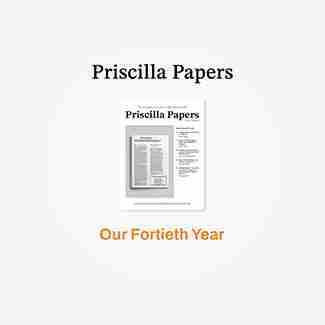
With this issue of Priscilla Papers, the journal begins its fortieth year! The cover photo shows the first issue, from the winter of 1987. Its opening article was, “When Will We Be Real? When Will We Be Free?,” by Kari Torjesen Malcolm.
I wonder if Kari and others from the early days of CBE would be surprised to learn that the first forty years have produced the same number of articles on the tragedies recorded in Judges 19–21 as they have on certain key passages. Priscilla Papers has published six articles each on 1 Corinthians 11, 1 Corinthians 14, Ephesians 5, and yes, Judges 19–21. The immensely important Genesis 3:16 and Galatians 3:28 have similar representation in the online Priscilla Papers index.
I propose that the prominence of the woman of Judges 19 in recent egalitarian scholarship illustrates how all-encompassing biblical gender equality is. Biblical exegesis is often the springboard for egalitarian thought and ethics, but that diving board inevitably propels us toward a pool, a deep and wide reservoir of topics, disciplines, concerns, challenges, opportunities . . . .
I became editor of Priscilla Papers in 2014 (I am now briefly standing in for editor Havilah Dharamraj), and I immediately began to grapple with the fact that egalitarian scholarship is interdisciplinary. I am a biblical scholar, and I rightly expected many exegetical articles to come across my desk. I was struck, however, by the large number of articles from historians. Nearly as many come from sociologists, psychologists, and counselors. Also, from scholars of literature, experts in ministry and missions . . . the list goes on.
Moreover, many articles are themselves interdisciplinary. Indeed, the perspectives on Judges 19 in this issue bring together the ancient and the modern in profound ways.
In the following pages, you will be blessed and challenged by:
- Craig Keener’s “A Negative Model of Manhood in Judges 19” (Spring 1995).
Deirdre Harlow’s “Voices of Outrage against Rape: Textual Evidence from Judges 19” (Winter 2014). - Chuck Pitts’s “Judges 19 as a Paradigm for Understanding and Responding to Human Trafficking” (Autumn 2015).
- Evelyn Sweerts-Vermeulen’s “He Made Her Play the Harlot: Judges 19 through the Lens of Domestic Abuse” (Summer 2021).
- Kimberly Dickson’s “Rape, Dismemberment, and Chaos in Judges 19–21” (Winter 2022).
As you turn to these articles on Judges 19, I leave you with the narrator’s chapter-ending exhortation: “Consider it, take counsel, and speak out.” Or, to quote the NIV, “Just imagine! We must do something! So speak up!”