

Q: What is the doctrine of the Trinity?
A: The Father incomprehensible, the Son incomprehensible, and the whole thing incomprehensible. It’s something put in by theologians to make it more difficult—it’s got nothing to do with daily life and ethics.
—Dorothy L. Sayers, Creed or Chaos?
In response to the reception of her successful Canterbury play, The Zeal of Thy House, Dorothy Sayers (1893–1957) wrote an essay bemoaning the misrepresentation of church orthodoxy. In the essay titled Creed or Chaos, Sayers argued that church doctrine was incomprehensible to the average layperson. While her question and answer are humorous (see quote above), Sayers was adamant that her dramatizations, like The Zeal of Thy House, did not make orthodoxy attractive:
It is the dogma that is the drama—not beautiful phrases, nor comforting sentiments, not vague aspirations to loving-kindness and uplift, nor the promise of something nice after death—but the terrifying assertion that the same God who made the world lived in the world and passed through the grave and death.”1
This statement is just one of Sayers’ rich theological sentiments and may serve as an introduction to an almost forgotten theologian of the twentieth century.
Dorothy L. Sayers is often described as a lay theologian, but the adjective is superfluous.2 If the term “lay” is applied because Sayers did not formally study religion, then the beloved C.S. Lewis (1898–1963) must also be considered a layman despite his enduring theological import. Like Lewis, Sayers also studied languages and literature at Oxford, and both had a way with words. Their prowess with the English language coupled with their unique story-telling abilities made their theology palatable for the common person. Though both went on to become prolific writers, publishing fiction and nonfiction works, Lewis remains at the forefront of Christian imagination while Sayers is lesser known.
Theology is talk about God, more specifically, human conversation about God.3 Sometimes this conversation happens in hefty theological tomes, like the Summa Theologica by Thomas Aquinas (c. 1225–1274), while others expound theology in a more pastoral voice, as in The Book of Pastoral Rule by Gregory the Great (c. 540–604) and Confessions by Augustine (354–430). Art and literature can also narrate theological truth, sometimes with more success than academic debate, and these were the tools that Sayers used so powerfully in twentieth-century England.
An Author of Fiction
After finishing her studies at Oxford, Sayers did translation and advertising work before writing a detective fiction novel titled, Whose Body? (1923).4 The success of the novel led to ten more books in the series, plus several short stories.5 Sayers proved an important contributor to the detective genre and served a term as president of the London Detection Club, a group of writers that boasted G.K. Chesterton (1874–1936) and Agatha Christie (1890–1976) as members.6 While Whose Body? is a far cry from Summa Theologica, the story nonetheless is full of theology. The idea that a popular fiction story can be theological may seem absurd but consider: the fulcrum of detective fiction is sin, the incessant problem of the human condition. The plot of murder is even more common in the genre, and death is a fundamental theological construct that is inextricably linked to several theological doctrines. Salvation, as understood in the Christian faith, is deliverance from the deadly consequences of sin. The Eucharist is a sacramental picture of the death of Jesus, a human death. The hope of heaven is a consolation for human suffering and death.7 More than an entertaining “whodunnit,” Sayers explored theology, especially life and death, in her fiction writing. Looking back at her body of works, she noted the continuity of her theological musing:
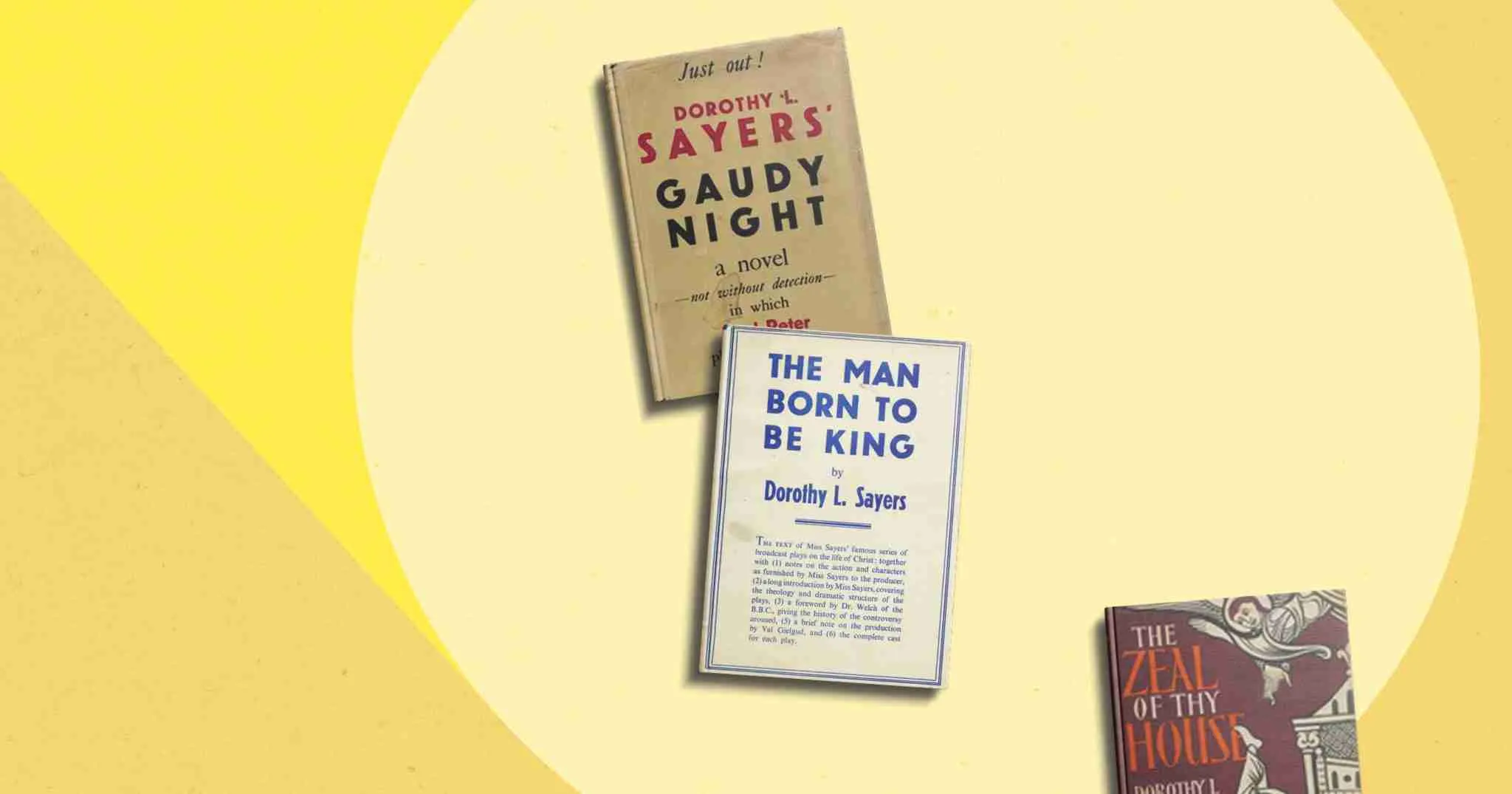
I know it is no accident that Gaudy Night, coming towards the end of a long development in detective fiction, should be a manifestation of precisely the same theme as the play The Zeal of Thy House, which followed it and was the first of a series of creatures embodying a Christian theology. They are variations upon a hymn to the Master Maker; and now after nearly twenty years, I can hear in Whose Body? the notes of that tune sounding unmistakably under the tripping melody of a very different descant; and further back still, I hear it again, in a youthful set of stanzas in Catholic Tales.8
After her success with the detective novels, Sayers was invited to participate in another type of creative writing: playwriting. It is this genre that solidified Sayers as an accomplished theologian. The dean of Canterbury Cathedral was hosting dramatic performances in hopes of reviving church attendance. T.S. Eliot’s Murder in the Cathedral was one of the first performances, followed by Thomas Cranmer of Canterbury by Charles Williams (1886–1945), a friend of Sayers.9 Williams had suggested contacting Sayers for a script which became the play The Zeal of Thy House. The play was so popular that additional trains were added to take passengers from London to Canterbury Cathedral.10 One critic wrote, “Not only is this play sincere and impressive . . . it is good entertainment . . . an essentially serious treatment of theological questions . . . which with rare skill Miss Sayers has made at the same time dramatic.”11 Sayers wrote several more plays after that, but her most notable script was The Man Born to Be King, commissioned by the British Broadcasting Corporation to be read on the air. A close friend and biographer of Sayers, Barbara Reynolds (1914–2015), described the play’s reception:
The nation-wide response to The Man Born to Be King was overwhelming. Appreciative, even rapturous letters poured in from listeners of all ages, of a wide range of professions and callings, from laity and from clergy of all denominations. Thousands are still alive who heard the broadcasts when they were young and whose lives were lastingly affected by them.12
Sayers alternated between writing plays, novels, poetry, and short stories. As her faith became a more integral part of her life, she also began to write theological essays, like Creed or Chaos? (1940), as well as reflections on the state of the church in its cultural moment. Though Sayers did not write extensively about feminism, her essay Are Women Human? (1938) has been transformational for many even to this day.
An Author of Faith
Despite her impact on English Christianity, Sayers had no illusions about herself and was well aware of her flaws. In 1943, the Archbishop of Canterbury wanted to present Sayers with an honorable Doctor of Divinity, but Sayers rejected his invitation. Reynolds notes the Archbishop’s praise, that Sayers’ plays “were one of the most powerful instruments in evangelism which the Church had had put into its hands for a long time past.”13 In her rejection letter, Sayers replied that “a degree in Divinity is not, I suppose, intended as a certificate of sanctity, exactly; but I should feel better about it if I were a more convincing kind of Christian.”14 Sayers set herself to the task of writing and there she stayed.
Though their repertoires had grown to include nonfiction theological treatises, both Sayers and Lewis found fictional story to be an important method for conversing about theology. “Sayers’ observations about the power of story were theologically grounded in her belief that truth and story were perpetually connected since God, the eternal truth, entered into human history in the incarnation of Jesus and that this was the ultimate story.”15
For Sayers, storytelling provided not only the means for theological conversation, but the reach: her theology was for the masses. Rather than academic tomes declaring her personal theology, Sayers wrote fictional stories that invited her readers to enter into a theological conversation. She wrote about the sins of humanity in her detective novels and the victory of Jesus in her evangelistic plays. Through her essays, Sayers desired to galvanize the church to better understand the gospel message. Scholar Crystal L. Downing writes, “When her faith was reenergized in middle age, Sayers did not change much in her desire to shock Christians, still disgusted by the way they had ‘certified’ Jesus to be ‘meek and mild,’ thus turning the ‘Lion of Judah’ into a ‘household pet for pale curates and pious old ladies’.”16
Dorothy Sayers died in her home in 1957 with a more than fifty publications to her name. Spanning several years and genres, Sayers’ work continues to be important today. “As the label evangelical alienates more and more people in our own era, Sayers can guide Christians through cultural minefields, providing direction to those wary of belief and weary of evangelical language.”17 Storytelling can be a refreshing invitation to a theological conversation. To be better theologians, we should become better storytellers.
Notes
- Dorothy L. Sayers, Creed or Chaos (Manchester: Sophia Institute Press, 1949), 19–25.
- Laura K. Simmons, “Theology Made Interesting: Dorothy L. Sayers as a Lay Theologian” (PhD diss., Fuller Theological Seminary, 1999), ProQuest Dissertations & Theses Global.
- Alister McGrath, preface to Theology: The Basic Readings (Malden, MA: Blackwell Publishing, 2008), x.
- Dorothy L. Sayers, Whose Body? (New York: Harper Collins, 1923).
- “About Dorothy L. Sayers,” The Dorothy L. Sayers Society, https://www.sayers.org.uk/.
- “About Dorothy L. Sayers.”
- Alister McGrath, A Brief History of Heaven (Newark: Wiley & Sons, 2003), ProQuest eBook Central.
- “Salute to Mr. G.K. Chesterton: More Father Brown Stories,” The Sunday Times, review, April 7, 1935, in Brown, “The Seven Deadly Sins in the Work of Dorothy Sayers,” 3.
- Charles Williams was a member of the informal literary society, “The Inklings,” which also boasted C.S. Lewis and J.R.R. Tolkien as members. See Grevel Lindop, Charles Williams: The Third Inkling (New York: Oxford University Press, 2015).
- Barbara Reynolds, Dorothy Sayers: Her Life and Soul (Kent: Hodder and Stoughton, 1993), 280.
- “Play Bill at the Theatre,” Illustrated Sporting and Dramatic News, 8 April 1938, 88.
- Reynolds, Dorothy L. Sayers, 327.
- Reynolds, Dorothy L. Sayers, 328–329.
- Reynolds, Dorothy L. Sayers, 329.
- Amy Orr-Ewing, “Truth, Story, and Pattern: Keys to Appreciating the Apologetic Contribution of Dorothy L. Sayers, ” paper presented at the Marion E. Wade Center of Wheaton College, Wheaton, IL, January 23, 2024.
- Crystal L. Downing, Subversive: Christ, Culture, and the Shocking Dorothy L. Sayers (Minneapolis: Broadleaf Books, 2020), 4–5.
- Downing, Subversive, 2.