


English versions of Gen 3:16 present two starkly different translations of God’s first words to the woman in the Garden of Eden. In 1611, the Authorized Version (AV or KJV) was released under King James in England. The translation of Gen 3:16a showed that God promised to take action in two ways, one negative and one positive. The result would be “sorrow and conception.” In 1952, the Revised Standard Version (RSV) was published by the Division of Christian Education of the National Council of the Churches of Christ in the USA. Its translation presented God as taking action not in these two ways but in just one very negative way by inflicting the woman in Eden with “pain in childbearing.”
The KJV rendered Gen 3:16a as follows: “I will greatly multiply thy sorrow and thy conception . . . .”
The RSV replaced the two nouns with a single idea as follows: “I will greatly multiply your pain in childbearing . . . .”
In Gen 3:16a in Hebrew, God tells the woman that action will be taken in two ways. Two nouns are joined by a conjunction. These Hebrew nouns, and the word patterns of which they are part, do not refer to the act of childbearing. God did not punish Eve and her daughters with physical pain related to the last moments of pregnancy. The theological implications of realizing this are important. They affect our understanding of God, woman, man, the world, and relationships. The ways related NT passages are translated and interpreted are profoundly affected as well.
God’s opening Hebrew words in Gen 3:16 can be translated in English as follows: “I will greatly multiply your sorrowful-toil and your conception.”
Here is a transliteration and translation of God’s first four Hebrew words (Gen 3:16a):
Words 1 and 2 | harbah ’arbeh | multiplying, I-will-multiply |
Word 3 | istabonek | your-sorrowful-toil |
Word 4 | weheronek | and-your-conception |
Which translation is more accurate—the KJV or the RSV? What interpretation is correct? Did God take action in two ways, or one? Did God treat the woman in Eden and her daughters in only a negative way that had an impact similar to the serpent and the ground—both cursed by God—or in a measured and very different way?1
The KJV and NKJV present the two Hebrew nouns in Gen 3:16a as two English words depicting two different results, one negative and one positive. The RSV and translations such as the NASB, NLT,2 and ESV present the two Hebrew words as only one very negative result.
The KJV and NKJV present the two Hebrew nouns in Gen 3:16a as two English words depicting two different results, one negative and one positive.
The RSV and similar translations present the two Hebrew words as only one very negative result.
The KJV rendering of Gen 3:16a takes the Hebrew syntax in a straightforward manner. God promised the woman that as a result of his taking action she would experience sorrowful-toil and God promised her that as a result of his taking action that she would certainly experience conception.3
The RSV rendering of Gen 3:16a treats these words as if God acted with only one result occurring. According to this translation, God promised to change her body in such a way that the act of childbearing would henceforth be different.
Many versions (such as NLT and ESV) have misconstrued Gen 3:16a to be talking about childbirth. But such looseness in translation takes unwarranted liberties with the Hebrew text. They have mistakenly presented the first two lines of Gen 3:16 as if God both times was talking about childbirth when actually he did so neither time.
One of the problems in translation and interpretation is that translators have rendered the first four Hebrew words as if they constituted a Hebrew grammatical construction called a hendiadys.4 Such a construction is possible when the grammar and syntax indicate that two words that would normally stand on their own should be read, instead, as one idea. In such an arrangement, the first noun would function as an adjective modifying the second noun (which might yield the dubious rendering, “sorrowful conception”).
However, the first four words in Gen 3:16 are not arranged to indicate a hendiadys. A hendiadys is not required by the syntax or grammar, nor is imposing one necessary to make the meaning clear.5 Furthermore, there are a number of difficulties with translating these words as a hendiadys, including the problem of conflating two distinct and important ideas, one positive idea and one negative, into a single very negative statement. There is also the problem created by changing the meaning of one of the four words, heron (“conception, pregnancy”).
There are significant word patterns in play here that must not be overlooked. These include (1) the pattern of six common elements in God’s first and third speeches, (2) the linchpin constructions in Sections A and A’ of Gen 2–3, and (3) the good news/bad news alternance in God’s words to the woman and God’s words to the man (Gen 3:16, 17–19).
The Parallel Pattern in God’s Speeches to the Serpent and to the Man
Word patterns carry meaning in Hebrew Scripture. In fact, the form conveys content. Six terms are used in the same order in both God’s speeches—the speech to the serpent (vv. 14–15) and the speech to the man (vv. 17–19). These six points stand out like mountain peaks on the skyline of God’s speeches in Eden. Notably, all six are completely missing in God’s words to the woman (v. 16). Yet, remarkably, the presence, and absence, of these peaks and their meaning have been missing in the interpretation of Gen 3.
In the speech to the serpent (3:14–15) the six points are as follows:
- “Because (ki) you . . .”
- “cursed (’arur) is/are”
- Object of the curse (serpent)
- Curse involves “eating”
- Curse duration: “all the days of your life”
- Repeating alliterative verb: shuph . . . shuph
In the speech to the man (3:17–19) the six points are as follows:
- “Because (ki) you . . .”
- “cursed (’arur) is/are”
- Object of the curse (ground)
- Curse involves “eating”
- Curse duration: “all the days of your life”
- Repeated alliterative verb: shub . . . shub
None of these six points used by God in the first and third speeches are present in God’s words to the woman in the second speech. God does not say to her, “Because you . . . .” The word “curse” is not used. No mention is made of “eating” or “all the days of your life,” and there are no repeated alliterative verbs. What is the meaning of their presence in Speeches 1 and 3? What is the meaning of their absence from Speech 2?
Jesus called the one who attacked the man and woman in Eden a liar and a murderer, in John 8:44. In his words at the tree, the serpent enemy both dismissed God’s words and twisted their meaning.6 This enemy in Eden was in full rebellion against the Creator God.
When the man speaks as recorded in Gen 3:12 he dismisses the actions and words of their attacker. He then accuses the woman and God himself of causing him to disobey God’s very words to him in Gen 2:16–17! The man too was in full rebellion against his Lord and Creator.
God noticed the active rebellion of the serpent and the man. He imposed a curse because of each one, “Because you . . . cursed is/are . . . .”
The six mountain peaks are missing in God’s second speech. The rebellion prompting these peaks was not present in the woman’s intent and actions. She did not dissimulate. She pointed out her attacker and confessed in Gen 3:13 that she had been deceived and eaten the fruit of the forbidden tree.7 God immediately confirmed the accuracy of her identification of the serpent enemy as a deceiver in God’s first words of speech number one (v. 14); God refers to what she had just said when he addresses the serpent with the words “Because you have done this.”
More Word Patterns: Chiasm, Linchpin, Mixed News
The account of the Garden of Eden in Gen 2–3 is structured using a literary pattern called a chiasm. A chiasm can be expressed in a convex series of parallel sections, culminating in a high point in the center section.8 The episodes in Gen 2:5–3:24 follow a chiastic structure of seven episodes:
A 2:5–15 God’s creation of the man and placement in Eden
B 2:16–17 God’s command
C 2:18–24 God’s creation of the woman
D 2:25 Harmony in Eden
C’ 3:1–5 The evil serpent-tempter
B’ 3:6–7 Transgression of God’s command
A’ 3:8–24 The results of disobedience and expulsion from Eden
Part I 3:8–13, Interrogation
Part II 3:14–19, God as judge and prophet
Part III 3:20–24, Aftermath and expulsion from Eden
The positive tone of the Garden of Eden passage is communicated in the high point of the chiasm at Gen 2:25, harmony in Eden. God had lovingly created what was very good for the man and the woman. Each was created in God’s image. Each was created from the same material and, as partners, they were to enjoy and rule the Garden of Eden and the whole earth together. The man and the woman each knew God personally and enjoyed fellowship with God and one another (Gen 2:7–8, 22).9
The woman and the man disobeyed God when they ate the fruit of the tree of the knowledge of good and evil, and God’s work of creation that was “good” in Gen 2 became tainted with “evil” in Gen 3. This is highlighted by the structure of God’s words to the woman and the man. There is an alternating pattern of good and bad side by side in God’s words to the woman in v. 16 and God’s words to the man in vv. 17–19 (diagrammed later in this article).
Genesis 3:16a
God’s very first words to the woman, “multiplying I-will-multiply” (harbah ’arbeh), are used in only two other places in the OT—both of them in Genesis—and are associated with exceptionally good news. God told Hagar he would multiply her offspring in Gen 16:10 (harbah ’arbeh zera‘, “multiplying, I will multiply your seed”). The other occurrence is when God blessed Abraham and told him he would multiply his offspring in Gen 22:16–18 (harbah ’arbeh zera‘, “multiplying, I will multiply your seed”) and bless all nations of the earth through Abraham’s seed. In Gen 3:16a, God gives the woman the good news that he will multiply her conception or offspring which (she had just learned in Gen 3:15) included one who would crush the head of her enemy. But the news for the woman in Eden is mixed. This mixed news is communicated in Gen 3:16a by the Hebrew nouns ‘itsabon and heron. She will experience sorrowful-toil (‘itsabon), the bad news. And she will experience conception (heron), the good news.
The Linchpin
A linchpin construction is a linking device. It was described by Isaac Kikawada as the “interlocking crossover point of an introversion or chiasm.” Kikawada noted that this is used in Gen 11:5 at the center of the Tower of Babel account (which is arranged as a chiasm). Kikawada also noted this construction in Gen 2:7–9.10
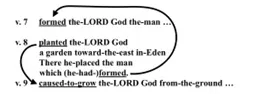
There are two linchpins in the larger passage of Gen 2–3; these are found in Gen 2:7–9 (in the middle of Episode A of the chiasm of the passage) and in Gen 3:15–17 (in the middle of Episode A’ in the passage).11
The linchpin in Gen 3:15–17 links words in a similar manner to the linchpin in Gen 2:7–9. A key word links to an upcoming word and another key word links back to a previous word. The first keyword in Gen 3:16a is ‘itsabon (“sorrowful-toil”) and it links to the exact same word, ‘itsabon, when it occurs again in Gen 3:17. The second key word in Gen 3:16a is heron (“conception” or “pregnancy”). It links back to a similar word, zera‘ (“offspring”), in Gen 3:15.
The bad news of Gen 3:16a is a proleptic prophecy, where the results are announced before the cause is given. She learns she will have sorrowful-toil, anticipating that she will soon learn more about the what and the why of this. When God speaks to the man, she learns more. She and the man will both experience “sorrowful toil” (‘itsabon) in working the soil due to God’s cursing the ground because of the man. God elaborates in detail what this will involve in Gen 3:17–19 where God mentions such elements as thorns and thistles and the sweat of his brow.
This bad news was not about the act of delivering a baby. It is not reserved for a woman at all. According to Gen 5:29, where the only other occurrence of ‘itsabon is found in the OT and the meaning is clearly and explicitly explained, the parents of Noah knew about ‘itsabon, which was the sorrowful toil they experienced from working the ground God had cursed. Genesis 5:29 says: “And he called his name Noah, saying, ‘This [one] shall comfort us concerning our work and toil (‘itsabon) of our hands, because of the ground which the LORD has cursed’” (author’s translation).
Additionally, note that the author of Gen 2–3 makes a pun on the word ‘ets (“tree”). The woman and man, who had both eaten of the ‘ets, will now experience ‘itsabon (“sorrowful toil”) in working the ground which God will curse.
The second keyword in Gen 3:16a is a positive one. Following the opening words, harbah ’arbeh, the word zera‘, “offspring,” would be expected next (as in its other occurrences, Gen 16:10; 22:16–18, noted above). The related Hebrew word heron takes its place. In the linchpin, heron links back to zera‘ in Gen 3:15. The good news of Gen 3:16a, as mentioned, points back to the coming Savior who would crush the serpent enemy (Gen 3:15). This first announcement of the Good News is begun in God’s words to the serpent enemy in Gen 3:15 and is completed with God’s confirmation to the woman of her offspring in Gen 3:16a.
The full linchpin of Gen 3:15–17 can be diagrammed as follows, with the two linking words: sorrowful-toil and conception.
3:15 I will put enmity . . . between your offspring and her offspring (zera‘)
3:16 I will greatly multiply your sorrowful-toil and your conception (heron)
3:17 Cursed is the ground . . . in sorrowful-toil (‘itsabon) you shall eat of it . . .
Genesis 3:16b
While God took action in two ways in Gen 3:16a, in the remaining lines of the verse, God took no further action. God did not say “I will [verb] . . .” in lines b, c, or d of Gen 3:16. Rather, in lines b, c, and d, God goes on to describe to the woman what life will be like in the world that now contains sin. Sadly, the world now is a mixture of good and evil.
God had mixed news for the woman in Gen 3:16b, c, and d. In line b of Gen 3:16, God explained to the woman what life would now be like. It was an announcement of bad news and good news. The bad news was that she would experience psychological sorrow or grief. The good news was that she would have multiple children.
In 3:16b, God explains to the woman that it would be with psychological sorrow (‘etseb) that she would be the mother (teldi) of children (banim). Her children would grow up in a world of good and evil. Sorrow was experienced all too soon in regard to her children when her first child Cain uttered rebellious and defiant words to God and murdered her second child Abel. Her heartache continued as the unrighteous line of Cain committed yet more evil acts.12 There is no mention of pain in childbirth in the words of Gen 3:16b, although modern translations regularly mention pain, rather than sorrow, in 3:16b.
The second Hebrew word in Gen 3:16b, “you-will-bring-forth” or teldi, is a form of the infinitive verb yalad. The third Hebrew word is “children,” banim. This is good news. It is about being a parent and raising children. It is noteworthy that this verb yalad is used elsewhere in regard to men. The same word is used in Gen 4:18 where it is translated in the KJV as “begat.” In that verse, four generations of men begat sons.13 It is clear that men can father (yalad) children, just as the woman could mother children. This word need not refer to the act of childbirth.
Good News / Bad News
There is a “good news/bad news” pattern in the Hebrew text of Gen 3:16a–b: The two who ate of the tree of the knowledge of good and evil now will experience a mix of both good and evil in their lives. God’s opening words in Gen 3:16, harbah ’arbeh (“Multiplying, I will multiply . . .”), are a positive message. (It was noted that in the two other occurrences of harbah ’arbeh in the OT, Gen 16:10; 22:16–18, this expression is clearly positive, is completed by the word zera‘, “seed, offspring,” and to Abraham is associated with blessing.) But because of the woman’s sin she receives mixed news. The bad news is that she will experience multiplied ‘itsabon, “sorrowful toil,” from working the ground which God will curse. The good news she then receives is that she will experience multiplied heron, “pregnancy, conception.” To experience ‘etseb, “sorrow,” will be bad; teldi banim, “to bring forth children,” will be good.
This good and bad news pattern can be written in the form of a chiasm of Gen 3:16a–b, as shown in the following lines:
Genesis 3:16 to the Woman
A harbah ’arbeh, multiplying, I-will-multiply [good]
B ‘istəbonek, your-sorrowful-toil [bad]
C wəheronek, and-your-conception [good]
B’ bə‘etseb, with-sorrow [bad]
A’ teldi banim, you-will-bring-forth children [good]
In God’s words to the man (Gen 3:17–19), there is also a “bad news/good news” pattern in the Hebrew text, as shown in the following lines. God announces and explains bad and good news, juxtaposed in a chiasm, that uses more bad and good words side by side than in the previous speech. God doubles down in his words to the man.
Genesis 3:17–19 to the Man
A ’arurah ha’adamah, cursed [is] the-ground [bad/good]
B bə‘istəbon to’kalnah, in-sorrowful-toil you-will-eat-of-it [bad/good]
C wəqots wədardar wə’akalta, thorns and-thistles . . . and-you-will-eat [bad/good]
B’ bəze‘at . . . to’kal, by-sweat . . . you-will-eat [bad/good]
A’ shubka ’el-ha’adamah, you-return to-the-ground [bad/good]
Genesis 3:16c–d
A literal translation of the four final Hebrew words in lines c and d of Gen 3:16 is:
3:16c: “Your-desire (is) for-your-man,
3:16d: but-he will-rule-over-you.”
In Gen 3:16c and d, God gave the woman additional mixed news. Translators of the ESV, NLT, and other versions, however, translate these lines as if God only provided bad news for the woman.
The good news for the woman in Gen 3:16c was that God looked into her heart and saw she still had affection or “desire” for her husband. The Hebrew word for “desire,” teshuqah, occurs two other times in the OT. Solomon was described as desiring his lover in Song of Solomon 7:10. The other time, it was used was in a nonsexual way in the story of Cain and Abel in Gen 4. There is no reason to assume there are any negative connotations to the word “desire” itself.14
The bad news in Gen 3:16d is God’s warning to the woman about the rebellious man. God knows the man’s heart. The man had rejected God and had chosen to take things into his own hands. He chose to reject God’s rulership in his life and furthermore to usurp God’s place by attempting to rule over the woman. Instead of a co-rulership (the verb radah in Gen 1:28) with the woman over God’s creation, which God decreed in Gen 1:26–28, the man would sinfully re-order things after his own design by ruling over (the verb mashal) her.15
Several versions mistranslate lines c and d, infusing their own interpretation (ESV, NLT, etc.). They make the woman out as the rebellious one. They make it appear that God is placing the man as ruler over the woman, when in fact, God is not speaking to the man in this verse and says nothing like this in the verses that follow.
Conclusion
For Gen 3:16a, the KJV and related versions, and the RSV and similar versions, present two very different translations of God’s first words to the woman in the Garden of Eden. Which is more faithful to the Hebrew word meanings and the word patterns of Gen 3:16 in context?
Of the two renderings of Gen 3:16a, the KJV is the more accurate rendering of the Hebrew. The RSV and others like it mistranslate the verse, misrepresenting the meaning. God does not promise, as the RSV suggests, a single negative action for the woman, the imposition of multiplied pain in childbirth. Instead, God promises to take action on two fronts; one is positive and related to the good news God promised of a coming Deliverer when God spoke to the enemy serpent; one is negative and related to the curse on the ground that God is about to impose because of the man. God’s two actions in Gen 3:16a—one positive and one negative—are not to be mixed, confused, or conflated.
The KJV delivers this double message more faithfully. Other translations are encouraged to “true” the verse—that is, to update their versions to correspond to the meaning and intent of the passage. In a faithful translation, the bad news needs to be made clear—that ‘itsabon, sorrowful-toil, will occur while working to wrest food from the ground which God will curse due to the man’s rebellion. This is not about childbirth. The same English word (or words) for the Hebrew ‘itsabon needs to be used in both Gen 3:16a and Gen 3:17 to help the reader understand that in both places the same thing is meant. The good news also needs to stand out and be made clear—that she would have multiplied offspring (Gen 3:16a) including the coming Deliverer (zera‘, “seed”) who would crush the serpent’s head (Gen 3:15).
Regarding Gen 3:16b, again, God is not talking about childbirth. God is explaining that although the woman will bring forth multiple offspring, she would experience sorrow and grief in a world mixed with both sin and righteousness (which is seen soon after in the graphic example of the evil actions of Cain and the righteousness of Abel).
As for Gen 3:16c–d, God alerted the woman to a topsy turvy disruption in her relationship with the man. She still had affection for her husband but his intentions had changed. Whereas God’s intention was for the woman and man to be co-regents of God’s beautiful world, she needed to beware that the man, who rebelliously rejected God, would attempt to take the place of God in her life (as he had done in his own life) and further subject her to himself, ruling over her. God warned the woman that the rebellious man had sided with the serpent and had rejected both God and the woman in their rightful places.
Notes
- Scholarly theological positions and popular opinion are both affected. Some believe that pain in childbirth is God’s curse on woman, equal in import to God’s curse on the serpent. Woman, therefore, is considered suspect as the temptress and is restricted in the home, in the church, and in society. https://tru316.com/the-bitter-fruit-of-false-teaching-on-eden/.
- NLT here refers to the 1996, 2004, and 2015 editions; a revision is currently underway.
- Joy Fleming, A Rhetorical Analysis of Genesis 2–3 with Implications for a Theology of Man and Woman (PhD diss., Université de Strasbourg, France, 1987) 261–62.
- “This is a method whereby two formally co-ordinate terms—verbs, nouns, or adjectives—joined by ‘and’ express a single concept in which one of the components defines the other.” E. A. Speiser, Genesis, AB (Doubleday, 1964) lxx.
- Robert R. Wilson, personal interview at Yale Divinity School, New Haven, CT (Dec 1983). See Umberto Cassuto, A Commentary on the Book of Genesis (Magnes, 1978) 165; Carol L. Meyers, “Gender Roles and Genesis 3:16 Revisited,” in The Word of the Lord Shall Go Forth (Eisenbrauns, 1988) 344.
- In Gen 2:16–17, “God’s first line had been positive, stating that they could eat from any of the trees of the Garden. His second line had been a prohibition, identifying one tree only from which they could not eat. The third line had explained the consequence of death. The serpent smoothly slides the negation (‘not’) from line 2 to line 1, thereby standing God’s command on its head.” Joy Fleming, Man and Woman in Biblical Unity: Theology from Genesis 2–3 (WestBow, 2013) 18.
- Two times in the NT it is confirmed that she was deceived: 2 Cor 11:3; 1 Tim 2:14.
- Chiasms are found throughout the Bible in varying lengths. For example, commentators have noted the detailed chiastic arrangement of the Flood Narrative in Gen 6:10–9:19. The center section of the chiasm is the turning point of the story: Gen 8:1, “And God remembered Noah . . . .” Bernhard W. Anderson, “From Analysis to Synthesis: The Interpretation of Genesis 1–11,” JBL 97/1 (1978) 38. Gordon J. Wenham, “The Coherence of the Flood Narrative,” VT 18 (1978) 336–48. Isaac Kikawada and Arthur Quinn, Before Abraham Was (Abingdon, 1985) 104.
- Some who center on later verses in Gen 2–3 focus on the wrongs of those who were involved at the tree of the knowledge of good and evil. Jerome Walsh, for example, places the center of the passage at 3:7; Walsh, Style and Structure in Biblical Hebrew Narrative (Liturgical, 2001).
- Isaac Kikawada, “The Shape of Genesis 11:1–9” in Rhetorical Criticism: Essays in Honor of James Muilenburg, ed. Jared J. Jackson and Martin Kessler (Pickwick, 1974) 24.
- In the linchpin of Episode A of Gen 2–3, Kikawada pointed out that in Gen 2:8, “the initial word of the verse points down to the following verse, especially to the first word [“planted” and “caused-to-grow”], while the last word points back to the preceding verse, especially to the first word” [“formed and “formed”]. Hyphenated words indicate one word in Hebrew. Kikawada, “Shape of Genesis 11:1–9,” 24.

- Gen 4:3–24.
- In Gen 4:18, the NKJV translates yalad as “begot”: “To Enoch was born (yalad) Irad, and Irad begot (yalad) Mehujael, and Mehujael begot (yalad) Methushael, and Methushael begot (yalad) Lamach.” It is clear that men can father (yalad) children.
- A proponent of the view that “desire” was negative was Susan T. Foh, “What is the Woman’s Desire?” WTJ 37 (1975) 381–82. Foh’s view has been sharply criticized for promoting abuse within the home and within the church.
- See the author’s description of the two parties in Gen 3:16c–d, whose relationship is not reciprocal. Fleming, Man and Woman, 31–33.