

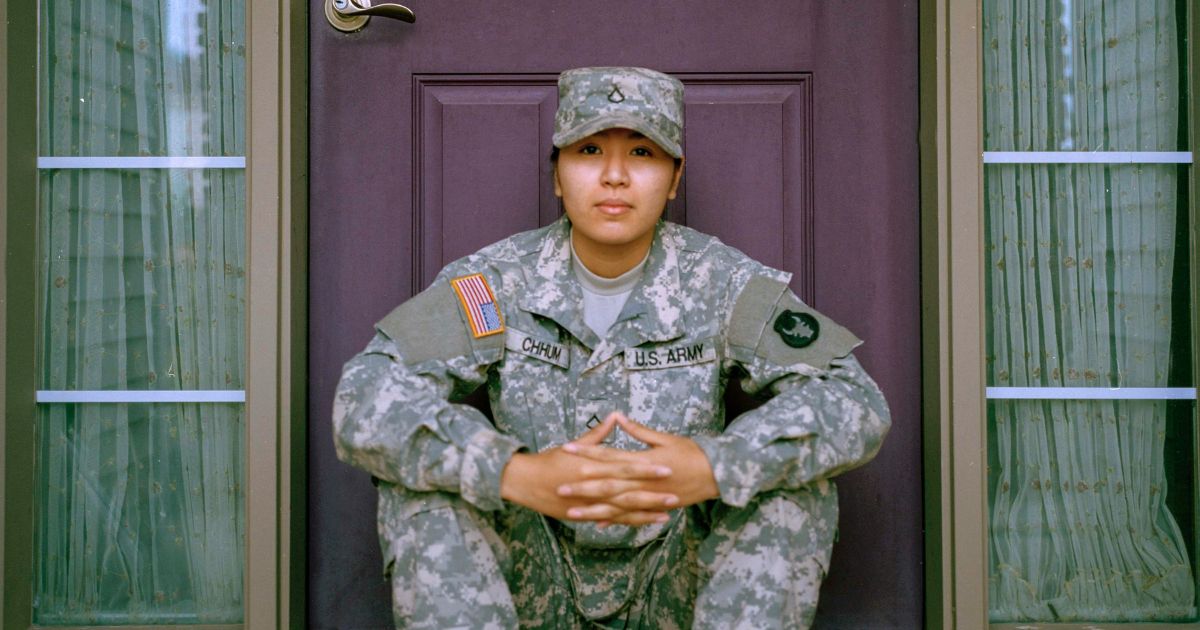

The chapel smelled like burnt coffee and old paper, a blend of comfort and memory that clung to the air. Outside, the relentless San Antonio sun beat down. Inside, I sat stiffly in the back row, my dress pressed, and my spirit weary. Worship music poured from the speakers, a voice sweet as honey slipping into the cracks of my soul. Still, I did not sing. To the left, a young mom clapped off beat, head tilted back in praise. To the right, a chaplain’s wife scribbled notes in a worn-out notebook balanced on a Bible whose pages were marked with color and conviction. In that moment, I felt almost invisible, like a smudge on a lens.
Too much.
Not enough.
Disjointed.
That feeling has followed me for nearly thirteen years as an Army spouse, through chapel doors across the country and into countless ministry spaces that rarely looked the same twice. Each move brought a new sanctuary, new traditions, and new expectations. Some wrapped me in warmth. Others held me at a cool distance. One praised my drive and dedication, while avoiding the word “leadership.” Another questioned my theology because I asked to speak before the group. One group saw me as too disciplined, and another as not military enough.
Each space held up a different funhouse mirror: distorted, fragmented, and never quite whole.
Shared Work, Singular Praise
And yet, again and again, I kept serving in both chapel and parachurch organizations. Sometimes that service was visible. Sometimes it was quietly essential. Often it was both at once.
In a chapel hallway after a long day of service, a church elder smiled at both my husband and me as he said, “You’ve done such a great job.” He was speaking to both of us, but the words were for my husband. This was despite the fact that I had coordinated volunteers, built the curriculum, fielded questions, and sat with anxious spouses after class. I stood there, invisible in plain sight, the familiar ache settling into my chest.
It was not the first time shared work had been translated into singular recognition.
Years earlier, our ministry had taken shape, not in a sanctuary, but in our garage. Before we were married, my husband had a true obsession with functional fitness. I joined him, earning certifications and experience. After we married, it was my decision to turn our garage gym into a ministry, a place where we could share our expertise as coaches with others while sharing the love of Jesus in an organic way.
What began as a hobby became fourteen classes a week run out of our home for free. Six of those were women-only classes. Infants were held while we did step-ups. Breaks were taken not for water, but so a toddler could make it to the potty in time. Strength training and discipleship unfolded side by side on concrete floors, shaped by bodies, schedules, exhaustion, laughter, and trust. And yet, when people spoke about that ministry, it was almost always framed as my husband’s. Even when leadership was visibly shared and deeply mutual, authority was assumed to belong more naturally to him.
When Practice Becomes Theology
Over time, I began to notice that this pattern extended far beyond our garage. In San Diego, we attended a home church sponsored by a parachurch organization dedicated to reaching military communities. Each week, families gathered in a different living room to worship and hear the Word together. Each week, when a baby fussed or a child needed something, it was the women who were expected to leave the room. The men stayed. The sermon continued. No one ever said this was policy, but it was practice. And practice, repeated often enough, becomes theology. This same community encouraged the men to memorize Scripture, prepare their one-minute testimonies, and share what they were learning with the body as a whole. The women, meanwhile, were expected to bring the food and clean up after.
The men were formed for voice. The women were formed for service.
Over time, I realized this was not simply about roles. It was about access to spiritual formation itself: who gets to sit under teaching uninterrupted, who is trained to speak, and who is assumed to carry the Word forward.
In military chapel communities and parachurch organizations alike, affirmation often comes in ways that subtly reinforce hierarchy rather than honor shared labor. When praise consistently bypasses the woman who leads to land on the man standing nearby, it reveals more than social awkwardness. It exposes an unspoken theology about who should lead, who is presumed to carry authority, and whose submission is expected before it is ever discussed.
This is not overt hostility.
It is something quieter and more dangerous because it is dressed as respect.
The Quiet Architecture of Weaponized Submission
I encountered this most clearly the first time I asked to lead a Sunday school class in the chapel. The chaplain pulled me aside gently and said, “We will need your husband in the room. Some of the older crowd think… differently.” The word carried decades of inherited assumptions. It was not about accountability or shared leadership. It was about legitimacy. I could teach Scripture, but only if my husband stood beside me as my cover.
In that moment, submission was not mutual. It flowed in one direction only.
My presence required permission. His did not.
So began my slow realization that that kind of “submission” has little to do with Christ and much to do with comfort. This is the quiet architecture of weaponized submission, not loud decrees or public rebuke, but policies shaped by unspoken fears and cultural habits rather than biblical witness. It is especially powerful in military chapel culture, where rank, authority, and order are already woven deeply into daily life. When hierarchical instincts from military systems bleed uncritically into ecclesial life, submission becomes something women perform so that men can be perceived as leading, even when leadership is already shared or solely on the woman’s shoulders.
Yet Scripture does not frame submission as a gendered performance.
What Scripture Actually Calls Us To
Paul’s call in Ephesians begins not with wives or husbands, but with the entire community: “submitting to one another in the fear of Christ” (Eph. 5:21, CSB). Mutual submission is not an exception for women. It is the starting posture for everyone. Jesus models authority not through domination but through service. He kneels. He washes feet. He refuses the kind of power that demands visibility and applause. He redefines leadership as self-giving rather than self-preserving (Mark 10:42–45, CSB). When submission becomes a tool to restrict who may lead, teach, or speak, it no longer reflects Christ.
It reflects anxiety about control.
Still, I wrestled. I remember the first time someone told me I had the gift of leadership. My pulse quickened. The words tasted like citrus, bright and unexpected. Then came the self-doubt. Could I truly belong in the Body when the Church could not agree on where I fit?
Too many assumed they already knew my place. “Oh, you homeschool? You would be perfect in children’s ministry!” But that is not my calling. Just because I shepherd my children does not mean my gifts are meant for the nursery on Sunday mornings.
The biblical vision of leadership is not gender-based.
It is gift-based.
It recognizes wisdom where it appears and honors the Spirit’s distribution of gifts without regard for cultural convenience (1 Cor. 12:4–7, CSB). Yet in practice, many church spaces, especially in military contexts shaped by rigid authority structures, confuse order with faithfulness and hierarchy with holiness. Mutual leadership often feels threatening in environments accustomed to clear lines of authority. When women lead alongside men rather than beneath them, the instinct is often to correct the image by adding a male figure, shifting the language, or reassigning visibility.
I have seen women in the Christian military community asked to soften their voices, redirect questions to their husbands, or frame their ideas as supportive rather than directive, even when they were the subject matter experts in the room.
The irony is painful.
The Cost of Conditional Leadership
In a culture that celebrates teamwork and joint mission in nearly every other domain of military life, mutual leadership in the church is often treated as radical. The cost is not abstract. When women are only permitted to lead under male supervision, their authority is perpetually provisional.
They are never simply leaders. They are allowed.
This shapes how girls see themselves in the church and teaches them that their gifts are negotiable, contingent on male presence. It teaches boys that leadership is inherent to their gender rather than cultivated through character and calling. It also distorts men’s discipleship. When men are positioned as necessary legitimizers rather than co-servants, they are burdened with a role Scripture never assigns them: gatekeepers of the Spirit’s work in others.
Mutual submission liberates both.
It allows women to lead without apology and men to follow without fear.
Toward Faithful Mutuality
So what might submission look like if we practiced it faithfully in military chapel and parachurch culture? It might look like chaplains asking not “Who should lead?” but “Whom has God gifted for this work?” It might look like teams where authority shifts according to calling, expertise, and context rather than gender. It might look like praise distributed accurately, visibly honoring the labor of all who serve. It might look like godly men joyfully supporting without needing to occupy the center.
It might look like submission not as silence, but as attentiveness, not as erasure, but as recognition.
If submission has been used to quiet you, limit you, or keep you small, you are not imagining the harm. You are not rebellious for naming it. And you are not unbiblical for seeking something closer to the teachings of the Messiah. Jesus never demanded submission to preserve unjust systems. He confronted them. He exposed them. He overturned tables when necessary.
Submission in Christ is never about protecting hierarchy. It is about being the hands and feet of Christ in the way that the Holy Spirit has gifted you to.
Military chapel communities are uniquely positioned to model this kind of mutual leadership. In spaces already defined by diversity, sacrifice, and shared mission, the church has an opportunity to bear witness to a different kind of authority, one that does not cling to control but trusts the Spirit’s work in every believer. And maybe one day, when someone says, “You’ve done such a great job,” they will mean it exactly as they say it. To all who have served together.
Perhaps the first faithful step is simply this: to begin noticing whose voices are centered, whose labor is named, and whose gifts are trusted in our own communities.
Photo by Jessica Radanavong on Unsplash.
Related Resources
War on Women: Roman Misogyny for Military Aim
Challenging Lines in the Sand: Women Are Also Called to Protect and Provide