

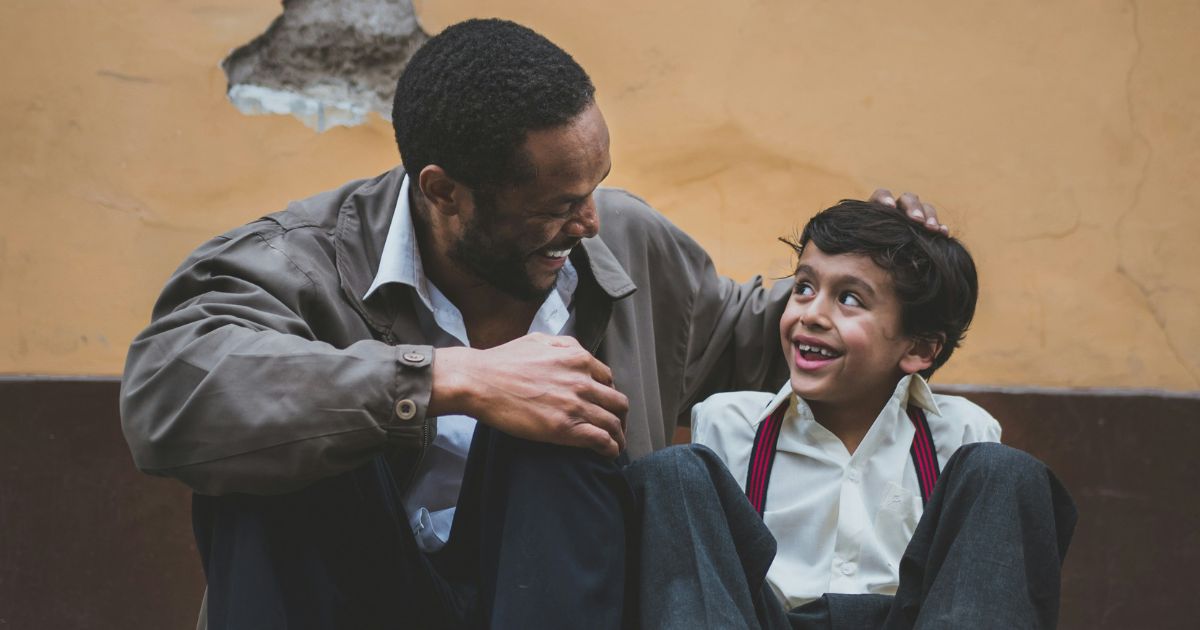

“It’s better to build boys than mend broken men.”
– S. Truett Cathy, Founder, Chick-fil-A
Introduction: The Problem with Toxic Masculinity
Early one Saturday morning, my ten-year-old son decided to make cinnamon toast for the family. As he cooked, the hot pan slipped and all his hard work scattered across the floor. He sank to his knees, brought his hands to his face, and sobbed. His little brother rushed to the rescue, gently patted his back, and whispered, “I’m so sorry this happened.” From the kitchen doorway, I caught a glimpse of two little boys—sensitive, kind, and heartbroken.
I always imagined I’d have a daughter and dreamed of how I’d teach her to find her voice and stand strong in the world. Instead, in one of life’s great ironies, I became the mother to four roughhousing, adrenaline-chasing, creative, and justice-minded boys.
Having spent much of my career working among sexually exploited women,1 I’ve seen layers of abuse compound and drive women into deeper harm—harm most often inflicted by men. In Latin America, violence against women is not only common but expected. Bolivia, where we live, reports some of the highest rates of gender-based violence and femicide in the region.2 So how do I reconcile my world at home with the world at large?
I decided to adjust my focus, determined to serve vulnerable women by raising a different kind of man.
Like many young men, my sons are hungry—sometimes literally, often figuratively. Hungry to prove themselves. Hungry for direction. Hungry to understand who they are becoming and who they’re meant to be. I believe they have the power to shape the reality they’ve grown up in—to help build a world where both women and men are safe, honored, and able to flourish.
But the messaging boys receive today is relentless. I was shocked to hear one son pipe up at dinner, “Andrew Tate has some good things to say.” Tate, a self-described misogynist currently charged with human trafficking, rape, and organized crime3 boasts,
I have everything every man has ever dreamed of . . . a big mansion . . . super cars . . . unlimited women . . . I do anything I want all the time. So, I’m an amazing role model.4
And if men like Tate flaunt and influence with bravado, pornography reinforces the ideas visually. Research shows that porn has become one of the primary sex educators for young people, training them—often before they’re teenagers. Porn teaches masculinity through dominance, entitlement, and the idea that women exist for male pleasure.5 Media and porn bombard boys with images of conquest and control, quietly shaping their understanding of intimacy, gender, and power.
The good life, the world tells them, is based on what you own, control, and consume.
In the church, some teachings—though well-intended—echo similar patterns. Christian men are told they hold God-given authority to lead, protect, and provide. Simply by virtue of being male, men hold the high calling of “priest, prophet, and king” of their household.6 Much of the current messaging also leans militaristic, with men as warriors—tough, controlled, and decisive—fighting evil and temptation with strength and confident leadership.7
My sons once sat through a sermon where Jesus was praised for overthrowing tables in the temple,8 wielding a whip and acting as “A man’s man. Not weak. Not wimpy.” The pastor concluded, “If you’ve got boys, raise them to be men—warriors like Jesus. Teach them to defend what’s right—lift weights, buy them boots—let them be a man!”
Meanwhile, my work supports single mothers who shoulder the full weight of their families’ survival—women abandoned or harmed by the very men called to lead and protect. I see daily what distorted masculinity destroys, and I appreciate the desire to call young men to maturity and fuller responsibility. But the version often handed to them is still top-down and privileged.9 We need a more balanced biblical vision of what it means to be a man.
Tucked into a small book of the Old Testament, we find a surprising alternative. In the book of Ruth, Boaz offers a quiet, counter-narrative to today’s imbalanced view of masculinity. Moving from the self-serving brutality of Judges to Boaz’s covenantal, protective strength,10 this essay proposes a fuller biblical model of masculinity—one that uses influence, strength, and power to honor, respect, and uplift the most vulnerable.
Boaz restores, heals, and redeems, just as our boys have the capacity to do.
Context: Moral Decay and Devastation
Boaz enters the biblical story during one of Israel’s darkest seasons—“in the days when the judges ruled,”11 and “everyone did what was right in their own eyes.”12 It was a time of moral chaos, social unrest, and extreme violence, especially against women.13 In the midst of national instability, famine strikes Bethlehem, forcing an Israelite family to seek refuge in Moab.14 Their attempts at survival collapse into tragedy, and Elimelech, the family patriarch, dies.15 Within a decade, both sons follow, leaving Naomi and her Moabite daughters-in-law widowed and desolate.16
Naomi urges the young women to return to their families, with the hopes that at least they could find “security in the house of a husband.”17 But Ruth refuses to abandon Naomi to face old age and destitution alone. She clings to her mother-in-law with an impassioned covenantal vow—“Your people shall be my people, and your God my God.”18 United in grief and extending sacrificial love, Ruth binds herself to a new identity, a new land, and a new God, despite the risks and the stigma she’ll bear.”19
With the weight of famine, exile, and bereavement—compounded losses she names as bitterness itself—Naomi returns to Bethlehem.20 Arriving at the start of the barley harvest, Ruth sets to work immediately securing food by gleaning behind the reapers,21 providentially, in the field of a man named Boaz.
Influence: Authority Earned
Boaz is introduced as “man of standing,” a prominent and respected landowner within his community.22 He greets his field workers with a blessing and receives their goodwill in return; mutual respect seems to undergird his home. When he notices Ruth, an outsider on the margins, he inquires of her.23 Rather than judge, dismiss, or even exploit her, Boaz responds to her story with overwhelming generosity.24 Ruth returns home that night with an abundance of grain, far more than a typical gleaner could gather, a clear sign of Boaz’s intentional kindness.
Here we see an upright man whose influence flows from a deep well of character—evident in how he treats others, stewards his resources, and upholds justice. He models a quiet strength grounded in humility, attentiveness, and the steady discipline of right living. His standing in the community is simply the public recognition of a life already marked by honor.
Strength: Counter-cultural Courageousness
Rather than the rough-and-tough messaging aimed at men today, Boaz’s strength emerges not in flashy displays of power but in countercultural gentleness and decisive courage. For example, as a faithful Israelite man, he had been trained to guard his boundaries and to avoid the “foreign woman.”25 Yet when he encounters Ruth in his territory, he doesn’t treat her as a threat. Instead, he welcomes her, offers her water,26 invites her into his fields, and addresses her tenderly as “my daughter.”27 Boaz’s fortitude is not found by hiding behind the safety of the law, but by courageously extending covenantal care to fulfill it.28 Later, he refers to Ruth as a “woman of valor,”29 the very title the wisdom literature reserves for the ideal woman.30
Boaz’s restraint comes into sharpest focus on the threshing floor, for which Naomi has devised a plan:
Now here is our kinsman Boaz,31 with whose young women you have been working. See, he is winnowing barley tonight at the threshing floor. Now wash and anoint yourself and put on your best clothes and go down to the threshing floor, but do not make yourself known to the man until he has finished eating and drinking. When he lies down, observe the place where he lies; then go and uncover his feet and lie down, and he will tell you what to do. She said to her, “All that you say I will do.”
So she went down to the threshing floor and did just as her mother-in-law had instructed her. When Boaz had eaten and drunk and was in a contented mood, he went to lie down at the end of the heap of grain. Then she came stealthily and uncovered his feet and lay down.32
Taking into account the sexual climate highlighted in Judges, this threshing floor scene is charged with risk; here, his power and her vulnerability are most exposed. In a situation ripe for misunderstanding or sexual advantage, Boaz instead shows virtuous restraint and protection.33
But perhaps Boaz as a responder is even more striking and culturally risqué. As Ruth boldly seeks to secure protection and a future, she initiates a marriage proposal, invoking his role as kinsman-redeemer. Surprisingly, in this strongly patriarchal society, Boaz seems neither offended nor imposed upon by her initiative. He simply listens, blesses, and commits to her request.34 Here, the script for strength is redefined—not as dominance or assertion, but restraint, receptivity, and the willingness to reconsider prevailing social norms.
Power: Responsible Stewardship
Finally, we see how Boaz uses his privilege to prioritize justice and enable the flourishing of the vulnerable. As a landowner, he sets up protective boundaries that extend beyond personal kindness. Boaz orders his men not to touch Ruth, welcomes her among his own workers, and grants her access to water reserved for hired hands. In a setting where a foreign, widowed woman was highly vulnerable, he protects her from male aggression and makes sure she can glean safely and publicly.35 He also uses his power to create belonging where privilege often reinforces exclusion. His public sharing of food and water36—symbols typically reserved for insiders—welcomes Ruth the Moabite into Israel’s covenant community with dignity.37
Boaz also honors women’s agency in tangible ways. He listens first—inquiring about Ruth’s story rather than judging her—and responds to the initiatives led by Naomi and Ruth without pulling rank or seizing control. Instead, he cooperates with their redemptive plan and affirms Ruth as a “woman of noble character.”38 His power dignifies rather than dominates, standing in sharp contrast to the distorted masculinity of Judges 19, where male authority destroys instead of heals.
And finally, Boaz’s redemptive power is clearest at the city gate, the place of public accountability. When the time comes to resolve the widow’s situation, he gathers the elders and family witnesses.39 He offers the closer kinsmen the first right to Elimelech’s land, and when that man declines, Boaz steps in, purchases the land, and marries Ruth, securing the women’s future and restoring Naomi’s family line. His leadership restores lineage, security, and hope. Unlike the destructive power in Judges, where men use authority to harm and abandon, Boaz models redemptive authority: his power is not leveraged for status but surrendered for the sake of others.
Boaz’s faithfulness does more than heal one family; it points forward to a greater Redeemer whose costly obedience will bring restoration to the whole world. We have hope because Boaz was faithful—and even more, because his faithfulness foreshadows the perfect, self-giving faithfulness of Christ.40
Conclusion: A New Kingdom
My boys are mostly grown up now, and as they begin to navigate adulthood and explore the world, I wonder how much their context has shaped them. Who and what will they choose to see? How will they use their gifts and privileges? Will the power they hold be rooted in character? And how will they choose to take up their cross and serve?
I once heard a joke at church about all the girls “waiting for their Boaz.” The preacher added, “But don’t settle for his cousins, Broke-az, Po-az, Lyin-az, and the rest.” It’s funny, kind of.
But while we sit at home and wait, there’s a world discipling our boys into aggression and entitlement while they slack on maturity. My husband recently said, “For some, it’s easy to wield a gun and shoot things. It’s a lot harder to show empathy or self-control.” So before our story slips into further chaos, let’s start working together to train a different kind of man: barrier-breakers in a new direction—men of courageous compassion, holy restraint, great generosity and genuine goodness. Instead of just hoping our daughters meet good men, let’s labor and pray so that our sons, brothers, and fathers become good men.
I’m ready for signs of another kingdom: men with nothing to prove, who seek first to serve, whose strength creates safety, whose power is surrendered for the sake of others. In a culture eager to script masculinity around dominance and control, may we return to the way of our true Redeemer—so that the men we raise and the lives we lead become living examples of God’s redemptive faithfulness in a wounded world.
Notes
1 Founder and International Director of Project Suma, Inc., a local foundation in Bolivia that serves among sexually exploited women and their families. See more at www.projectsuma.org.
2 According to a 2024 evidence review, drawing on Equality Now’s analysis, Bolivia has the highest rate of partner and non-partner sexual violence in Latin America. Emma Bell and Fiona Hale, Bolivia and GBV (Violence Against Women and Children Helpdesk, July 2024), 7, citing Equality Now, Sexual Violence Against Adolescent Girls in Bolivia and Its Consequences (n.d.). https://www.datocms-assets.com/112720/1727362670-ending-vawc-hd-report-bolivia-and-gbv-jul-2024-final.pdf
.3 Express Web Desk, “Brothers Andrew and Tristan Tate face rape and trafficking charges in the UK,” The Indian Express, updated May 29, 2025, accessed November 14, 2025.
4 Bold Voices CIC, “Andrew Tate Parents Toolkit: How to Talk to Young People about Andrew Tate” (PDF, 2022).
5 Pornography is the world’s most powerful sex educator. It trains an entire generation of boys to see sex as domination and women as objects. Gail Dines, Pornland: How Porn Has Hijacked Our Sexuality (2010).
6 Greg Morse, “Prophet, Priest, and King: The High Calling of Christian Husbands,” Desiring God, April 30, 2021.
7 For example, Legendarios is a growing movement in Latin America that seeks to form engaged, spiritually awake men who reclaim their roles as protectors, providers, and leaders—renewing their identity, purpose, and faith so they can become the “hunting heroes” their families need. https://legendariosfrontrange.com/
8 “In the temple [Jesus] found people selling cattle, sheep, and doves and the money changers seated at their tables. Making a whip of cords, he drove all of them out of the temple, with the sheep and the cattle. He also poured out the coins of the money changers and overturned their tables.” John 2:14–15.
9 “Complementarian marriage resources that frame men as unquestioned leaders create the conditions where emotional or sexual abuse can flourish.” Sheila Wray Gregoire, Rebecca Lindenbach, and Joanna Sawatsky, The Great Sex Rescue: The Lies You’ve Been Taught and How to Recover What God Intended (Grand Rapids, MI: Baker Books, 2021).
10 Throughout the book of Ruth, Boaz embodies ḥesed, the book’s defining theme, covenantal love expressed through steadfast faithfulness, kindness, mercy, and loyalty: unmerited acts of care for the good of another. Not small, sentimental, or even obligatory, these spontaneous acts of kindness are profoundly transformative, reshaping not only individual lives but the future of an entire people.
11 Ruth 1:1.
12 “In those days Israel had no king, and everyone did what was right in their own eyes.” Judges 17:6, 18:1, 19:1, 21:25.
13 The period of the Judges spans roughly 300 years of generations “that did not know the Lord or the work that he had done for Israel” (Judg. 2:10 NRSV). It was a time of covenant abandonment, political fragmentation, and idolatry. Social structures collapsed. Violence escalated and ultimately led to civil war.
Judges 19 spotlights this descent through the horrific assault and dismemberment of a nameless, voiceless concubine. In Gibeah, hospitality fails (cf. Lev. 19:33–34), the men of the city choose violence, and a Levite— a religious leader himself—hands over the concubine to be raped through the night, left for dead. When he retells the events, he centers the “outrage” against his own honor and property rather than the horror done to her (Judg. 20:4–7), revealing the climactic loss of covenant love (ḥesed) toward God and the breakdown of covenant care among humans.
14 Moab had long been considered an enemy of Israel. Deuteronomy 23:3–6, Psalm 60:8, Psalm 108:9.
15 Rabbinic tradition teaches that Elimelech was a wealthy leader who fled Bethlehem during the famine to avoid supporting the poor. His departure from the “house of bread” is interpreted as selfish and faithless, and his death in Moab is viewed as divine judgment for refusing generosity and abandoning his community. Rashi. Commentary on Ruth 1:1–2. In The Complete Tanakh with Rashi and Sefaria. Ruth Rabbah 1:2–4, Sefaria.
16 With the loss of an entire male line, the women fall outside the provision of levirate marriage (Deut. 25:5), placing them among the most vulnerable members of ancient society.
17 Naomi is hopeful that these young women can find a marriage prospect among their own people, the primary means of survival for a widow in ancient times. Ruth 1:9.
18 Ruth 1:16–17.
19 Ruth is a foreigner, childless (her infertility inferred from Ruth 1:4–5) and now widowed.
20 Once wealthy, but now destitute, Noemi has lost camels and cattle and then her beloved loved ones (Rashi 1:5). Returning home, Naomi is unrecognizable (Ruth 1:19), grieving and deeply bitter (Ruth 1:20).
21 A provisional law requiring landowners to leave the edges of their fields—and anything dropped during harvest—for the poor to collect. Lev. 19:9–10; 23:22; Deut. 24:19.
22 Ruth 2:1 describes Boaz in Hebrew as ’ish gibbor ḥayil, highlighting Boaz’s reputation, resources, and integrity. English translations render him differently: “a man of standing” (NIV), “a man of great wealth” (NKJV), “a man of substance” (JPS 1917), “a mighty man of excellence” (LSB), “honorable” (VOICE), “wealthy and influential” (NLT), “prominent” (NRSV/NRSVue), “one of great power” (RGT).
23 His attentiveness stands in stark contrast to the Levite in Judges, who, after an entire night of gang rape, fails to even register his concubine’s condition, not even pausing to determine whether she is alive. Judg. 19:28.
24 At mealtime, he invites her to sit with his reapers and serves her food himself, ensuring she eats until satisfied. He orders extra grain to be left for her to gather, turning subsistence gleaning into abundant provision. Ruth 2:14–17.
25 “No Ammonite or Moabite or any of their descendants may enter the assembly of the LORD, not even in the tenth generation…. Do not seek a treaty of friendship with them as long as you live.” Deut. 23:3–6.
26 “Watch the field where the men are harvesting, and follow along after the women. I have told the men not to lay a hand on you. And whenever you are thirsty, go and get a drink from the water jars the men have filled.” Ruth 2:8–9.
27 “So Boaz said to Ruth, “My daughter, listen to me. Don’t go and glean in another field and don’t go away from here. Stay here with the women who work for me.” Ruth 2:8.
28 Laura Quick, “The Book of Ruth and the Limits of Proverbial Wisdom,” Journal of Biblical Literature 139, no. 1 (2020): 33.
29 “And now, my daughter, don’t be afraid. I will do for you all you ask. All the people of my town know that you are a woman of noble character,” Ruth 3:11.
30 “Many women have done excellently, but you surpass them all.” Proverbs 31:29 NRSV.
.31 According to Israel’s covenant law (Lev. 25:25; Deut. 25:5–6), Boaz was a “kinsman-redeemer” in the family line of Elimelech, Naomi’s husband, meaning he was a close male relative with the right and responsibility that could protect from ruin.
32 Ruth 3:2–7 NRSV.
33 Ruth 3:8–11, 13–14, though ambiguous, contains strong sexual overtones. Ruth, for example, uncovers a man’s body – at night – in a place known for “licentiousness” (see Hosea 9:1), an act that Rabbi Shai held explains is “obviously highly suggestive and …not only in the ancient world.” https://www.youtube.com/watch?v=Z1EHjDQ0T_Q.
34 Ruth 3:10–13.
35 Ruth 2:6–9. This contrasts with the Levite, who chooses to protect himself and sacrifices his own concubine. Judges 19:25.
36 “At mealtime Boaz said to her, “Come here and eat some of this bread and dip your morsel in the sour wine.” So she sat beside the reapers, and he heaped up for her some parched grain. She ate until she was satisfied, and she had some left over.” Ruth 2:14
37 “Boaz’s field symbolizes the land of Israel,” where Ruth is gradually finding a sense of belonging.” André LaCocque, Ruth (Minneapolis: Fortress Press, 2004), 64, 67.
38 Ruth 3:11.
39 Boaz ensures that every step of the process is public, transparent, and in accordance with the law. Ruth 4:1–6.
40 Boaz’s actions not only restore his immediate family but also contribute to God’s redemptive action across generations. Through Boaz, God raises up King David (Ruth 4:17). And David, though a flawed man, helps bring unity and peace to the tribes of Israel, which eventually extends to the whole family of God (Matt. 1:5–6).
Photo by Sebastián León Prado on Unsplash.
Related Resources
My Kingdom for A World of Such Men: 3 Hallmarks of Healthy Masculinity
Centering Truth, Not Masculinity, in Christian Discourse
New Voices: Non-Toxic Masculinity with Zachary Wagner
Home, Church, and World: Mutuality and Masculinity with Zachary Wagner: Part 1