


2021: My First ETS Annual Meeting
I was thrilled when, three years ago, Dr. Mimi Haddad asked me to attend the 2021 ETS Annual Meeting[1] as a CBE International representative for the first time. As a Master of Theology student, I was excited to see part of what my professors referred to as “the academy.” But before attending, I was warned about ETS’s inhospitality to female scholars as revealed in CBE’s 2014 sociological qualitative case study, “Women at ETS.” I was cautioned that I might hear many triggering stories and to be sure to come covered in prayer. However, that year marked a great turning point at ETS that left us amazed and joyful. For the first time in ETS history, a woman was elected to the executive committee! Two years later that same woman, Karen Jobes, emeritus professor of New Testament and exegesis at Wheaton College, would become president.
Our booth became a place of joyful congregation that year where we heard stories of women coming to understand their value as equal partners in ministry. At least two women reported to us that finding CBE International had literally saved their lives as they recognized the abusive marriages and churches that were draining them of their health and future. Others walked quietly by our booth and thanked us for being there all these years. My best conversation was with Eric Redmond, a professor at Moody who acknowledged our minority presence in the room. Together we looked out at the exhibitor hall and saw only a handful of women and even fewer people of color. Though both evangelicals, together we mourned how ostracized the ETS community made us feel. But we could feel things changing regarding women and, I prayed, for people of color too. Avowed complementarians, rather than staying away from our booth, came to look at our materials. As one complementarian explained, though they hadn’t changed their mind yet, CBE’s materials were a “honeypot” for scholars interested in the topic. We enjoyed a lot of laughter from that comment.
2022 ETS Annual Meeting: Basking in the Changes
Last year was a year of basking in the changes, listening to amazing papers delivered by female and male scholars alike, and hearing updates on women who had made practical changes in their lives as they lived in the truth of their biblical equality. It was a year of connections where I saw prominent women scholars doing their best to hold open doors for more women scholars. That year’s women’s networking meeting had a record number of women. As Carmen Joy Imes asked women to stand if they had entered a PhD program, defended a dissertation, published an article, written a book, or were hired as a professor, my heart burst with pride as more and more women stood. And there was Karen Jobes on the executive committee and one year away from being president, praying for us and challenging us to not allow her to be the first and last woman committee member.
2023 ETS Annual Meeting: Making Room for More Women
This year, Elizabeth Beyer and I attended ETS without Mimi Haddad, the dynamic powerhouse and face of CBE International. Unable to present herself because of illness, I read Mimi’s paper under “Other Voices in Interpretation,” titled “Egalitarians and Complementarians in Dialogue: The Last Fifty Years.” Mimi wrote of the differences in theology which led to a different emphasis on history, resulting in varied practices. Her paper ended on abuse and the need for egalitarians and complementarians alike to come together and work diligently to make their communities safe.
Mimi’s absence at ETS wasn’t the only difference from previous years. Carmen Joy Imes of Talbot School of Theology and Biola University passed her leadership of the women’s network on to Christa McKirland of Carey Baptist College. She, in turn, included others in leadership like Kaitlynn Scheiss. In a way, it was a conference where those who poured their hearts and souls into advocating for a women’s space at ETS — who opened doors for others, who revealed abuses within ETS and stayed to help bring healing with male allies, who laughed and cried and sacrificed so that the next generation might not have to cry so hard — stepped back for those they had mentored to step in. Needless to say, the entire conference felt different.

Packed Luncheon with Andrew Bartlett and Sandra Glahn
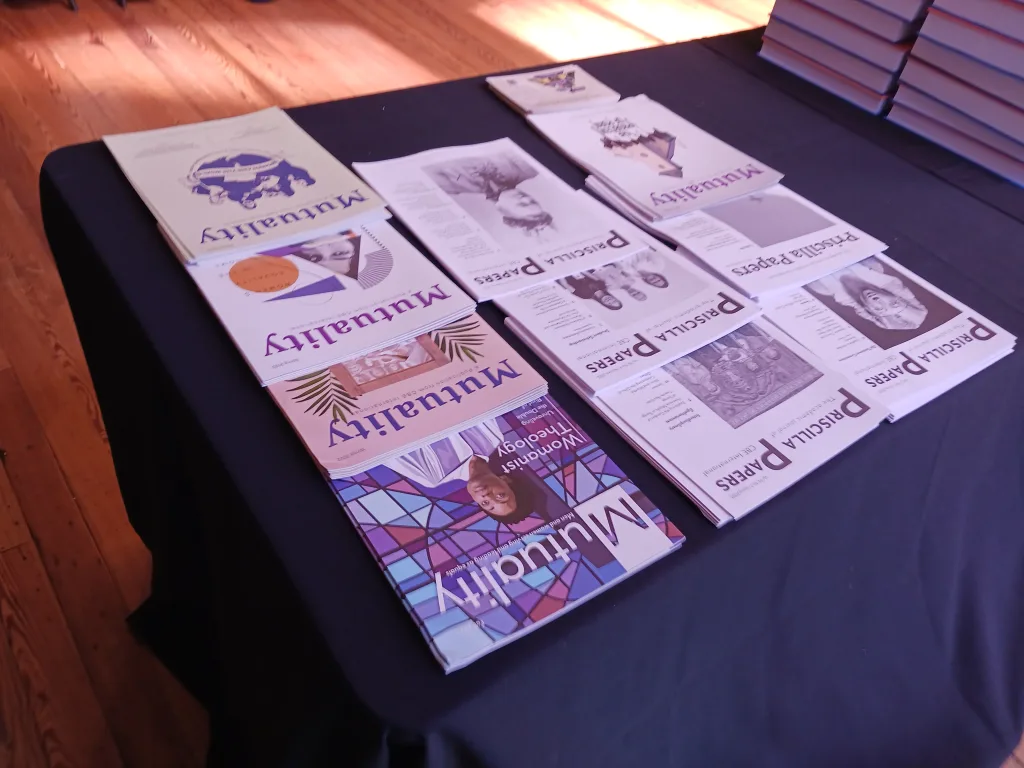
In one sense, women scholars at ETS now felt normalized. Our sponsored luncheon hosted alongside IVP Academic was full, with both women and men attending. The luncheon consisted of a panel discussion with Andrew Bartlett about his book, Men and Women in Christ: Fresh Light from the Biblical Text and Sandra Glahn about her new book, Nobody’s Mother: Artemis of Antiquity and the New Testament. Attendees were delighted to receive free copies, as well as copies of CBE International’s academic journal Priscilla Papers and magazine Mutuality.
Egalitarian and Complementarian Discussion: But What About Abuse?
At the Evangelicals and Women panel, Andrew Bartlett and Tom Schreiner debated the positions of egalitarians and complementarians. Their commitment to humbly engage with one another embraced the spirit of their session, “Come Let Us Reason Together: Women, Authority, and Scripture.” The discussion invariably circled around their different interpretations of the disputed and, by the very nature of the ongoing debate, unclear meaning of 1 Timothy 2. Repeatedly Schreiner said he might be wrong, and his stance could change, but based on his current scholarship, he believed 1 Timothy 2 supported his view that women should not teach men. When pressed, he admitted that the implications of this interpretation extended beyond the church to the seminary. Women simply should not be in authority over men nor teach them in church and, by extension, in seminary as well. Bartlett’s arguments, as both a theologian and a lawyer, were well-researched. He had read Schreiner’s work and clearly explained how the complementarian conclusions did not follow the evidence presented. He also articulated how difficult it is for women to navigate the vast and conflicting complementarian rules with their ever-changing boundary lines.
During the question-and-answer segment, the issue of abuse continued to surface. One woman asked Schreiner about how complementarian theology results in abuse — abuse she had experienced personally. As she spoke, her pain could almost be felt, causing the room to fall silent. Schreiner emphatically stated that the church should not tolerate abuse. Batanayi Manyika, one of the panel moderators, stepped in with deep compassion and empathy. Manyika voiced his own struggle as he embraces complementarian theology yet hears and recognizes that the pain she voiced was not unique to her, but a problem that must be seriously and humbly engaged. Cynthia Long Westfall, another moderator, explained that when there are not women at all levels of authority within the church, the structure becomes unsafe for women. However, Schreiner stated that in his own church, where women are not allowed authority over men, women are safe, flourishing, and not abused.
Another woman came to the microphone with her squirming and delightful baby girl in her arms. She asked Schreiner specifically about abusive pastors who continually get reappointed to their pastoral positions after an apology and confession. She wanted to understand the church’s responsibility towards both the abusers and the survivors of abuse — most often women and their families. Schreiner argued that in most instances, the men should not be reinstated to protect them from unfair positions of temptation. He only addressed the church’s role regarding the abuser, not its role in protecting and caring for the survivors.
While the discussion covered translation issues, textual criticism, and interpretive choices, the practical impact of each theology seemed to touch a nerve. Though abuse occurs in both egalitarian and complementarian churches, Schreiner had no answer regarding how to make the church a safer place. His world was theology, not practical implications. Bartlett, on the other hand, had a three-point answer which reminded me of Mimi’s paper, CBE’s Created to Thrive, and our many journals and magazines that explicitly address abuse and steps toward safe churches. For egalitarians, theology is integrated with its practical implications.
After this discussion, I tracked down the woman and her baby. She articulated well that Schreiner’s answer to her question was male-centric, focusing on protecting the abusers, while not addressing the church’s role in healing for the survivors. She continued saying it was a shame three hours were devoted to men arguing about what women were allowed to do, while women had moved on and were going to minister regardless of whether men gave them permission. In a sense, that summarized the feel of this ETS: women were going to follow the Holy Spirit’s leading in their life and dare not disobey.
Change Is Happening
Our booth was tucked away in the exhibitor’s hall, meaning that people who stopped by really wanted to find us. Though we missed the many casual greetings of our longtime CBE friends, a few still made their way over to us, grabbing their favorite journals to pass on to friends, coworkers, churches, and students. Our CBE postcards advertising our July 26–28, 2024, conference in Denver, Tell Her Story: Women in Scripture and History were also snatched up in handfuls. Those who found us stayed and poured out their dreams, their questions, and their experiences. One man arrived short of breath minutes before the exhibit hall closed, saying he needed good materials. He explained that scholarly arguments were making him question his complementarian theology causing him to now declare himself an agnostic on the issue. He needed good resources to help his mind follow his heart’s shift towards egalitarianism. While telling his story, he was ushered out of the exhibit hall — closing time was an ETS non-negotiable. He showed up first thing in the morning, specifically carving time out of his schedule to review each of our books in detail. Likewise, another pastor came to our booth because his church was looking at this issue in earnest. Though his background was complementarian, he wanted good resources to help his church take an honest look at the issue. I found both men’s visits encouraging because they indicated a generous heart that trusts egalitarian scholars to be motivated by their love of God and dedication to their faith. This commitment to humbly seek truth, despite the vitriol against those who may disagree, reminded me of one of the many strengths of our faith.
There was much to celebrate at this conference! Women and their allies showed up in force at the business meeting to elect three members to the nominating committee. Women of ETS wanted to see diversity on the executive committee that reflects Galatians 3:28 — women and men, people of all ethnicities and races who more broadly represented our evangelical church. To this end, they succeeded in electing three people: Carmen Joy Imes of Talbot School of Theology and Biola University, Andrew King of Every Voice: A Center for Kingdom Diversity in Christian Theological Education, and Dana Harris of Trinity Evangelical Divinity School. I thought back to my first ETS three years ago and my long conversation with Eric Redmond . . . diversity was beginning to happen.
Shortly after the conference, Christianity Today celebrated the ETS changes in an article titled, “First Woman Steps into Leadership of Evangelical Theological Society.” The article cited Jobes as she reflected on the changes where men had once dismissed her as a scholar because she was a woman. She and other women recounted early comments from male scholars who would ask, “Well, whose wife are you?” or “Where does your husband teach?” But this year she would become president! And while ETS celebrated their seventy-fifth anniversary, women presented seventy-five papers with their sessions packed. The gist of this year’s ETS meeting could be summarized as THINGS HAVE CHANGED!
Still Much to Do
Yet, a young woman’s story sobered us. Standing before me at CBE’s booth she poured out her heart, explaining that her mother had been a pastor her whole life, but now at her Christian college she was being taught that God does not allow women to be pastors. And while here at ETS, a male scholar asked her, “Where is your husband?” I gasped. I repeated her words during my presentation of Mimi’s paper, citing these same comments said to women scholars recorded in the 2014 sociological survey at ETS.
Our women scholars and allies have fought so hard! They have gone before us and over time, they have gained respect in their own right. They no longer hear what they once heard as new, young scholars daring to follow God’s call. It reminded me that our dedicated warriors must not assume that because they have finally gained well-deserved respect, those who follow them are not still trudging through the same morass that they survived. We celebrate our victories, but there is still so much work to do!
Photos by Elizabeth Beyer.
[1] The Evangelical Theological Society (ETS) held its annual meeting this year in San Antonio, Texas. ETS is a professional academic society of biblical and theological scholars, pastors, and students. They seek to foster conservative biblical scholarship, and CBE’s earliest founders were prominent scholars within the ETS.
Related Resources
A Question Mark Over My Head: Experiences of Women ETS Members at the 2014 ETS Annual Meeting
ETS and Women’s Belonging
Come Let Us Reason Together: ETS 2021 Annual Meeting Recap