

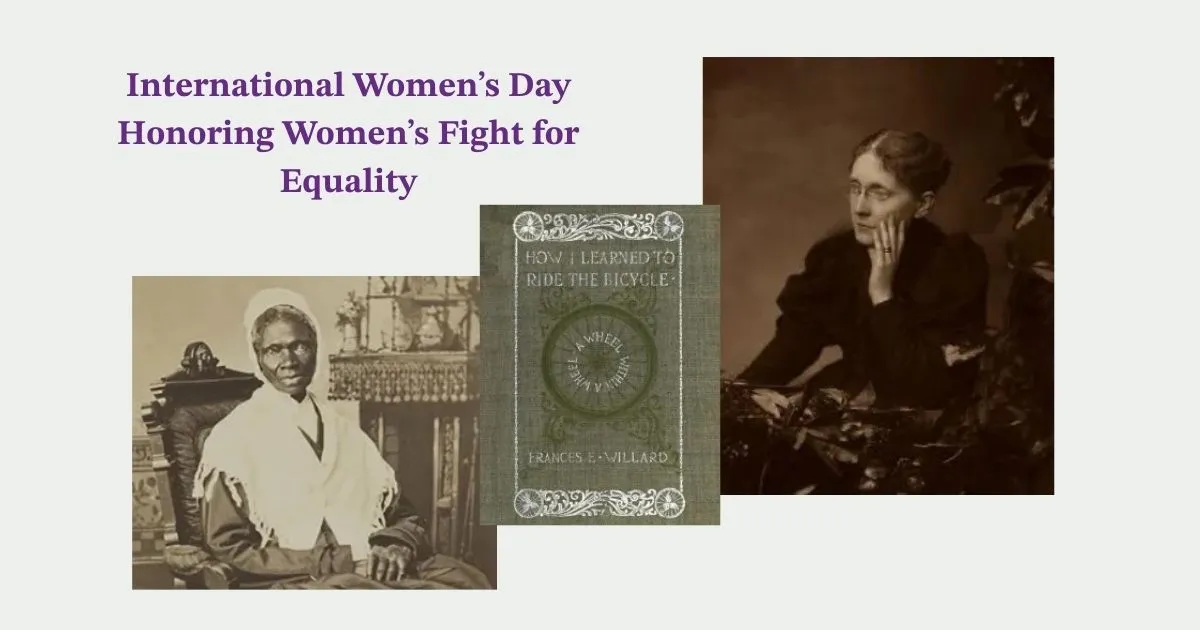

In March, CBE celebrates both Women’s History Month and International Women’s Day. Perhaps there’s no better time to celebrate women’s battle for the vote alongside their spectacular courage in leading the abolition of slavery. Gaining the vote, freeing the enslaved, and exposing the abuse and prostitution of women was exceedingly dangerous work because it challenged not only male privilege and power, but it also threatened the financial gains that accompanied women’s domination and exploitation. Clearly, it is a wonderful season to memorialize and emulate women’s faith and holy boldness in fighting injustice, regardless of the risk! Join me in honoring the Christian women on whose shoulders we stand.
At a time when women’s public leadership was not widely accepted, women had a courageous and exceptionally strong public witness that exposed the moral issues entrenched in both suffrage and abolition.[1][2] Infused with God’s power, women’s fight for the oppressed not only forged an arc of justice for those on the margins, but women’s public leadership also revealed the power of women created in God’s image with noble purposes. Genesis 2:18 makes it clear that God created woman as ezer—a strong rescue. Used twenty-one times in Scripture, ezer most often refers to God’s rescue. According to R. David Freedman, the Hebrew word used to describe woman’s help (ezer) arises from two Hebrew roots that mean “to rescue, to save,” and “to be strong.”[3] It is opportune that we honor this month women leaders among the early evangelicals who exposed flawed Bible translations and the exploitation of girls and women worldwide. Their strong rescue and holy courage display the fruit of God’s Spirit, bringing justice to the oppressed through leaders like Sojourner Truth (1797–1887) and Frances Willard (1839–1898)—both prominent suffragists and abolitionists. In remembering our leaders who spoke God’s truth to us, let us “consider the outcome of their way of life, and imitate their faith.” (Hebrews 13:7, NRSVUE).
Frances Willard
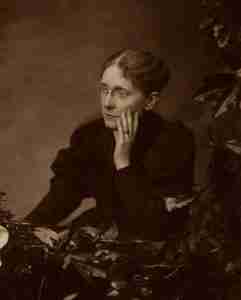
Born in 1839, Frances Willard became one of the most popular women in the United States in her day. When she died at the age of fifty-nine, thirty thousand people came out to mourn her loss, and flags were flown at half-mast in Chicago, Washington, D.C., and New York. In the National Statuary Hall Collection in Congress Hall, where each state has a statue recognizing two of their most honored citizens, Frances Willard represents the people of Illinois. There are fifteen women honored in the National Statuary Hall Collection in Congress Hall, including Francis Willard.
Converted at a Methodist revival meeting, Willard was passionate to protect women and children from the abuses of alcohol consumption that peaked in 1830 as Americans drank six to seven gallons of pure alcohol each year.[4] Attending the first national Women’s Christian Temperance Union (WCTU) convention in 1874, Willard became a founding member and, five years later, became the second president of the WCTU. Deemed one of the largest 19th-century women’s organizations, with 2 million members, the WCTU was an army of females with a three-fold mission: temperance, abolition, and suffrage.
An outspoken advocate of women’s suffrage, gaining the vote for Willard was based on the belief that God intended Christian women to advance the well-being of their families and communities through their political voice.
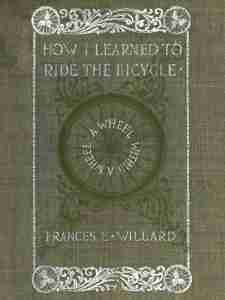
Throughout her life, Willard combated prostitution, exposed the need for laws against rape, and called fashion designers to eliminate pencil-thin waistlines that were
deforming women’s bodies and compromising their health. Willard encouraged women’s physical fitness by scandalously promoting bloomer pants so women could more easily and safely pedal their bicycles.[5] Taking it one step further, she even
wrote a book titled How I Learned to Ride the Bicycle: Reflections of an influential 19th century woman.[6] And she also lobbied for public drinking fountains to keep thirsty travelers out of saloons.
As evidence of her own achievement as an educator, Willard became president of Evanston College for Ladies, which later became Northwestern University. As her prominence grew, she was invited by the renowned evangelist D. L. Moody (1837–1899) to speak at his 1877 evangelistic campaign in Boston. Here she addressed a women’s meeting, and Moody himself asked her to preach during a Sunday afternoon meeting. It was unprecedented.
All her life, Willard believed herself an advocate of women in ministry. She encouraged women to pursue ministry, not limited to work among other women, as she herself had often felt confined. In a letter to Mrs. D. L. Moody, she wrote,
All my life I have been devoted to the advancement of women in education, an opportunity I firmly believe God has a work for them to do, as evangelists, as bearers of the Christ’s message to the ungospeled, to the prayer meeting, to the church generally, and the world at large, such as most people have not reamed. It is therefore my dearest wish to help break down the barriers of prejudice that keeps them silent. I cannot think that meetings in which “the brethren” only are called upon are one half as effective as those where all are freely invited, and I can but believe that “Women’s Meetings” as such are a relic of an outworn regime. Never did I hold one of these meetings without a protest in my soul against it. As on the day of Pentecost, so now, let men and women in perfectly impartial fashion participate in all services conducted in His name, in whom there is neither bond nor free, male nor female, but all are one. [7]
Moody invited Willard to speak during his 1877 Boston revival campaign, the same year the Boston Missionary Training School began Gordon College, and afterwards merged with Conwell School of Theology (part of Temple University in Philadelphia, Pennsylvania) to become Gordon-Conwell Theological Seminary.[8] The vision of Gordon-Conwell Theological Seminary was to “establish within a strong evangelical framework, an independent, interdenominational seminary whose constituents are united… to educating men and women in all facets of gospel outreach.”[9] While Willard had a strong public voice and modeled women’s Christian leadership for women and men, there were other powerful examples, like Sojourner Truth.
Sojourner Truth
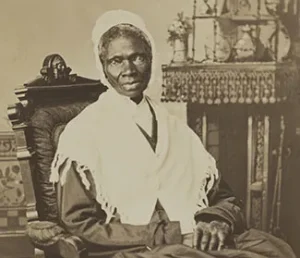
Sojourner Truth (1797–1887) was a nationally recognized abolitionist, suffragist, preacher, and social reformer. Sojourner caught the attention of many political leaders, and even President Abraham Lincoln was one of her admirers.
Sojourner Truth, or Isabella, was born a slave and remembers hearing her mother cry long into the night as she mourned the loss of her children who had been sold away from their family. Isabella’s mother, reminded of her remaining children, said, “Oh my children there is a God who hears and sees you. He lives in the sky and when you are beaten or cruelly treated or fall into any trouble you must ask Him to help because he always hears you.”[10]
Isabella was sold away from her parents and was “married” to a slave on her plantation at the age of seventeen. After giving birth to five children, Isabella decided to run away, convinced that God affirmed freedom for the slave. She hired herself out as a house servant to a Quaker couple and, for the first time, Isabella earned money for her labor. It was at this point in her life that she changed her name from Isabella to Sojourner Truth. In her words, she explains:
My name was Isabella, but when I left the house of bondage, I left everything behind. I wa’n’t goin’ to keep nothin’ of Egypt on me, an’ so I went to the Lord an’ asked him to give me a new name. And the Lord gave me Sojourner, because I was to travel up an’ down the land, showin’ the people their sins, an’ being a sign unto them. Afterward I told the Lord I wanted another name, ‘cause everybody else had two names; and the Lord gave me Truth because I was to declare the truth to the people.[11]
Truth felt a call to preach the gospel, and though she was without training or education, she traveled from Connecticut to Massachusetts, preaching as she went. So fiery were her sermons that the farmers would lay aside their work to enjoy her skillful preaching.
The great abolitionists Frederick Douglas (1818–1895) and William Lloyd Garrison (1805–1879) recognized Truth’s talent as a public speaker, and they persuaded her to speak on behalf of the American Antislavery Society. Not only did Truth electrify crowds with her poignant wisdom and impeccable allegory, but she also published her accounts as a slave in 1850 titled The Narrative of Sojourner Truth: A Northern Slave. Proceeds from the sale of her book were a welcome source of income.
Abolitionist lectures were often violent occasions, but Truth was known for her fearlessness as she spoke to crowds. When asked where she acquired her courage, she was known to say, “I feel safe even in the midst of my enemies, for the truth is powerful and will prevail.”[12]
Many of the abolitionists became advocates for women’s suffrage, as the parallels were endless. Sojourner was a popular speaker for the cause of women’s rights, and when she rose to speak, her stature was imposing, her voice was powerful, with rich tones that none dared to interrupt. During a 1851 suffragist convention in Ohio, Truth gave what was perhaps her most famous lecture on women’s rights, and her words ring immortal. She said, “I born my children and seen most of them sold to slavery, and when I cried out with a mother’s grief, none but Jesus heard—and ar’n’t I a woman?… Den dat little man in black dar, he say women can’t have as much rights as man, cause Christ weren’t a women. Whar did your Christ come from? As she stood there with outstretched arms and eyes of fire.” Raising her voice still louder, she repeated, “Whar did your Christ come from? From God and a woman. Man had nothing to do with him.”[13] Lest you think this uneducated woman was not theologically astute, the same reasoning is used by Karl Barth, who argued that there is a subtle judgment on men in the birth of Christ, who was conceived without their involvement.[14]
In 1864, Truth met Abraham Lincoln (1809–1865), who told this freed slave that he had been observant of her work for years. She was commissioned by Washington, D.C., to work on behalf of the National Freedman’s Relief Association (NFRA), where she was obliged to ride the streetcars. Anticipating the civil rights movement years before Dr. Martin Luther King Jr. (1929 –1968), Truth challenged the Jim Crow laws, which segregated the streetcars by race. Exhausted by her duties at the NFRA, Truth sat in a seat reserved for white people, and the driver pulled her from her seat, dislocating her shoulder. He was promptly fired and, after the ordeal, Truth had the pleasure of observing integrated streetcars that looked like salt and pepper on the inside.
In 1887, Truth died having failed to secure a land act through which she hoped to relocate and employ former slaves. Her funeral procession was attended by a thousand people: abolitionists, suffragists, and friends who recalled how Truth had served her country and said how happy she was “that the stars and stripes of the American flag no longer represent the scars and stripes of the slave.”[15]
We celebrate International Women’s Day through the lives of these women evangelists and missionaries, praising God for the way they served Christ above all else. Being created in God’s image and born of the Spirit endows each of us with spiritual gifts for great gospel-adventure, and these gifts, we are told by Paul, are never delineated along gender lines. My question to you is, what legacy will you leave?
Notes
[1] https://www.archives.gov/education/lessons/woman-suffrage#:~:text=In%20the%20second%20decade%20of,It%20lasted%20nearly%20three%20years.
[2] 2C+were+women+more+active+in+abolition+than+men%3F&sca_esv=2cf39a8e3998f015&rlz=1C1GCEA_enUS1171US1173&biw=1536&bih=729&sxsrf=ANbL-n5KSuWtLX_htyRb6zERq3L25v4H0Q%3A1771891320333&ei=eOqcaaSFFKmmptQPvOOzqQI&ved=0ahU
[3] David R. Freedman, Archaeology Review (9 [1983]: 56–58).
[4] https://www.bbc.com/news/magazine-31741615 See also https://www.ncbi.nlm.nih.gov/books/NBK217463/figure/mmm00001/?report=objectonly
[5] France E. Willard, How I Learned to Ride the Bicycle: Reflections of an influential 19th century woman. (Sunnyvale, CA: Fair Oaks Publishing Co., 1991).
[6] France E. Willard, How I Learned to Ride the Bicycle: Reflections of an influential 19th century woman. (Sunnyvale, CA: Fair Oaks Publishing Co., 1991).
[7] From Willard’s letter to Mrs. Dwight L. Moody, September 5, 1877 (360). See https://gcah.org/resources/worship-resources/celebrating-our-united-methodist-heritage/voices-from-our-past/frances-willard/
[8] https://www.gordonconwell.edu/about/history/
[9] https://www.gordonconwell.edu/about/history/
[10] https://www.battlefields.org/learn/primary-sources/narrative-sojourner-truth#:~:text=’My%20children%2C%20there%20is%20a,’
[11] https://historicalsnapshots.substack.com/p/sojourner-truth-part-i
[12] https://docsouth.unc.edu/neh/truth75/truth75.html
[13] https://www.nps.gov/articles/sojourner-truth.htm
[14] https://barth.ptsem.edu/barths-interpretation-of-the-virgin-birth/
[15] https://docsouth.unc.edu/neh/truth84/truth84.html