



Introduction1
Mark stages his account of Herodias and her daughter at a public birthday celebration for Herod Antipas. Most scholarly works on Mark discuss the correlations between Jesus and Herod, Jesus and John the Baptizer, and the disciples and John the Baptizer; the women are only tangentially mentioned.2 Other scholars correlate Herod and Herodias with the typological characterization of the “tyrant” king and his queen, as in Ahab and Jezebel, and Ahasuerus and Esther.3 While there is much insight from these canonical, intertextual readings, this study will limit its scope to reading the passage within the narrative boundaries of Mark. More specifically, we argue that the implied author deploys the typology of the parable of the four kinds of soil in Mark 4 to show his implied audience who or what these characters are with reference to the other characters.4 Herod is exposed as an unfit Roman ruler who, along with Herodias (who is hostile to the word of God) and her daughter,5 is responsible for John the Baptizer’s death. Pilate will also be shown to be an unfit Roman ruler who, along with the religious leaders and the crowd, is complicit in Jesus’s death.
Literary Setting
After Jesus chose his disciples (Mk 1:16–3:19), he then identified obedient disciples with his true family (Mk 3:20–6:6) and cautioned his disciples on the contamination of Herod Antipas and the Pharisees (Mk 6:7–8:21). Because of the parallel threats by Herod and the Pharisees, the unit can be broadly structured around a two-fold interchange:
A Herod / feeding of five thousand (6:7–44)
B Jesus on the sea / the disciples’ hard hearts (6:45–52)
A’ Pharisees / feeding of four thousand (6:53—8:13)
B’ Jesus on the sea / the disciples’ hard hearts (8:14–21).6
An example of the disciples being influenced by Herod is at the beginning of the central section of the Gospel where the disciples initially respond to Jesus’s question about his identity in a way that is parallel to those around Herod (8:28, cf. Mk 6:14–15). An example of the disciples being influenced by the Pharisees is their inability to understand Jesus’s teaching about what is clean or unclean (Mk 7:17) while the Syrophoenician woman, a Gentile, understands and builds upon his parabolic words in her response to Jesus (Mk 7:27–28). Jesus addresses the inability of the disciples to grasp his self-revelation by telling them that they are being influenced by the threats of Herod and the teaching of the Pharisees (Mk 8:14–21). The narrator focuses on one of those threats through characterizing Herod and those around him—Herodias and her daughter (Mk 6:21–29).
An Initial Reading
The narrator has provided the implied audience with a grid to understand the upcoming characters in ch. 4. The broad message of all the parables in Mark 4:1–34 is that although many will not respond to the word, some will; therefore, Jesus proclaims the word knowing that it will bring about the kingdom, which will start small but will expand under its own power for God to harvest. The first of the parables, which is subsequently interpreted by Jesus, concerns the four soils (Mk 4:3–9, 14–20). Jesus states that it is necessary to understand this parable to understand any parable (Mk 4:13). A broad diagram of the parable is as follows:7
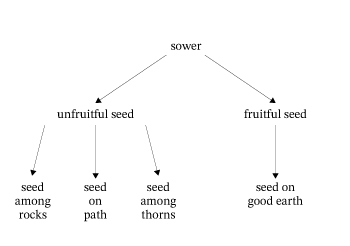
Commenting on this structure, Craig Blomberg states: “The parable itself describes in detail four kinds of soil. This detail is superfluous if each portion of the ground on which the seed falls does not stand for something fairly specific.”8 Mary Ann Tolbert has persuasively argued that the Parable of the Soils in Mark 4 provides a plot synopsis for the implied audience early in the Gospel that identifies the different, typological responses that people will have to the word.9 Each of the main groups in the parable is instructive for the recipient. There are not only fruitful and unfruitful responses, but different kinds of unfruitful responses. Tolbert also observes:
Jesus teaches from a boat on the sea and the massive crowd is by the sea on the earth (epi tēs gēs). It is typology, not geography or history, that stands behind this setting. In the parables that follow, those who hear the word that Jesus speaks may respond in one of the same four ways in which the four different types of earth (gē) respond to the seed sown in them. The huge crowds who listen to Jesus “on the land” are types of the parabolic “earths” about to be expounded.10
Tolbert has summarized the responses as follows:
| Parable of the Sower |
| Interpretation |
| Gospel Group |
1 | seed sown along the way; eaten by birds | = | these in whom the word is immediately removed by Satan | = | scribes, Pharisees, Jerusalem’s Jewish leaders |
2 | seed sown in rocky ground; comes up quickly but has no root; withers with the sun | = | these who accept the word immediately, endure for a time, but fall away when tribulation or persecution comes | = | disciples, especially Peter, James, and John |
3 | seed sown among thorns; thorns choke it and it produces no fruit | = | others in whom the word is choked by the cares of the world, delight in riches, and desire for other things | = | Herod, rich man of 10:17–22 |
4 | seed sown on the good earth; brings forth grain in triple abundance | = | those who hear the word, accept it, and bear fruit in triple abundance | = | ones healed (or saved) by their faith11
|
Each type of soil is identified as a group of people:
- These (houtoi) in 4:15,
- These (houtoi) in 4:16,
- Others (alloi) in 4:18, and
- Those (ekeinoi) in 4:20.
As Tolbert observes: “The contrast should suggest to the audience that “these” are groups nearby, recently discussed; “others” and “those” are not yet fully explicated.”12
The group that has opposed Jesus up to this point in the narrative are the religious and political leaders (scribes, Pharisees, Herodians, and Jerusalem Jews) (cf. Mk 2:6–7, 16, 24, 3:2, 6, 22). They hear but do not heed what he says.
The other nearby group in the narrative (“these”) is the disciples. Several textual links suggest the disciples are the rocky soil. The first link is that the name of the leader of the Twelve, Peter (Petros), is a play on the word for “rocky” soil (petrōdēs) (cf. Mk 3:16 and 4:5). The second link is that the rocky soil springs up quickly (euthus) (Mk 4:5, 16). Following the call of Peter and Andrew, and of James and John, the narrator reported that they “quickly” (euthus) followed Jesus (Mk 1:18-20). Finally, the rocky soil is said to fall away (skandalizō) when trouble or persecution comes because of the word (Mk 4:17). Before Jesus is arrested, he announces that all the disciples will fall away (skandalizō) (Mk 14:27), and they do (Mk 14:50–52).
The other group not yet fully disclosed in the narrative (“others”) appears to be first encountered in the person of Herod in Mark 6. Herod is described as someone who feared John the Baptizer as a righteous man, even though John spoke against Herod for taking his brother’s wife (Mk 6:18). Herod was perplexed by what John said to him, but preserved John from his wife, Herodias, who had a grudge against him and wanted to kill him; despite pressure from Herodias, Herod gladly heard John (Mk 6:19–20). However, when Herodias’s daughter danced for Herod and he swore to give her whatever she asked, he found himself caught in a bind when she, in collusion with her mother, asked for the head of John the Baptizer. Like the seed sown among thorns, Herod was pressured by his oath before his dinner guests who were prominent men in his world—nobles, commanders of thousands, and prominent ones of Galilee (Mk 6:21). His desire to protect the righteous man, John, was choked out by the cares of his world sitting around him in the banquet hall. So, he acquiesced and had John beheaded (Mk 6:26–27).13
Jennifer Knust has written extensively on how Christians in the first century used virtues to praise or vices to expose “elite” Roman rulers.14 Although Knust’s focus is often on the deviant sexual behavior that vilified those who were culturally considered to be virtuous (which was different for men than for women), she emphasizes that virtues were broader than sexual behavior. For instance, elite Roman men included those who ruled well over themselves and others, and elite Roman women included those who remained loyal to their husbands and did not bring shame on themselves or their families.15 As Knust explains: “Generations of Greek and, later, Roman schoolboys were trained in the repertoire of categories appropriate for praise or blame.”16 Therefore, the implied audience of Mark would know that, “A man is virtuous when he is in control of himself and his household, when he is courageous in battle, and when he is wise in his dealings with his subordinates.”17 A man who renounced his prerogatives of masculinity was corrupt and worthy of blame. Similarly, if “a man cannot be trusted to keep his women in line, then he should not be trusted with the well-being of the state.”18 Accordingly, the lack of self-control by Herod when he offered up to half his kingdom to Herodias’s daughter in appreciation for her dance shows to the implied audience that Herod is not virtuous. Further, being tricked into killing John the Baptizer shows the implied audience that Herod is not able to control the women in his household and is thus not fit to be a ruler over his Galilean tetrarchy.
Who does Herodias show herself to be in the typological characterization of the soils? The implied audience, primed by ch. 4, would recognize Herodias’s similarity to the first soil mirroring the rejection of Jesus by the religious leaders. When John the Baptizer speaks against the divorce of her first husband, Herod Philip, and her marriage to Herod Antipas, she cannot receive the prophet’s revelation. Like the religious leaders with Jesus, she has a grudge against John for his exposing words and wants to kill him. Through this typology, the narrator vilifies Herodias and her daughter as unstable, deceptive women. Significantly, this characterization is a subtle means of vilifying Herod whose lack of self-control and inability to control those under him, including the women in his house, exposes him to the implied audience as depraved and “unmanly.”
Moreover, by her strength and resolve, Herodias weakens Herod. As Catharine Edwards explains:
Male members of the Roman elite . . . were expected to display the greatest degree of control over themselves, just as they exercised the greatest degree of power over other people: over the non-Romans they ruled, the poorer Romans to whom they were patrons, their female relatives, and of course their slaves.19
In the conflict between Herodias and Herod, it is Herodias who shows herself to have the greater self-control and Herod who cannot display self-control over his own feelings: “The king was greatly distressed . . . but because of his oaths and his dinner guests, he did not want to refuse her” (Mk 6:26). In an ironic twist, Herod shows himself as “feminine” by not exercising self-control over Herodias and her daughter. The strong, immoveable, self-controlled one was Herodias who wanted to kill John and then arranged to accomplish her will. The actions of the executioner further emphasized this reversal of roles. Herod orders the executioner to bring John’s head (Mk 6:27). After beheading John, the executioner brings back John’s head on a platter and does not present it to Herod, but to the girl who then gives it to Herodias (Mk 6:28). As Michelle Connolly observes: “In a sense, Herod is bypassed in the chain of command and the women have taken over.”20
Unlike the women previously portrayed in Mark, Herodias and her daughter come from a different and higher social class. As Connolly observes: “In a sense, their world represents the Roman Empire in Palestine.”21 Within the value system of the Romans, the account of Herodias provides a subtle critique of male Roman underlings. This is apparent when the Herodias narrative is compared with another featuring a similar hierarchy—the religious leaders, the crowd, and a Roman procurator named Pontius Pilate.
A Subsequent Reading
In Mark 15 we encounter another Roman ruler, the procurator/governor in Judea, Pontius Pilate (AD 26–36).22 The narrator’s portrayal of Pilate has many similarities to his portrayal of Herod:
Herod | Pilate |
A feast (birthday party) | A feast (Passover) |
Herod offers Herodias’ daughter anything she wishes. | Pilate offers the people the freedom of any prisoner they wish. |
Moved by her mother, the girl asks not for a trinket, but for John the Baptizer’s head. | Moved by the priests, the people ask not for Jesus, but for Barabbas. |
Herod is lukewarm—would spare the preacher (John) if he could. | Pilate is lukewarm—would spare the preacher (Jesus) if he could. |
Herod is subject to pressure (party guests) which he fails to resist. | Pilate is subject to pressure (Jewish leaders) which he fails to resist. |
Herod is trapped by his princely promise. | Pilate is trapped by his princely promise. |
John is executed. | Jesus is executed.23 |
These parallels resonate with the Parable of the Soils in Mark 4. Like the seed sown among thorns, Pilate was pressured, just as Herod was, by his offer before the religious leaders and the crowd (Mk 15:6–15). His desire and attempts to protect Jesus (Mk 15:10) were choked out by the cares of his world as the priests and the crowd called for the release of Barabbas and the crucifixion of Jesus. Consequently, Pilate acquiesced (satisfied the crowd) and handed Jesus over to be flogged and crucified (Mk 15:15). This parallel with Pilate demonstrates how the associated character, Herod, also corresponds with another subtle, vilified character, Pilate.
Not only are there parallels between Jesus and John and between Herod and Pilate, there are also parallels between Herodias and her daughter and between the religious leaders and the crowd. We have already seen that Herodias was like the religious leaders in that they both resisted divine revelation. What is enlightening when comparing Mark 6 and 15 are the parallels which arise between Herodias’s daughter and the crowd. Just as the chief priests stirred up the crowed to have Pilate release Barabbas to them instead of Jesus (Mk 15:11), so was it that Herodias stirred up her daughter to ask Herod for John’s head instead of anything else a young girl might desire (Mk 6:24–25). The daughter and the crowd are lethal instruments in the hands of the more powerful mother and religious leaders, respectively.24 Further, both the crowd and the daughter go beyond what they are encouraged to do. Not only does the crowd ask, as instructed, for the release of Barabbas, but it then calls for the crucifixion of Jesus (Mk 15:11–14). Likewise, Herodias’s daughter goes beyond the request of her mother. As Connolly observes:
She does not merely repeat what her mother said, but makes it her own, insisting, “I want you to give me at once.” She adds her own grotesque recognition of the birthday scene, asking that her request be presented “on a platter,” as though it is to be yet another course of the banquet.25
Conclusions
Writing from a feminist perspective, Connolly concludes that Mark has portrayed women badly in the Herod narrative because they are shown to cooperate to disrupt male power and dominance:
The misogynist message of this rich narrative is never to let women collaborate together on what is otherwise an entirely civilized relationship of agreement to differ, between two powerful men. Women, when they get power, are frighteningly violent and vindictive in a way that men cannot imagine. Female bonding, when women consult together, is particularly prone to grave disorder. Male bonding does not protect men but will be turned against them, to destroy them. The obvious solution is not to allow women to collect together.26
While Connolly’s reading provocatively highlights gender dynamics if Mark 6 is considered in isolation, Connolly’s conclusion is not founded on the full narrative of the Gospel of Mark. The parallels between the proximate causes of John’s and Jesus’s deaths explicitly show that the collusion is not one of women against men since Mark 15 has men in a parallel role with Herodias and the crowd in a parallel role with Herodias’s daughter. These disruptive, disorderly, deadly consequences do not arise as the result of a clash between the sexes. They arise because of how people respond to the revelation they are given as foretold in the Parable of the Soils in Mark 4.
Herodias is shown to act like the religious leaders, and her daughter becomes a pawn like the crowd to force the hand of a Roman official. Yes, Herodias and her daughter are portrayed negatively—sly, seductive, deceitful, not to be trusted, not given to repentance, and characterized by uncontrolled revenge—but only because they do not respond well to the message of the prophet but instead use their power to bring about the prophet’s death. As women, they are powerful—even more powerful, strategically, than their male ruler. But they are not unique in this struggle. They are like the other characters, including male religious leaders and the crowd in the broader narrative who back the Roman governor into a corner to do their will and crucify Jesus.
The subtle message for the implied audience is that these Roman representatives are not “manly” but are in fact more womanly than the women in Mark 6 because these male Roman pawns are weak, irresponsible, out of control, and without knowledge about how to rule. The point of the story is not to caution against the disruption that can arise from females who bond together, but to beware of those who will not receive the word of God, whether male, female, or even a crowd, because they can be treacherous—even deadly.27
Notes
- This paper was presented at Evangelical Theological Society, Annual Meeting, Nov 19, 2025.
- See Tom Shepherd, Markan Sandwich Stories: Narration, Definition, and Function (Andrews University Press, 1993) 172–209; Tom Shepherd, “The Narrative Function of Markan Intercalation,” NTS 41 (1995) 530–31; R. Alan Culpepper, “Mark 6:17–29 in Its Narrative Context: Kingdoms in Conflict,” in Mark as Story: Retrospect and Prospect, ed. Kelly R. Iverson and Christopher W. Skinner, SBLRBS 65 (SBL, 2011) 145–63; James R. Edwards, “Markan Sandwiches: The Significance of Interpolations in Markan Narratives,” NovT 31/3 (1989) 205–6.
- Abraham Smith, “Tyranny Exposed: Mark’s Typological Characterization of Herod Antipas (Mark 6:14–29),” BibInt 14/3 (2006) 259–93; Culpepper, “Mark 6:17–29 in Its Narrative Context,” 146–53.
- The actual author decides how to represent himself, whether negatively or positively, through expressions in the text and through common reservoirs of knowledge between him and the audience he has in mind to create an implied author for the implied audience. The implied audience is created by the actual author through selected means and material (including socially conventional and acceptable language, cultural codes, compositional levels of design, selection and arrangement or design of material) deemed suitable to enable the implied audience to interpret a text whether it is read, heard, or performed. See Wayne Booth, The Rhetoric of Fiction, 2nd ed. (Chicago: University of Chicago Press, 1983), 70–75, 137–38, 157, 422–31; James L. Resseguie, Narrative Criticism of the New Testament: An Introduction (Grand Rapids, Mich: Baker Academic, 2005), 39; Mieke Bal, Narratology: Introduction to the Theory of Narrative, 2 ed. (University of Toronto Press, 1997), 18; Seymour Chatman, Story and Discourse: Narrative Structure in Fiction and Film (Ithaca, N.Y.: Cornell University Press, 1980), 148–51.
- Because of variation among the manuscripts of Mark 6:22, there is some question over the identity of the daughter who danced. Josephus identifies her as the daughter of Herodias and Herod Philip: “Their sister Herodias was married to Herod [Philip] the son of Herod the Great by Mariamme, daughter of Simon the high priest. They had a daughter Salome, after whose birth Herodias, taking it into her head to flout the way of our fathers, married Herod [Antipas], her husband’s brother by the same father, who was tetrarch of Galilee.” Flavius Josephus, Jewish Antiquities, trans. Ralph Marcus and Allen Wikgren, LCL VII, 93. For a more thorough discussion of the evidence in support of Salome being the daughter of Herodias by Herod Philip see Harold W. Hoehner, Herod Antipas: A Contemporary of Jesus Christ (Zondervan, 1980) 151–52. See also Robert Horton Gundry, Mark: A Commentary on His Apology for the Cross (Eerdmans, 2000) 320.
- See C. S. Mann, Mark: A New Translation with Introduction and Commentary, AB 27 (Doubleday, 1986) 182–83.
- Adapted from Craig L. Blomberg, Interpreting the Parables (IVP Academic, 2009) 226.
- Blomberg, Interpreting the Parables, 226.
- Mary Ann Tolbert, Sowing the Gospel: Mark’s World in Literary-Historical Perspective (Fortress, 1989) 148–64.
- Tolbert, Sowing the Gospel, 149.
- Table slightly edited from Tolbert, Sowing the Gospel, 171.
- Tolbert, Sowing the Gospel, 153.
- See Tolbert, Sowing the Gospel, 158.
- Jennifer Wright Knust, Abandoned to Lust: Sexual Slander and Ancient Christianity (Columbia University Press, 2005) 15–50.
- Knust, Abandoned to Lust, 47.
- Knust, Abandoned to Lust, 47.
- Knust, Abandoned to Lust, 48. See Plutarch, who states: “A man therefore ought to have his household well harmonized who is going to harmonize State, Forum, and friends.” Moralia: Advice to Bride and Groom, trans. Frank Cole Babbitt, LCL 2:222, 144c.
- Knust, Abandoned to Lust, 49; Plutarch, Moralia: Advice to Bride and Groom, 144c.
- Catharine Edwards, “The Suffering Body: Philosophy and Pain in Seneca’s Letters,” in Constructions of the Classical Body, ed. James I. Porter (University of Michigan Press, 2002) 255. See also Knust, who states: “For elite men, virtue meant mastery of others (penetration, controlling the household, displaying military courage) but also self-mastery. The man who could not or did not control his passions was untrustworthy: if he could not master himself, how could he master others? He was depicted as enslaved to pleasure and unfit for his position.” Abandoned to Lust, 47. See Plutarch, Lives: Marcus Cato, trans. Bernadotte Perrin, LCL 3.6, 4.2.
- Connolly, Disorderly Women and the Order of God: An Australian Feminist Reading of the Gospel of Mark (T&T Clark, 2018) 139–40.
- Connolly, Disorderly Women, 134.
- For a more detailed discussion of Pilate see Raymond E. Brown, The Death of the Messiah, From Gethsemane to the Grave, Volume 1: A Commentary on the Passion Narratives in the Four Gospels (Yale University Press, 1998) 693–705; Emil Schürer, The History of the Jewish People in the Age of Jesus Christ (T&T Clark, 1890) 2:81–89.
- See Robert M. Fowler, Loaves and Fishes: The Function of the Feeding Stories in the Gospel of Mark (SBL, 1981) 123–24, quoting Austin Farrer, St Matthew and St Mark (Dace, 1954) 14. See also Elizabeth Struthers Malbon, “The Major Importance of the Minor Characters in Mark,” pp. 58–86 in New Literary Criticism and the New Testament (Sheffield Academic, 1994) 70.
- Malbon, “The Major Importance of the Minor Characters in Mark,” 70.
- Connolly, Disorderly Women, 138. See also Malbon, “The Major Importance of the Minor Characters in Mark,” 70.
- Connolly, Disorderly Women, 140.
- The implied author’s discourses on women in Mark show that the determinative difference in every case has to do with how well they respond, or fail to respond, to what God is saying and doing. Mateus F. De Campos arrives at a similar conclusion for all characters in Mark affirming that knowledge of Jesus is determined by their response to his revelation. “Markan Epistemology and the Problem of Incomprehension,” JETS 64/4 (2021) 745–66.