

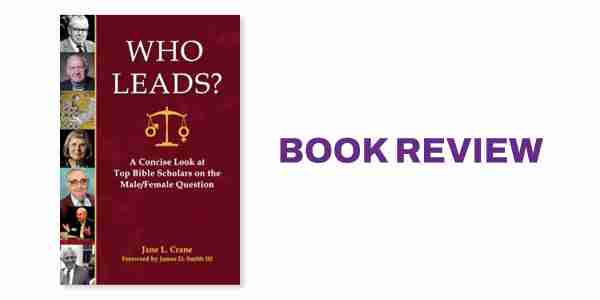
Jane L. Crane begins her introduction to Who Leads?: A Concise Look at Top Bible Scholars on the Male/Female Question by writing, “I needed a book, a simple book. One that pastors and others could read in a relatively short time to learn what top Bible scholars say today on male and female leadership” (xvii). Crane goes on to explain that, even after studying this topic for years, she could not find the book she was looking for—so she decided to write it! And she has succeeded admirably. Who Leads? is the result of Crane’s three years of intensive study and research into the evidence that reputable and trustworthy biblical scholars have brought forth in support of an egalitarian/mutualist interpretation of the Bible.
Because Crane wanted to produce a book that presented egalitarian biblical interpretation in an approachable, concise way, she divided the book into two sections. The first half presents biblical evidence and abbreviated scholarly arguments, organized roughly chronologically, glancing briefly at the Old Testament before diving into the New Testament. The second half entirely consists of extensive footnotes (dozens per chapter) that provide both references as well as further scholarly commentary on each chapter. Crane gives her readers a summary of Jesus’s interactions with women as well as how women functioned in the early church. Then, she spends the next five chapters tackling the passages in the Pauline letters that may seem to limit women in leadership, systematically tearing down complementarian arguments about each passage.
Each chapter is only a few pages long, and not a word is wasted. Every sentence provides insight as she builds her argument. Crane writes that she “chose to focus primarily on facts rather than opinions and leave conclusions to the reader” (xvii). However, given the brevity of the book, Crane does not spend much time on complementarian counterarguments. It’s clear Crane intends to move her readers toward a particular conclusion, but her arguments are compelling enough to support that conclusion.
Crane presents her research in a clear, accessible, and powerful way. She highlights the fact that “nearly every action by Jesus regarding women…is considered revolutionary for his time” (15). She celebrates the contributions that women made to the early church. She presents a fascinating scholarly argument that 1 Corinthians 14:34–35 was actually not part of Paul’s original letter. While this is a compelling argument, Crane makes the somewhat confusing choice to simultaneously write about John 8 (the woman caught in adultery) without mentioning the fact that most Bible scholars believe this passage was not part of the original Gospel. In fact, she only mentions the debate about John 8 in a footnote about 1 Corinthians 14:34–35. Outside of this area, though, Crane’s arguments are strongly backed up by scholarship at every point. Her most powerful argument about Paul’s letters is made in highlighting the passages where he celebrates women in church leadership and treats them as equals. Crane quotes Roger Nicole: “Do not doubt in the darkness what you have seen in the light. We are not at liberty to imagine that St. Paul condemned in Timothy what he had sanctioned in Romans” (62).
Toward the end of Who Leads?, Crane summarizes her preceding arguments by providing a list of fifteen things that “the Bible does not say,” among them that, “the Bible does not state that only a man can be an overseer or pastor or elder,” and, “the Bible does not say that wives are to obey husbands” (74–75), followed by evidence for each list item. This list condenses Crane’s arguments even further, giving her readers a simple, useful reference point for the most important tenets of egalitarianism or mutualism.
While a remarkable work of scholarship, Who Leads? would be stronger if it included a more diverse body of scholars. Due to the condensed nature of the book, Crane relies heavily on the ethos (authority and credibility) of the scholars she cites. She doesn’t include much information about how she decided which scholars to cite, writing that she “aimed to include mainly scholars from leading seminaries . . . or . . . scholars who were highly respected for their academic publications” (99). This strategy directs her study toward early egalitarian scholarship that has stood the test of time, but it also leads to a blind spot: Nearly all the scholars cited in the book are both white and at least middle-aged. While these scholars are undoubtedly wise and have insightful and well-researched opinions, citing more diverse biblical scholars, both in terms of ethnicity and age, as well as citing more recent egalitarian scholarship would have added to the richness of the material.
The book’s dual structure of content followed by extensive footnotes might also become frustrating for someone deeply invested in the details and intricacies of the scholarship Crane cites. While some footnotes contain commentary, some are only references; it may have been better to separate the two so that the reader can know in advance if they will see commentary in the notes or not. That said, Crane explicitly states that the book is not intended for extensive and prolonged scholarly consideration; her goal is to present all the necessary information in the most concise way possible.
Who Leads? is the perfect book to give to a relative, friend, or coworker who is curious about egalitarian/mutualist biblical scholarship, but even experienced scholars will likely learn something new from the book. The book aligns perfectly with CBE’s mission to advocate for the equal authority and leadership of women in the church. Any Christian woman who reads this book will come away feeling empowered, challenged, and—most of all—loved by God. “All believers,” Crane writes, “both male and female, may enter the Most Holy Place, approach the throne of grace, and draw near to God. And all believers, male and female, are a holy priesthood, offering spiritual sacrifices acceptable to God” (70).Related Resources
Book Review: The Bible vs. Biblical Womanhood: How God’s Word Consistently Affirms Gender Equality
Book Review: Tell Her Story: How Women Led, Taught, and Ministered in the Early Church