

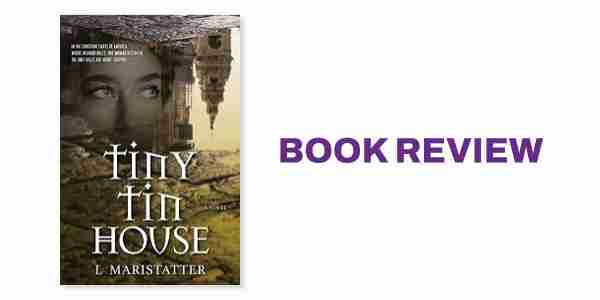
Tiny Tin House follows Meryn Flint, a teenage girl navigating a dystopian society shaped by distortions of scripture, especially the scriptures regarding how women and men should interact in the church and in marriage. In this society, the Christian States of America (which appears to have previously been the southern United States), is run by a merged church and government called the Reformation Directorate. Breaking every rule in the book, Meryn rejects her “Family Duty” to marry and have children (her husband, of course, would have been chosen by her stepfather), instead choosing to forge her own way of life in a community of outcasts. As Meryn guards her newfound independence from men who see her as a threat, she begins to question whether the oppressive, misogynistic faith she has been taught really reflects God’s will.
Although this book is a work of dystopian fiction, the main themes address the role of women within the Christian faith. With the exception of the country’s caste system, we do not learn much about other aspects of this culture apart from its laws surrounding women. We hear Meryn’s thoughts, emotions, and prayers as she tries to reconcile her instinctive beliefs about God, the “still small voice” that speaks to her in moments of doubt and fear, and the morals that she has been taught in church her whole life. She meets a wide variety of people throughout the book and nearly all of them express their own perspectives on how women should be treated.
Because Tiny Tin House shows egalitarian concepts through a fictional narrative, it can serve as an engaging introduction to the discussion of women in the church. However, it may not be appropriate for younger audiences. Because of its dystopian genre, the book does include depictions of domestic abuse, sexual assault, execution, and forced injection of mind-altering drugs. It also may not be ideal reading for very new Christians due to its portrayal of prophecy and a mysterious reference to demon possession. Neither issue is carefully explained, and the version of prophecy depicted (largely incomprehensible, metaphorical predictions of one person’s future life) doesn’t fully align with mainstream interpretations of biblical prophecy. One last thing to keep in mind is that this is the first book of a series, so most plot lines do not resolve at the end. The later books are not yet published.
Apart from these issues, Tiny Tin House is an enjoyable and thought-provoking read. Perhaps its most powerful aspect is the fact that every rule, law, and attitude in this society is shown as the “logical conclusion” of a seemingly minor misogynistic belief in the real world. The book continually emphasizes how a misogynistic attitude can grow and grow until it distorts society and does great harm to women. In addition, the characters within the book are all complicated and flawed—and therefore seem more real. The choices they make are realistic responses to such an oppressive regime. Meryn herself follows a very believable journey from helplessness to hope, with moments of transcendent joy and angry despair interwoven with each other. She does not easily break free of her society, but we see her courage and determination to do so.
Tiny Tin House dramatizes and makes “real” the consequences of beliefs about women within the church. While the language of the book sometimes becomes overly dramatic, overall, it is a well-written story that draws you in and makes you think. The book aligns well with CBE’s values and mission. It shows us that God is not always in favor of what people may do in his name on earth: no matter what, God loves women as his daughters and empowers them by the Spirit to discern and fight for the truth.