

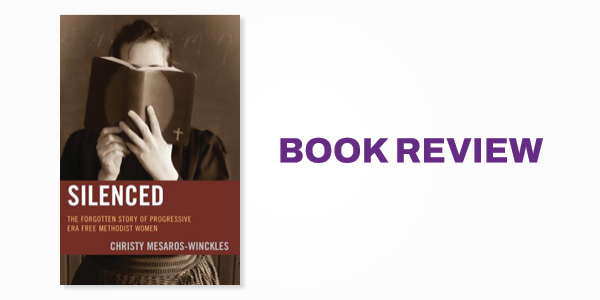
Christy Mesaros-Winckles’s book, Silenced: The Forgotten Story of Progressive Era Free Methodist Women, carefully charts the changes in the American religious landscape that led to the silencing of women in the Free Methodist Church in the United States. Through painstaking research in denominational magazine articles and women’s field reports, Mesaros-Winckles has traced how a church founded on equality and social reform in the 1860s became a church that silenced and sidelined women’s ministry from 1890 until 1974. Using the voices of those who fought on both sides, Mesaros-Winckles reveals an untold story of church history.
Founded in 1860 by Benjamin Titus Roberts in reaction against the Episcopal Methodist Church, the Free Methodists “embodied the ideals of equality and the value of every person to God” (5). They purposefully sought to bring equality to slaves, women, and the poor because they believed the Episcopal Methodists favored the wealthy against the poor, marginalized, and oppressed. As Roberts saw it, the Free Methodists were returning to “Old School Methodism,” which was founded upon John Wesley’s understanding of spirituality and sanctification.
Mesaros-Winckles does not cover Wesley’s study of the ancient beliefs still practiced in Eastern Orthodoxy that led to his novel (in Protestantism) understanding of sanctification, but she does explain its impact on the Free Methodist Church. Namely, Wesley’s theology of sanctification is that, over one’s lifetime, one could become free of intentional sin. Importantly, this means that truly following God’s law leads to radical love of God and neighbor. Practically, this means believers “would seek social and religious reform and devote much of their time to these efforts” (6). As Mesaros-Winkles states: “Radical social reform was at the heart of an individual’s quest for Christian perfection” (6). As this merged with the Holiness Movement of the 1860s, the Free Methodist Church grew rapidly. Mesaros-Winckles’s thorough explanation of the Free Methodist Church’s founding principles and theology proves essential to understanding the conflict that emerged in the church around women’s ministry.
Though Roberts stridently promoted the equality of women, other influential founding members of his denomination did not. A battle of beliefs ensued, wherein Roberts strategically used his position as editor of the leading denominational magazine to promote gender and racial equality. As editor, he published the work of women and men who favored women’s ordination and often highlighted women’s reports of their work as evangelists and church planters (18). These stories demonstrated that, contrary to the belief that women were weaker than men, women were in fact doing the same work as men but without the pay or transportation help that the denomination afforded to men.
Mesaros-Winckles highlights three women evangelists from this era: Clara Wetherford (1849–1921), Dr. Sarah Anne Grant (1845–1916), and Ida Gage (1861–1915). Their stories, gathered from their own ministry reports, magazine articles, sermons, speeches, and newspaper clippings, illustrate how these women adapted to the pressures of their era. Early on they code-switched, knowing that they needed to present their ministry work like the men, distinctly separating their evangelistic and church planting work from other relational responsibilities. However, when the cult of domesticity grew in influence, they wrote about their dual “spiritual calling and commitment to family” as a means of validating their ministry (69). Though trusted and empowered by their church to spread Free Methodism across the country, their leadership voice had waned by the late 1800s and early 1900s. As Roberts and his allyship died and others left the denomination for churches that ordained women (like the Congregational Church), the voices opposing women’s leadership became dominant (17).
Finally, in 1911, the conference created a deaconess role, which sidelined women into ministry beneath and separate from men. They also denied pay to women leaders who were married to men in church leadership. This remained the reality until 1974, when the culture shifted enough to allow a vote for the equality of women in all aspects of leadership. However, the church had absorbed the then-new complementarian theology, significantly slowing the momentum for female leadership.
Mesaros-Winckles particularly excels in her description of the era’s historical realities that worked against women’s leadership. This was the time of the suffragette movement, which, she notes, Protestants largely opposed. Fundamental to this opposition was the belief that women were naturally inferior to men (8, 83). Simultaneously, the cult of domesticity was on the rise, which argued that women were morally superior to men but weaker when facing the harsh realities of the world. Thus, women should remain at home and raise the next generation of children, leaving church ordination and leadership to men (8).
Furthermore, Mesaros-Winckles’s description of the changing theology is eye-opening. She explains that the new theology of premillennialism propelled the growth of Protestant Fundamentalism. According to Mesaros-Winckles, premillennialism promoted a “literal” interpretation of the Bible that eschewed study of the Greek and Hebrew texts as well as their historical contexts and thus obscured the intent of difficult biblical passages. Regarding gender roles of women and men, premillennialism promoted a straightforward biblical interpretation that deemed women’s ordination as a slide toward secularism and sin (97–99). Moreover, this move toward premillennialism turned Free Methodists away from Wesley’s founding beliefs about sanctification. This, in turn, caused skepticism, though not outright rejection of their focus on social reform work. Pulling together and making sense of several historical threads, Mesaros-Winckles connects premillennialism and the fundamentalist shift away from social outreach with the limiting of women in church leadership.
Though academic in its rigorous research and writing style, Silenced adds to our understanding of women’s history in the American church. Not only does it fill in missing history, but it also provides a case study for what was happening more broadly in nineteenth-century Protestantism regarding women’s leadership. The Free Methodist Church is not alone in abandoning its founding egalitarian principles as it absorbed prevailing cultural shifts, ultimately restricting leadership in the church to white men. Were we to look, we would find many more examples.