


As the well-known saying goes, “history is written by the victors.” Many governments, institutions, and individuals have used their power to craft narratives that drown out voices in opposition. Generations have grown up learning rewritten versions of history that elevate the victors but demonize or erase those who opposed the victors.
Jesus was clear that his kingdom would be marked by service in love and humility, honoring one another and partnering with him to restore broken relationships. Writing someone out of history to erase inconvenient truths is antithetical to the priorities of the kingdom of God. As such, it is sobering to read an account of how prominent members of Baylor University and the Texas Baptist community took deliberate steps to twist and bury the story of Antônia Teixeira in the aftermath of her rape and subsequent childbirth, acting more in line with hunger for power than the values of the kingdom.
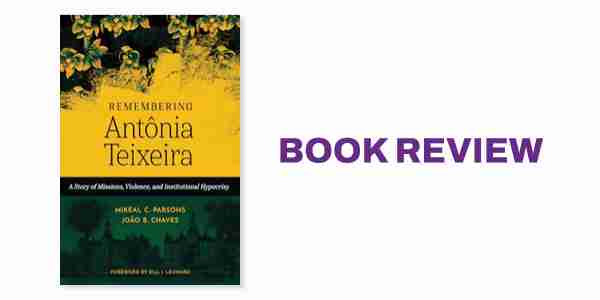
Authors Mikeal C. Parsons and João B. Chaves don’t mince words in this book as they share the details of their research into Antônia’s story, holding Baylor University and the Southern Baptist Convention (SBC) accountable for their selective memory and careful construction of an institutional legacy to the detriment of Antônia and her family. Their book invites readers to enter the world of Baptist missions in Brazil, where Antônia’s story begins, as well as the world of the Texas Baptist community in the 1890s.
Parsons and Chaves start the book with a history of SBC missionary efforts in Brazil, which is closely tied to the story of Antônio Teixeira de Albuquerque (1840–1887), Antônia’s father. They uncover evidence of arrogance, ways that SBC missionaries disparaged the Brazilians they went to serve, noted in the way they treated and depicted Antônio which reflected U.S. nationalism and white supremacy that was rarely challenged, even among Christian missionaries. As an American who has participated in multiple church mission trips, this portion of the story reminded me of how missionaries today can similarly look down on various people groups. I found myself nodding along sadly in familiarity as I read such quotes from these nineteenth-century SBC missionaries.
After setting the stage with stories of Baptist missions in Brazil and Antônio Teixeira de Albuquerque, Parsons and Chaves continue onto the story of Antônio’s daughter, Antônia (born around 1872, unknown date of death), and her travel to the United States to study at Baylor University. Her studies were sponsored by Rufus Burleson, who served as president of Baylor from 1851–1861 and 1886–1897. Burleson hoped that Antônia’s education would contribute to Baptist missionary efforts in Brazil.
While Antônia was staying with the Burlesons, H. Steen Morris, brother of Burleson’s son-in-law S. L. Morris, raped her, and spent the ensuing court cases defending himself and denying the allegations. When local media publicized the scandal, Burleson put pen to paper and publicly supported Morris, denigrating Antônia and her family in ways clearly rooted in his racist attitude towards Brazilians, as well as blaming her for her circumstances.
Altogether, the authors have pieced together the evidence to show that Burleson and his contemporaries at Baylor, including the Baylor trustees, time and time again chose to write into history a productive portrayal of Baylor and leave out of history the story of how they treated Antônia. They wrote into history that Antônia came from an immoral family, and they portrayed her culture as evil, leaving out the important legacy of her family in the Baptist mission in Brazil and Burleson’s responsibility for her welfare. Subsequently, the story of Antônia remained largely forgotten for more than a century.
In closing, Chaves and Parsons draw a line from Antônia’s story to the current milieu of institutional cover-ups of sexual assaults, including Baylor University’s recent failures in handling sexual assault allegations. They invite their readers to consider the complex, multifaceted nature of beloved institutions and heroes. How would our perceptions of these institutions and individuals change if we saw not just their monumental triumphs, but also how they treat the most vulnerable and those of a different ethnicity or nationality? How would our narratives of history change?
I want to thank Chaves and Parsons for their thorough research into the story of Antônia, for uncovering inconvenient truths that have been hidden for far too long. Their strong sense of justice shines clearly through the text and challenges readers to take a good, hard look at the way church communities and institutions can prioritize their reputation over accountability. In what ways are we so passionate for the cause of Christ that we fail to see Christ in those we choose to forget?
While reading this book, my mind kept returning to the story of David and Bathsheba in 2 Samuel 11. David used the power of his kingship to take sexual advantage of Bathsheba and then murdered her husband, Uriah, to cover up his sin. Then, in Matthew 1:6, we encounter this story embedded in the lineage of Jesus: “David was the father of Solomon, whose mother had been Uriah’s wife.”
Why would such a horrific story be referenced alongside David’s name in the genealogy of Christ? I believe the answer to this question is the same point that Chaves and Parsons make throughout their book: powerful individuals and institutions should not be exempt from accountability. The story of how they have treated “the least of these” is deeply important to God and deserves to be written into historical narratives. Only then can redemption begin.
Author’s note: Baylor hired law firm Pepper Hamilton to investigate how the school responds to sexual assault allegations. The firm found that Baylor had mishandled such reports for years. More information on these recent scandals, starting with the sexual assault scandal in 2012, can be found in the below website: The Associated Press, Key dates and developments in the Baylor assault scandal, 11 August 2021, 9 February 2024. <https://apnews.com/article/sports-college-football-violence-lawsuits-sexual-assault-9fe035761dc3d1f3d42c714a87c78a10>.
Related Resources
Book Review: Trauma: Caring for Survivors
Book Review: We Too: How the Church Can Respond Redemptively to the Sexual Abuse Crisis
Book Review: The Samaritan Woman’s Story: Reconsidering John 4 After #ChurchToo
Book Review: Redeeming Power: Understanding Authority and Abuse in the Church