

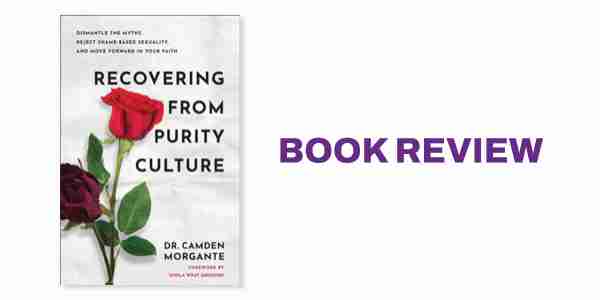

In the introduction to Recovering from Purity Culture, Dr. Camden Morgante writes, “Purity culture may have stolen a lot from you. It may have left you exactly where it left me: with years of disillusioned faith, broken relationships, shame in your sexuality, and toxic beliefs” (24). Dr. Morgante knows firsthand the damaging effects of purity culture. As a survivor of purity culture and a licensed clinical psychologist and therapist, she is uniquely positioned to help other women affected by purity culture toward healing and new beliefs.
In Recovering from Purity Culture, Morgante draws from her own experience, therapeutic expertise, and academic research to dismantle the myths of purity culture and give her readers practical tools to overcome damaging thought patterns of shame and erroneous beliefs about sex, purity, and sexuality. She begins her book with an overview of how purity culture came to be, demonstrating that it arose as a response to culture pressures and women’s empowerment. “Fear and shame were the twin swords used in the battle against promiscuity and the war to control and subdue women,” she writes (29). Morgante explicitly connects purity culture to the patriarchy and misogyny present within the church, writing, “if we want to fully dismantle the myths of purity culture and rebuild healthy faith and sexuality, we have to pluck out the roots of patriarchy in ourselves and in our systems” (51).
Next, Morgante deconstructs five myths of purity culture: the spiritual barometer myth (your purity demonstrates the strength of your faith); the fairy-tale myth (God owes you a wonderful marriage if you stay pure); the flipped switch myth (you will instantly love and become great at sex when you get married); the gatekeepers myth (women are responsible for men’s lust; men cannot control themselves sexually); and the damaged goods myth (if you are not a virgin, your worth has fundamentally lessened).
Morgante then delves into what she calls “reconstruction”: how purity culture survivors can create a new sexual ethic based on their values and beliefs, leaving behind fear and shame. In this section, she also provides some “sex ed” and practical advice for those readers who may not have received any. Lastly, she provides a long list of resources for further reading, organized by topic (she notes that she does not agree with all the content in all these books).
Recovering from Purity Culture contains a wealth of information about purity culture and sexuality—but more than that, it provides hope to those feeling trapped and burdened with the after-effects of purity culture. At the end of every chapter, Morgante provides “Tools for the Journey,” which are questions and activities based on therapeutic principles that readers can take to deconstruct their beliefs affected by purity culture. Indeed, the entire book is eminently practical. Reading the book feels like going to a therapy session with Morgante herself. By the end of it, you will know more about your body, your sexuality, your sexual ethic, and your faith.
Throughout the book, Morgante makes it clear that her goal is not to delineate a Christian sexual ethic, writing, “You will not find many black-and-white answers here; instead, I will encourage you to explore the gray areas, search for sources of truth (including the Bible), and develop more robust beliefs” (22). She argues that one of the failings of purity culture is that it does not help anyone develop mature decision-making skills or translate their values into actions. Therefore, although she makes it clear that she believes a Christian sexual ethic approves of sex only within the context of marriage, she does not spend much time defending that belief. Some Christian readers of the book may wish that she spent more time on what she thinks a Christian sexual ethic is, not just what it is not.
Still, Morgante does emphasize that a fully developed Christian sexual ethic does not include misogyny, fear, or shame. She contrasts purity culture with the Christian virtue of chastity, which she defines as “a lifelong pursuit” that “encompasses a full stewardship of our sexuality, yielding our choices to God, as we offer our bodies as living sacrifices to him in a spiritual act of worship” (64). Ultimately, Recovering from Purity Culture gives readers a compassionate, practical guide to overcoming the fear and shame that purity culture uses to try to control and disempower women in the church.