

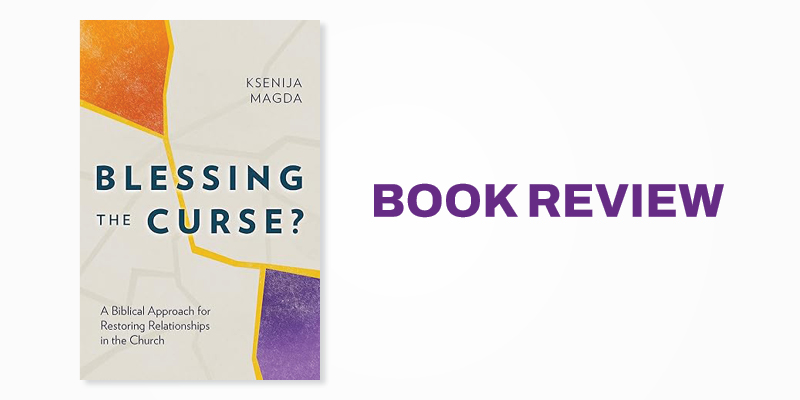
The church’s understanding of the good news has been distorted due to improper evaluation of the overall content and package of what the good news is to be. Ksenija Magda’s Blessing the Curse? A Biblical Approach for Restoring Relationships in the Church presents a logically accurate and practically oriented insight on how relationships between men and women could be better addressed in the church from the biblical point of view.
The church should appreciate the good news as a reinterpretation and understanding of Genesis 3. By so doing, an in-depth understanding of Christ’s redemptive work, which encapsulates women’s liberation from any form of oppression and curse, would be embodied. The church is thus entreated to embrace this understanding of the good news and articulate it to members within and without the community of faith for advancing a society free of patriarchy and oppression against women while honouring all humans (both women and men) as created in the image and likeness of God. Magda offers scholarly research on the topic by exploring the dual role of women and men in society, typically from the biblical point of view. Her fair evaluation of the issue helps shape an understanding of how the church should help society understand the role of women and men in the contemporary era.
Blessing the Curse is divided into four chapters. Chapter One examines the root cause of the problem of hierarchy in the world today, which is wrongly attributed by the church to the curse in Genesis 3. Chapter Two explores the present church hierarchical structures as sinful, calling for a restructuring of the church. Chapter Three offers a solution to the problem of sin from the perspective of Paul, Christ, and the need to bear fruit. Finally, Chapter Four presents the church as a new creation, thus urging women and men to live according to that biblical pattern for life and the church in the world. The linear order in which Magda presents her arguments makes it easy for everyone to follow, understand, and embrace the thesis of the book. Although the book is scholarly in nature, everyone, irrespective of academic background, should be able to read and understand the argument Magda posits.
While the book lives up to its potential to a large extent, Magda could have still helped readers embrace the thesis of the book better by appreciating the effort of the church in addressing the negative effects of the hierarchical structure that has existed within societies in the past and now. Her ideas give the impression that the church has not contributed anything to the better understanding and embodiment of the mutual relationships that exist between women and men within and without the community of faith in the past and the present.
By asking whether Genesis 3 is a blessing or a curse, Magda indicates that the discussion has long scratched at the surface of the passage without examining its depths to determine what is at its core. That is, by failing to look into the root causes of why problems happen, we only end up fabricating answers and drawing conclusions that eventually make it harder to provide lasting solutions to the problem. Magda employs the examples of rampant teenage mothers in Africa, complaints of a church organization in the US about those working to mediate this challenge, and activists’ role in ameliorating human trafficking in the world: All, she says, are scratches on the surface when the root causes of these problems have not been dealt with properly. Problems confronting societies should be treated in their entirety, although the world has instituted structures of sin that enslave humanity irrespective of context. But for Magda, “Jesus came to break their power to enslave and to lead people to freedom” (p. 11). This balanced message is what the Church ought to preach and teach, and not to slash it by situating human suffering in the world only in relation to Genesis 3. It is by so doing that true human liberty can be experienced. Magda asserts, “I believe that the path of liberation can only be recovered by reading Genesis 3 through the lens of Christ’s incarnation and redemption for the whole world” (p. 12).
Magda does a good job of informing women about the structures of sin in society and inspires them to challenge the hierarchical structures, live in the reality of the liberative work of Christ Jesus, and foster Christian solidarity, equality, and unity. In so doing, as Magda puts it, “There will be no curse” (p. 226). In all, the book aligns with the mission and values of CBE by honouring the place and role of women and men as equals in the redemption story of Christ for the furtherance of the mission of God in the world.
Other Books to Check Out:
The Bible vs. Biblical Womanhood: How God’s Word Consistently Affirms Gender Equality
A Biblical Case for Women Pastors, Elders, and Deacons
The Book of Eden, Genesis 2–3: God Didn’t Curse Eve (or Adam) or Limit Woman in Any Way
A Church Called Tov: Forming a Goodness Culture That Resists Abuses of Power and Promotes Healing
The Gospel According to Eve
The Ministry of Women in the New Testament: Reclaiming the Biblical Vision for Church Leadership
On Purpose: Understanding God’s Freedom for Women Through Scripture
Preacher Woman: A Critical Look at Sexism without Sexists
Redeeming Power: Understanding Authority and Abuse in the Church
Tell Her Story: How Women Led, Taught, and Ministered in the Early Church
Women in the Mission of the Church: Their Opportunities and Obstacles throughout Christian History
Your Daughters Shall Prophesy: Amplifying the Voice and Place of Christian Women