

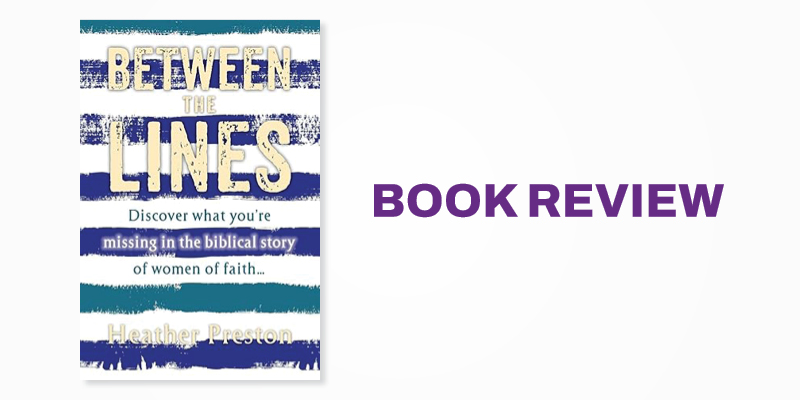
Even for scholars, the Bible is often difficult to understand. Millennia separate us from the people in Joshua, Judges, Matthew, and all the other Biblical books, yet understanding them and their cultures is central to our modern-day faith. In the introduction of Between the Lines, Heather Preston makes it clear that her book is all about “letting a reader benefit from the tools of academia” (p. viii) such as exegesis, linguistic analysis, knowledge of Ancient Near Eastern cultures, and more—without bogging all of that down with confusing or formal language.
As she walks her audience through the stories of four women from the Old Testament (Abigail, Ruth, Rahab, and Deborah) as well as two from the New Testament (Mary the mother of Jesus and the unnamed woman who touched the hem of Jesus’s robe), Preston presents scholarly research and historical context alongside retellings of the women’s stories in an approachable and casual tone. While this book suffers at times from a lack of organization and direction, it may be a useful resource for those hearing these stories for the first time—or the first time in a long while.
Between the Lines is divided into twelve chapters, with two focusing on each of the above-named biblical women. Each pair of chapters opens with a selection of biblical verses from the story at hand. While these verses are helpful, it’s best to read each woman’s story in the Bible before reading her chapter in Between the Lines, as Preston sometimes references a part of the biblical story that she doesn’t quote herself. Each individual chapter then combines a retold biblical narrative with Preston’s analysis and commentary based on her scholarly training. There are a number of reflection questions at the end of each chapter to encourage the reader to apply what they’ve just read to their own life of faith.
While this book does a great job of making the women of the Old and New Testaments real and relatable, it does unfortunately fall short in tone and style. The narratives Preston writes have a lot of potential, but that is undermined by a writing style that jumps back and forth within every narrative, failing to provide fully coherent or chronological stories. Similarly, the women’s stories aren’t presented in chronological order to each other. So even someone who has grown up with these stories may find Preston’s narratives hard to follow at times. On the academic side, Preston has many great ideas and points of analysis, but they are presented in a non-linear way that may confuse many readers. Each chapter would have benefited from a “main point”: something to focus Preston’s reflections and provide her audience with a clear takeaway. Instead, some of Preston’s points within the chapters and even some of the reflection questions seem very disconnected from each other.
Still, although this book doesn’t quite live up to its potential, it still provides some insightful analysis into these women’s stories and portrays them in a new and interesting way. Having the biblical story open while reading each chapter may help with following Preston’s train of thought. As Preston writes, “The aim of this book is to inspire readers, not just to educate them, and to allow a reader to fully experience a book that has not lost relevance, even after thousands of years” (p. x). While the book might benefit from more organized narratives and cleaner prose, it certainly achieves its goal of inspiring its audience to see these women—and themselves—in a new light. It therefore aligns with CBE’s mission as we strive to uplift women in the ongoing story of Christianity.
You May Also Be Interested In:
Book Review: Tell Her Story: How Women Led, Taught, and Ministered in the Early Church
Book Review: The Biblical World of Gender: The Daily Lives of Ancient Women and Men
Book Review: Women in a Patriarchal World: Twenty-Five Empowering Stories from the Bible
Book Review: Not Alone: 11 Inspiring Stories of Courageous Widows from the Bible
Book Review: Defiant: What the Women of Exodus Teach Us About Freedom
Book Review: The Gospel of Ruth: Loving God Enough to Break the Rules
Book Review: The Ministry of Women in the New Testament: Reclaiming the Biblical Vision for Church Leadership
Book Review: Mary and Early Christian Women: Hidden Leadership
Book Review: Three Wise Women: 40 Devotions Celebrating Advent with Mary, Elizabeth, and Anna
Book Review: Junia, a Woman, an Apostle
Book Review: Junia is Not Alone
Book Review: Priscilla: The Life of an Early Christian
Book Review: Priscilla’s Letter
Book Review: Women in the Mission of the Church: Their Opportunities and Obstacles throughout Christian History