

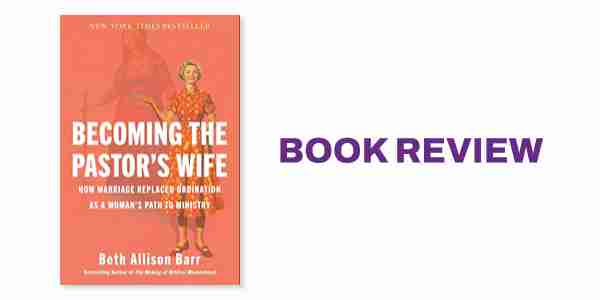
Beth Allison Barr describes her book, Becoming the Pastor’s Wife: How Marriage Replaced Ordination as a Woman’s Path to Ministry, as “the history of how Christian women gained a new and important leadership role” (xxii). Nevertheless, “it is also the history of how this gain came at a cost for some women. Both the cost and the gain are bigger than we have yet realized” (xxii). Within this context, Barr clearly relays how women who are married to pastors have had their desires for ordination to full-time ministry replaced by the church with their positions as wives of pastors. In the nexus of her own experiences as a wife of a Southern Baptist pastor for over two decades, and as a professor of medieval history, women’s history, and church history, Barr contends for change in how the role of the pastor’s wife has been used to push women out of ordained ministry.
Correctly situating the thesis of the book in groundbreaking scholarly historical and theological academic resources that span from 1923 to 2023, Barr helps readers navigate the main argument. Ardent support of her argument with convincing historical records demonstrates that the past informs the present, while the present informs the future. Candid existential realities about her personal life and ministry add flavour to the historical narrative. That said, I found that certain extraneous information distracted from the book’s main argument.
The book is divided into nine chapters. Chapter one exemplifies the essential role of pastors’ wives. Chapter two critically examines the history of women who served in diverse leadership positions in the ancient church. This is evidenced by the Priscilla Catacombs, an ancient cemetery in Rome notable for serving as a cemetery for early female Christians and for its preservation of portraits of female leaders in the ancient church. Chapter three presents medieval women’s ordination into pastoral ministry as a real case for the ordination of women into pastoral ministry in the contemporary era. Chapter four examines the strategic ways the pastor’s wife has risen to prominence amidst prevailing challenges that tend to thwart her efforts. Chapter five determines how the high expectations of the pastor’s wife are considered crucial for the upkeep of her home and the sustenance of her husband, children, and other congregants. Chapter six looks at the qualities of the stereotypical ideal pastor’s wife. Chapter seven addresses the policy of the Southern Baptist Church regarding the ordination of women into pastoral ministry. Chapter eight discusses the public appearance of wife of the pastor. Chapter nine, the culmination of the book, analyzes how the perceived traditional role of the pastor’s wife can be re-conceptualized by recognizing the pastor and his wife as partners in ministry for the advancement of the gospel.
Barr cautions that women who are married to ministers of the gospel are not to be misconstrued as being enrolled or ordained automatically into full-time ministry or to the service of the church. Instead, they should be permitted to seek ordination into ministry positions if they feel called into such capacities. This should extend to ordination to the office of pastor, for mutual growth and nurturing of the church with their husbands. “What a difference it would make for a ministry wife called to ministry to be able to serve as a ministry partner alongside her spouse instead of subsumed under his role!” (44).
Barr bemoans the fact that the white evangelical church and Southern Baptist tradition have “used the pastor’s wife role to enshrine biblical womanhood as the only godly role for women” (192). The rationale for this decision, according to Barr, is that they believe “the pastor’s wife role provides an acceptable way in complementarian theology for women to serve in ministry,” thus, “it has been weaponized to condemn women’s ordination and exclude women from pastoral positions” (192). Apart from being unfair to women, this is not in conformity with Scripture. Indeed, women were an integral part of Jesus’s earthly ministry (see Matt 27:56, 61; 28:1; Mark 15:40, 47; 16:1, 9; Luke 10:38, 40; 24:10).
Barr is right to ask, “What if the White evangelical church could follow the example more prevalent in Black churches where women married to ministers can serve as co-pastors alongside their husbands?” (192). This could offer Christian women and pastors’ wives fertile avenues to utilize their spiritual gifts and talents in a more advanced, liberated, and guided manner for the growth and development of the church, beyond simply complementing the efforts of their husbands.
Could it also be that women are sometimes denied this amazing privilege because they are their own worst enemies? To this end, Barr admonishes women to encourage one another in their calling instead of fighting against one another (192). She entreats both men and women to remember the pastoral and leadership positions of women like Milburga, Sarah Lee, Maria Acacia, Weptanomah Carter, Emily Dorothy Scarborough, Bertha Smith, and “the orans position [extending hands during prayer] as indicative of authoritative religious speech” (36, 48).
Since historical evidence abounds for how women and pastor’s wives have positively impacted the church, what then prevents those who feel called to pastoral positions to be ordained? Would their ordination not glorify God (1 Cor 10:31)? Together, the local and global church ought to chorus with Barr that indeed, “it is time we change it” (193). Marriage should not be considered a replacement for ordination as a woman’s path to ministry in the church.
This book is a valuable, balanced, and thoughtful treasure for embracing the gifting and talents of the wives of pastors and of Christian women in general for the furtherance of the church around the world, now and in the future.