


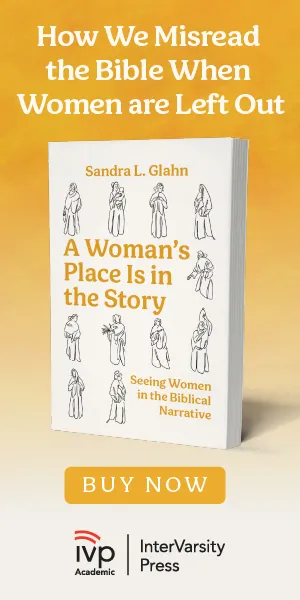
Who doesn’t love a good story? Narratives inspire us, touch our hearts, and teach us deep truths about the world. Jesus taught in parables, and the Bible is one grand narrative of God’s relationship with humanity. But too often, the women in that grand narrative are overlooked. A Woman’s Place Is in the Story is Sandra L. Glahn’s response to this problem. As she writes, preachers often “skip over women when they do appear in the biblical text, and leave them out of applications (or apply the text only to motherhood or parenting)” (2). Even when we highlight the women of the Bible, she says, we miss how they fit into the wider narratives around them (4).
A Woman’s Place, therefore, does not tell the stories of biblical women in isolation. Instead, Glahn takes an approach grounded in narrative theory, showing how each woman’s narrative functions within the surrounding context. This “big picture” view helps us see these stories in a whole new light. As Glahn writes, “knowing the building blocks of narrative and how stories work will help us avoid insufficient if not downright wrong interpretation of Scripture. Better interpretation will lead us to more faithful application. And the entire process will help us more accurately view God and the women he made in his image” (8).
After the introduction, a chapter describes how stories function as well as how the Bible functions as a story. While this section can get slightly dense, she breaks narrative theory down into manageable definitions and categories, so the reader need not have prior knowledge of narrative theory to understand the book. Glahn focuses primarily on plot, characters, and setting as a framework to analyze the stories that follow.
For seven chapters, Glahn takes her readers on a tour through the OT, looking at the stories of Tamar (Gen 38), Shiphrah and Puah (Exod 1), the unnamed women who save Moses (Exod 2), Abigail (1 Sam 25), the daughters of Zelophehad (Num 26–27, 36; Josh 17; 1 Chron 7), Job’s daughters (Job 42), and Jezebel (1 Kgs 16–21, 2 Kgs 9). She then devotes a chapter to the Samaritan woman (Jn 4) before ending with a reflective chapter that once again looks at the big picture of the Bible and narrative theory. The end of the book includes discussion questions for groups studying it together.
The vast majority of Glahn’s analysis of the biblical narratives is straightforward, insightful, and easy to follow. If there is a theme in which the reader may get lost, it is the discussions of why certain women of the Bible remain nameless. Glahn discusses naming and namelessness at length in several chapters, but she makes so many different points about why a character might remain nameless (ranging from strong indictment to reverent honor), it becomes difficult to understand which point applies to which story and why. Nevertheless, her discussion of names, though complex, is informative and even illuminating at times.
This book can benefit anyone who reads it, not only women. As Glahn points out, “both males and females lose out when they hear and learn only parts of the Bible rather than the whole. The daughters of Zelophehad are models for us all, not for women only. Deborah is a model for us all. Jezebel, well, she’s a warning to us all” (200). The Bible brings everyone truth through these stories. Glahn shows how each story of women in the Bible works within the whole to illuminate a God who cares about all of us, male and female, and who can use all of us to further God’s story and God’s glory throughout history.