


Eden was a place made for human flourishing. The creation narrative of Genesis 1–2 reveals the equality and mutuality of male and female. Made in the image of God, man and woman together represent the imago Dei. As image bearers, they have a shared identity and a shared purpose: “God blessed them and said to them, ‘Be fruitful and increase in number; fill the earth and subdue it. Rule over the fish in the sea and the birds in the sky and over every living creature that moves on the ground.’” (Gen. 1:28, emphasis added). John Mark Hicks explains that “God shares divine dominion with human beings and invites both male and female to participate in God’s mission.”1 So, why are women so often limited in today’s churches? Beth Allison Barr asks a similar question: “What if patriarchy isn’t divinely ordained but is the result of human sin? What if instead of being divinely created, patriarchy slithered into creation only after the fall?”2
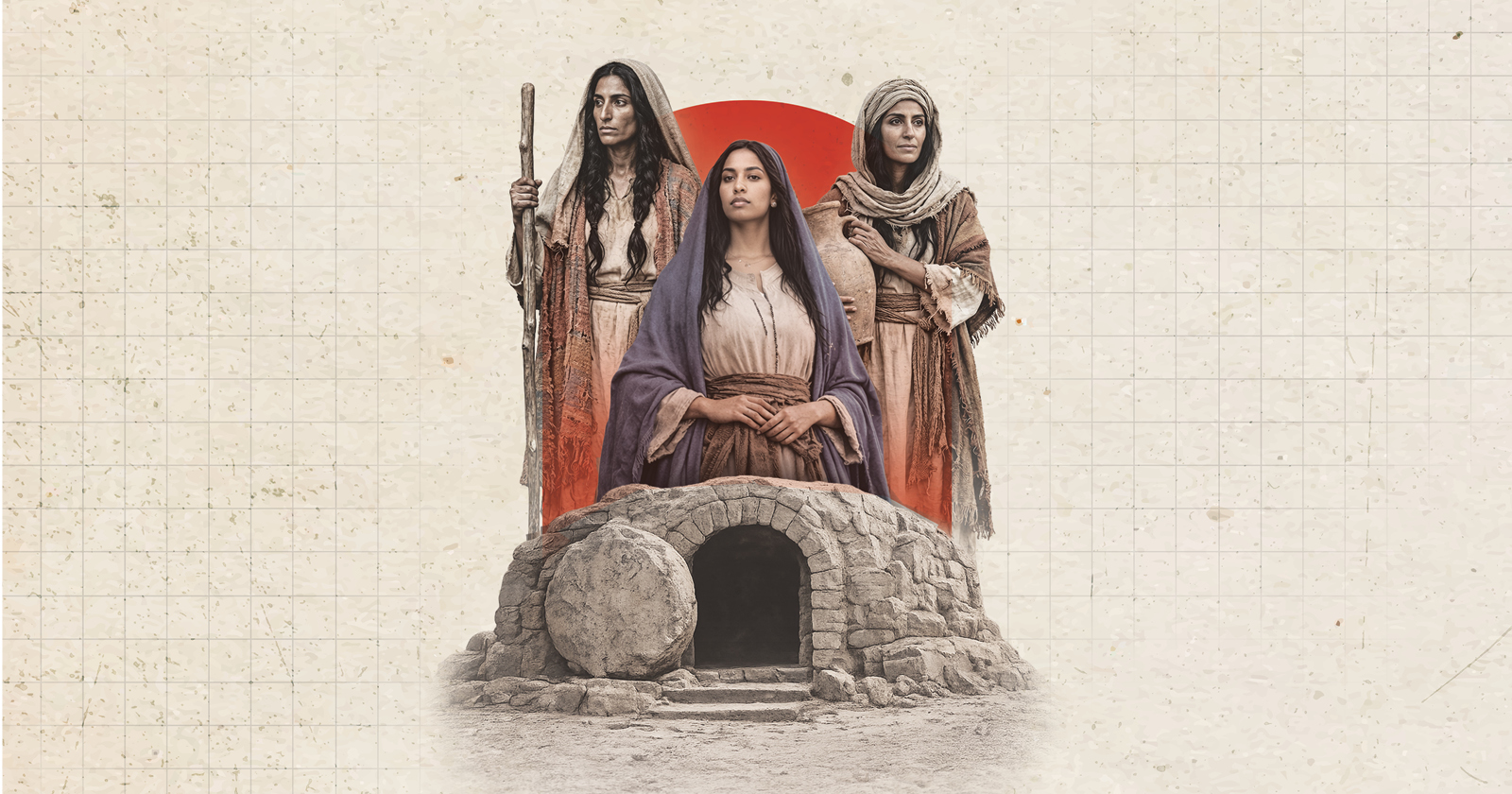
Though complementarian theology gatekeeps the participation and influence of women, the person and work of Jesus restores in new creation that which God designed at the original creation. His life, death, and resurrection don’t just open the way to a nebulous idea of spiritual salvation; “salvation heals the divisions that have vandalized God’s creation and ripped human to human relationships to shreds.”3 Jesus restores the mutual relationship between men and women as was always part of God’s good design. While the Gospels demonstrate how Jesus overturned long-held beliefs and social norms in his interactions with a variety of women, let’s consider how Eden is restored in the lives of three specific women: Mary the mother of Jesus, Mary of Bethany, and Mary Magdalene.
From Eve to Mary, the Mother of Jesus
Some assert that when the serpent spoke to Eve first, he was attempting to bypass some ordained hierarchy of male leadership. This idea appears nowhere in the text. God asks, “Have you eaten from the tree that I commanded you not to eat from?” (Gen. 3:11), not “Did you violate the creation order of male hierarchy?” This idea is also undermined by the fact that God addresses Adam and Eve individually, rather than just Adam. Furthermore, it is the seed of Eve that will crush the serpent’s head, a promise which comes to fruition through another woman, Mary, the mother of Jesus.
Regarding Mary, contrary to what would be expected in a complementarian framework, the angel Gabriel spoke directly to her alone, rather than to her father or to her betrothed, Joseph.4 This lowly teenage girl with no connections or power was the first to receive the good news of the Christ. She was called to participate in a most crucial way in one of the most important parts of God’s redemptive plan. Only later was Joseph informed of God’s plan in a dream, reassuring him that he should take Mary as his wife and to follow her into this calling.5 Where Adam and Eve’s actions ushered in sin and death, Mary’s brought forth life. In the Gospel of John, Jesus gives seven I AM statements, three of which identify him with life:
“I am the bread of life,” or “I am the living bread,” (John 6:35, 48, 51).
“I am the resurrection and the life,” (John 11:25).
“I am the way and the truth and the life,” (John 14:6).
Mary symbolizes the new Eve. Through her, God brought forth his Son to overturn the consequences of the Fall and restore all things.
Mary of Bethany
Mary of Bethany is first introduced in Luke 10:38–42. In this short account, Jesus and his disciples were welcomed into the home of Martha and her sister Mary. Mary sat listening at Jesus’s feet as he taught. Overwhelmed with all the preparations and work of hosting, Martha asked Jesus to tell Mary to help her. Jesus responds, “Martha, Martha, you are worried and troubled about many things. But one thing is needed, and Mary has chosen that good part, which will not be taken away from her.”6 The Lord does not condemn Martha for her devotion to her ministry, but he praises Mary for choosing that which is more important: listening and learning. In a time and culture where women were denied education, Jesus frees Mary to pursue knowledge and understanding of God’s word. And since women are free to learn, “they are also empowered to teach once they have learned.”7 Jesus’s command to “go therefore and make disciples of all the nations”8 applies to all disciples for all time with no restrictions on who can teach or to whom they can teach. However, Mary goes on to embody more than the role of disciple.
The word “Messiah” is translated as “anointed one.” Although Jesus is eternally anointed before creation, he received public confirmation at his baptism when the Holy Spirit descended upon him like a dove (Matt. 3:16). He was physically anointed with oil on more than one occasion, each time by a woman (Matt. 26:6–13; Mark 14:1–9; Luke 7:36–50; John 12:1–11). The gospel accounts of Luke and John tell us that his feet were anointed, a moment which Jesus identifies as preparation for his burial (John 12:7). In John’s Gospel, the woman is identified as Mary of Bethany. Mary’s loving act was prophetic, pointing forward to Christ’s death. Matthew and Mark reveal that an unnamed woman anointed Jesus’s head. “An anointment,” according to Jennifer Powell McNutt, “is a weighty act that often carries a twofold purpose: (1) preparation for burial and (2) the coronation of kings. A sacred anointing is a priestly act.”9 In the Old Testament, kings, priests, and prophets received sacred anointings; Jesus embodies all three. Whether or not Mary of Bethany was the unnamed woman in either of these gospels, the act of anointing was of a priestly nature, a role specifically limited to men of the tribe of Levi under Jewish law. Jesus’s ministry broke cultural barriers and made room for women in previously male-only places. Because of his sacrifice, we are all, both women and men, now part of a “royal priesthood” (1 Peter 2:9).
Mary Magdalene
Mary Magdalene “is mentioned in the gospel accounts nearly as much as Jesus’s mother, Mary (Mary of Nazareth), and more than most of the disciples.”10 Luke introduces her as part of the entourage that followed along with Jesus and the twelve. A woman healed of seven demons, she is included in a list of other women who ministered to and financially supported the ministry of Jesus (Luke 8:1–3). The very nature of these women, Mary Magdalene among them, being included among Jesus’s disciples represents a breaking of social and religious expectations of the first century. Still, Mary Magdalene’s significance in the gospels goes further.
Matthew, Mark, and John each name specific women who remained at the cross during Jesus’s crucifixion. Mary Magdalene is the only woman consistently named in all three of these gospel accounts. Matthew and Mark also tell us that she, along with another Mary, followed along to see where Christ’s body was buried. It is Mary Magdalene and some other women who go to the tomb early on the first day of the week. They are surprised to find the stone rolled away and even more astonished to be told, by angels no less, that the Lord had risen. Mark recounts: “Now after He had risen early on the first day of the week, He first appeared to Mary Magdalene, from whom He had cast out seven demons” (Mark 16:9). In John’s account, “Jesus said to her, ‘Mary!’ She turned and said to Him in Hebrew, ‘Rabboni!’ (which means “teacher”). Jesus said to her, ‘Stop clinging to Me, for I have not yet ascended to the Father; but go to My brethren and say to them, “I ascend to My Father and your Father, and My God and your God.” Mary Magdalene came, announcing to the disciples, ‘I have seen the Lord,’ and that He had said these things to her,” (John 20:16–18).
In John’s account, Mary had already told Peter and John that Jesus’s body was missing. Both men ran to the tomb to find it empty and, not understanding the Scriptures, returned to their homes. Only then did Jesus choose to reveal himself to Mary Magdalene. In a time when a woman’s witness was considered unreliable, it is remarkable that Jesus chose to place the news of his resurrection into the mouth of a woman. No wonder Thomas Aquinas called her the “apostle to the Apostles.” By authorizing Mary Magdalene to share the news of gospel resurrection with the male disciples, Jesus proclaims that women are partners in the Great Commission to “Go therefore and make disciples of all nations,” (Matt. 28:19). He acknowledges that their witness is trustworthy and necessary.
What was fractured at the Fall—male-female relationships—is redeemed in the resurrection of Jesus Christ. Mary the mother of Jesus, Mary of Bethany, and Mary Magdalene are just three examples of how Jesus engaged with, elevated, and affirmed women throughout his ministry. Women were the first to hear of Christ’s birth, the ones to remain at the cross, and the first to be witness to and proclaim his resurrection. Women stood with Jesus from the cradle to the grave. In a patriarchal culture, his interactions with women proclaimed (to borrow from the popular series The Chosen): “Get used to different.” It’s questionable at best, antithetical to the gospel at worst, to teach that all participate fully in the salvation offered through Jesus Christ, but not all can participate fully in service to Christ and his church. I recently listened to a sermon on women’s roles within the church, the minister asserted that “women make beautiful welcome baskets.” To limit women to financiers and foot washers, basket makers, and cradle roll teachers is to deny the full image of the imago Dei as granted at creation. This isn’t how Jesus saw women. He saw them as disciples, priests, and preachers, and he released them to fully partner along with men in spreading the gospel and building his church.
Notes
- John Mark Hicks, Women Serving God (John Mark Hicks, 2020), 121.
- Beth Allison Barr, The Making of Biblical Womanhood (Brazos Press, 2021), 25.
- Bobby Valentine, “Christ’s Cosmic Gospel: It’s Not About Me, but It Includes Me,” Stoned Campbell Disciple, March 28, 2020.
- Luke 1:26–33
- Matthew 1:18–21
- Luke 10:41–42
- John Mark Hicks, Women Serving God (John Mark Hicks, 2020), 189
- Matthew 28:19.
- Jennifer Powell McNutt, The Mary We Forgot (Brazos Press, 2024), 36.
- McNutt, The Mary We Forgot, 12.