3.3 Julia Evelina Smith
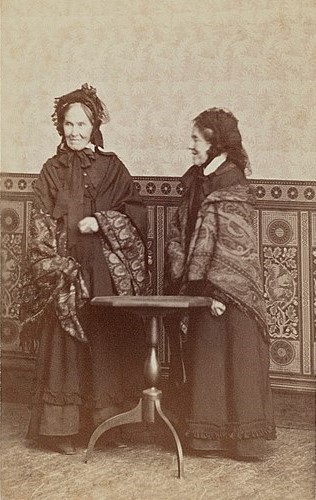
Julia Evelina Smith (1792–1886) was born in a well-to-do family that emphasized their children’s education. Early in her childhood, Smith displayed a great talent and interest in languages. It is said that at the age of eight, she asked her father to give her a copy of a Latin grammar. In a time where few women had the opportunity to be educated, Smith’s parents tried their best to help her achieve the highest level of education deemed acceptable by societal standards at the time. Accordingly, she finished secondary school where she formally learned Latin as well as Greek.
Although Smith was not able to obtain higher education, she still took advantage of all kinds of chances to improve her language skills. For example, at age eighteen, to learn French, she went to live with a French speaking family. To maintain her French, she wrote her diary in French for many years.[1] In the end, the education that she received as well as her experiences with languages made it possible for her to one day pick up Hebrew on her own to learn more about the Bible.
To Avoid Being Misled
Smith’s reason for wanting to translate the Bible on her own was to avoid being misled by preachers. The 1830s saw a revivalist fever sweep over America, such that many thought that Christ’s second coming would be imminent. One instigator in this fervor was the famed preacher William Miller, who, based on his interpretation of the Bible, declared that the world would end on October 23, 1844. His following was so widespread that, when autumn came that year, many farmers who believed in his prophecies even abandoned their crops, thinking that they would soon meet Jesus and therefore have no need to reap the harvest.[2] However, the world did not end on that day. Miller’s failed prediction shook the faith of many a believer in America; many were surprised at how a human being could be so wrong in understanding the Word of God.
After suffering such a blow to her faith, Julia Smith realized that the best way to avoid this kind of error in the future is to fully understand the original text of the Bible, rather than rely on artificial interpretations. Accordingly, in the eight years between 1847–1855, she translated the whole Bible twice: once from Hebrew and Greek, once from Latin. By doing so, Smith became the first woman in history that we know of who completed an entire Bible translation by herself.
In the eight years between 1847–1855, Smith translated the whole Bible twice: once from Hebrew and Greek, once from Latin. By doing so, she became the first woman in history that we know of who completed an entire Bible translation by herself.
Smith’s Bible—A Testament to Women’s Intellectual Capability and Inluence in Society
For Smith, translating the Bible was simply an act of personal devotion aimed at learning more about God’s Word, therefore she only shared her translation with her friends without planning for it to be publicly published. However, something happened late in her life that made her change her mind.
In the 1870s, a policy was enacted that raised property taxes for elderly women. Smith, who was then over eighty years old, found this to be extremely unfair. However, women did not have the right to vote, and elderly women often lacked male relatives who could help fight for their rights. Not to be deterred, Smith and her sister took it upon themselves to organize a series of public demonstrations, demanding not only that the unfair tax policy be rescinded, but also that women be given the right to vote.[3]
It was in this milieu of Smith’s involvement in the women’s suffrage movement that she decided to publish her translation of the Bible, the thinking being to demonstrate that the intellectual capability of women is not worse than that of men, that women are even able to complete a Bible translation solely on their own! By proving that women are on par with men, Smith’s argument was that women should receive the same rights and protections as men under the law.
Beyond the Spiritual Realm
Looking at Smith’s translation from professional translation standards, it is not an ideal Bible. As Smith did not have the opportunity to be trained at the college level—it was not until 1876, when Smith was eighty-four years old, that the first female Bachelor of Divinity was awarded—there were a number of errors in her understanding of the Biblical languages. Furthermore, Smith’s extremely literal translation also made her work hard to read and understand.
That being said, her pioneering act of translating the Bible was in itself a great source of encouragement and inspiration for feminists who were to come later. Among them was Elizabeth Candy Stanton, the author of the Declaration of Sentiments, arguably one of the most representative leaders of the women’s rights movement in the United States.
The story of Julia Evelina Smith shows that the work of Bible translation is not purely a spiritual matter, nor is it simply a church issue. It is not just an academic topic either. As we can see from Smith’s story, who gets to translate the Bible and how they translate it is often tied to social factors of the day, and the work of translation will often exert its inluence in the political arena.
Going Deeper
Equating “Feminisms”
Allison Quient
The reinterpretation and retranslation of the Bible by women in the US is closely related to feminist activism in history. Yet while biblical equality can be considered as an expression of feminism, this article distinguishes biblical equality from liberal feminism, a movement that has its roots in Elizabeth Cady Stanton’s The Women’s Bible.
Reference
[1] Kathleen Housley, “‘The Letter Kills but the Spirit Gives Life:’ Julia Smith’s Translation of the Bible,” The New England Quarterly 61, no. 4 (1988): 555–68, 557–558.
[2] Luise von Flotow, “Women, Bibles, Ideologies,” TTR: Traduction, Terminologie, Rédaction 13, no. 1 (2000): 9–20, 9.
[3] Flotow, “Women, Bibles, Ideologie,” 10.