3.2 Paula of Rome and the Latin Vulgate
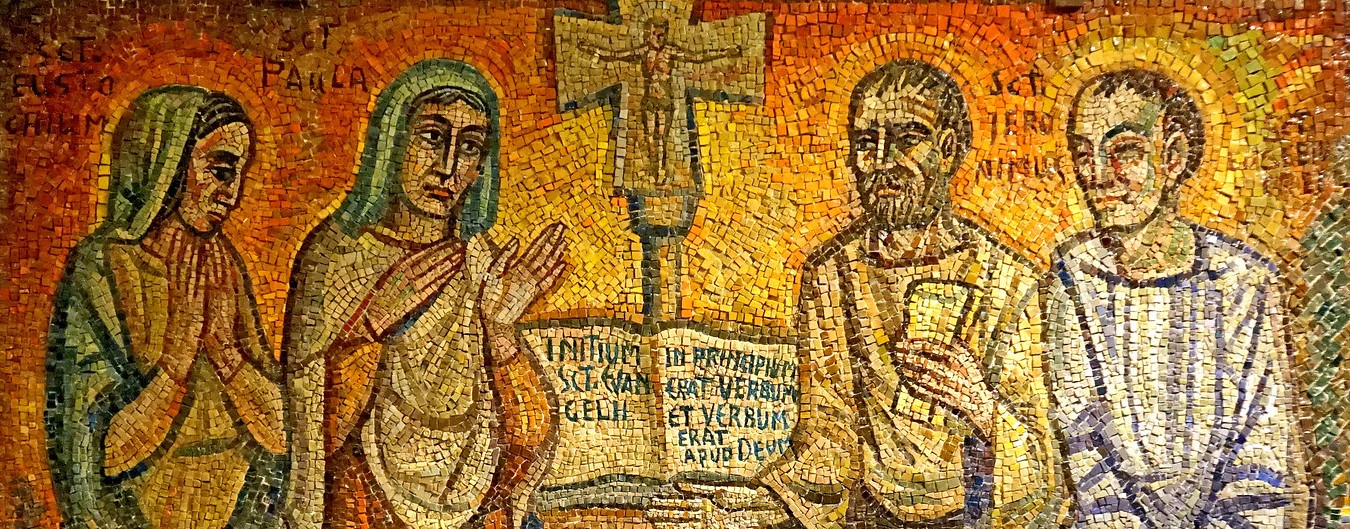
Among the few Bible translators who left their name in the history of Bible translation, Jerome is one. While many people often attribute to Jerome the creation of the Vulgate Bible—an influential Bible that was used by the church in the West for over a thousand years, few people know that crucial to its production was a woman, Paula of Rome (347–404), who funded the project, collected the manuscripts for use as its source text, led the monastic translation team, and engaged in a great deal of editorial work.
Paula’s conversion and her subsequent growth in the faith reflected the Christian culture among aristocratic women in fourth century Rome. During that time, many women from aristocratic backgrounds grew tired of the upper class’s lavish and vain lifestyle and chose to focus their attention on learning and practicing the Christian faith. They abstained from marriage (a choice that was squarely at odds with how mainstream culture expected women to behave) and instead joined female monastic communities. Some of these women even went on and established and led monasteries of their own, directing the spiritual formation of community members and keeping and passing on theological and biblical knowledge through these communities.[1]
While many people often attribute to Jerome the creation of the Vulgate Bible, few people know that crucial to its production was a woman, Paula of Rome.
As Paula’s Christian faith and her devotion to Christ grew and grew, like many pious believers of her day, she eventually decided to devote herself to desert asceticism, a kind of Christian lifestyle practiced by many at the time.[2] Taking her daughter Eustochium, Paula left Rome and moved to Bethlehem to embark on her life of monasticism. From this time on, Paula gave all her wealth and skills to the monastic ministry, holding nothing back. Using her financial resources, Paula established three monasteries: one female monastery led by herself, one male monastery led by Jerome, and one in Bethlehem to host pilgrims, the income of which was used to support the former two monasteries. Paula pursued of life of simplicity, prayer, and service. In obedience to Christ’s command, she devoted large amounts of resources to take care of the poor. She also devoted her linguistic abilities to Christ—not only did she become well-versed in the biblical languages, the women in her monastery also were experts in these languages, engaging in the task of copying and preserving ancient manuscripts.
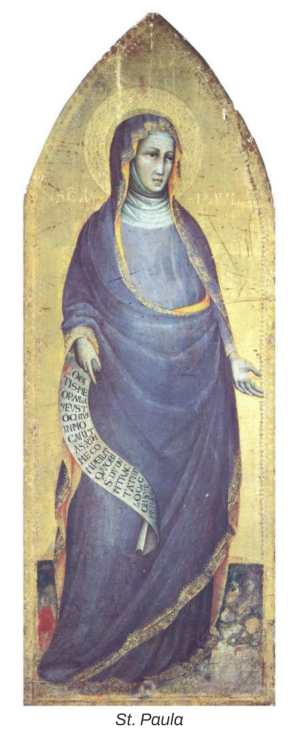
When Paula learned about the Pope’s commission for Jerome to complete a Latin translation of the Bible, she realized at once the importance of the task and set out to encourage Jerome, who was then ambivalent about the task, to shoulder the responsibility of its completion. To ensure the quality of the translation, Paula used her financial resources to acquire rare manuscripts for the project to use. In addition, Paula and her daughter took up the responsibility of translating the entire Book of Psalms; they also served as editors for the entire project. Acknowledging that Paula’s command of the Hebrew language far surpassed his own, Jerome agreed with all of Paula and Eustochium’s editorial suggestions. It is not an understatement to say that Jerome had a very high view of Paula’s spiritual and intellectual leadership.
Perhaps Paula, like many other Bible translators and servants of Christ, never cared whether her name would be remembered at the time she decided to devote herself to a life of poverty, chastity, and anonymity. Yet having learned about her story, now whenever we think of the Vulgate Bible, we are reminded that God does not use only men to translate God’s Word; God also raises up women to work alongside men to complete the task that God commissions.
Going deeper
Single But Never Alone
Mimi Haddad
Paula was one of the single women—either never married or widowed—in Christian history who dedicated their lives to form communities of love and service of Christ.
Women in Scripture and Mission: Paula of Rome
Kimberly Dickson
Paula, one of the most remarkable but barely remembered women in Christian history, worked with Jerome to produce the Bible that was in use for the longest time in history.
Paula of Rome (347–404): A Woman of Inluence, Intellect, and Concern for the Poor
Kimberly Dickson
Paula of Rome was an aristocrat who defied cultural expectations to fulfill the calling of God.
Reference
[1] Anne Yarbrough, “Christianization in the Fourth Century: The Example of Roman Women,” Church History 45, no. 2 (1976): 149–65.
[2] Yarbrough, “Christianization in the Fourth Century,” 157.